Elanga's Brace, Yamal's Penalty and the Second Half That Ended Newcastle's European Season
Barcelona are in the Champions League quarterfinals. They won 7–2, 8–3 on aggregate, but for the first forty-five minutes Newcastle United were in it with a chance

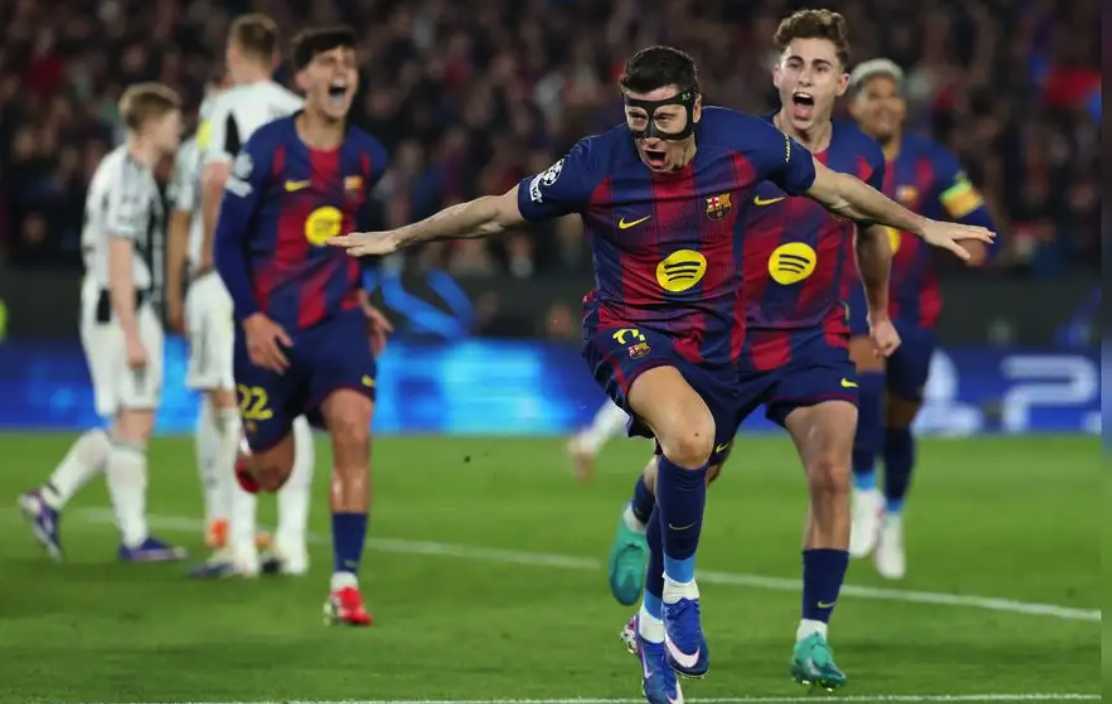
How Howe's man-oriented press held Barcelona for forty-five minutes before Flick pulled it apart
Barcelona are in the Champions League quarterfinals. They won 7–2 on the night, 8–3 on aggregate, and the scoreline is both accurate and misleading — accurate because the goals were real and the margin was decisive, misleading because for the first forty-five minutes Newcastle United were a serious football team executing a serious plan against the best side in Spain, and it was working.
The second half is what people will remember. Four goals in twenty-one minutes. Raphinha everywhere. Lewandowski breaking Messi's record for scoring against the most different Champions League opponents — forty-one and counting — before anyone had time to appreciate what they were watching. But the story of this match — the one worth telling — begins not with the second half demolition but with the first half problem, because you cannot understand what Flick solved at half-time without first understanding what Howe built.
This was not a comfortable evening. It became one.
Howe's Brief Was Specific. And Newcastle Followed It.
Eddie Howe had done this before. In the first leg at St. James' Park, Newcastle had pressed Barcelona high, disrupted their build-up, and led 1–0 in the eighty-sixth minute before Yamal's last-gasp penalty broke the tie level. The blueprint existed. The question was whether they could sustain it for ninety minutes at Camp Nou, and whether Barcelona — with a full week to prepare — had found an answer.
For forty-five minutes, the answer was no. Newcastle's man-oriented press was triggered from the right side of their structure, and every assignment was specific. Elanga jumped aggressively onto Gerard Martín the moment Barcelona looked to build from the back, denying the centre-back time to scan and play forward. Trippier — replaced at the break by Livramento but effective until then — tracked Cancelo into wide zones, cutting off his preferred early combination with Raphinha. Thiaw shuffled across to cover Raphinha's run into the channel. Tonali, the most relentlessly physical player on the pitch in the first forty-five minutes, had a single brief: follow Fermín López. Everywhere. Don't let him turn. Don't let him link.
The most tactically interesting assignment was Hall's. In the first leg at St. James' Park, Hall had been outstanding — press-resistant, technically assured, willing to invite pressure and beat it. Here he was given Yamal, a different kind of problem entirely, and his instruction was equally specific: show Yamal outside, stay on his left shoulder, force him toward the touchline where he is least dangerous. Over the full ninety minutes, Hall won that individual battle across both legs — Yamal's dribble completion rate against him was poor, and his influence in open play was more limited than his threat suggested.
What the press created structurally was a 4v4 in Barcelona's attacking third — their front four, Yamal, López, Raphinha, Lewandowski, individually marked by Tonali, Thiaw, Hall, and Burn. Once Trippier jumped onto Cancelo in the wide zone, the press was fully engaged. The risk in that structure is the space it creates in behind. But Newcastle's defensive line was disciplined and compact, and for a half of football, it held.
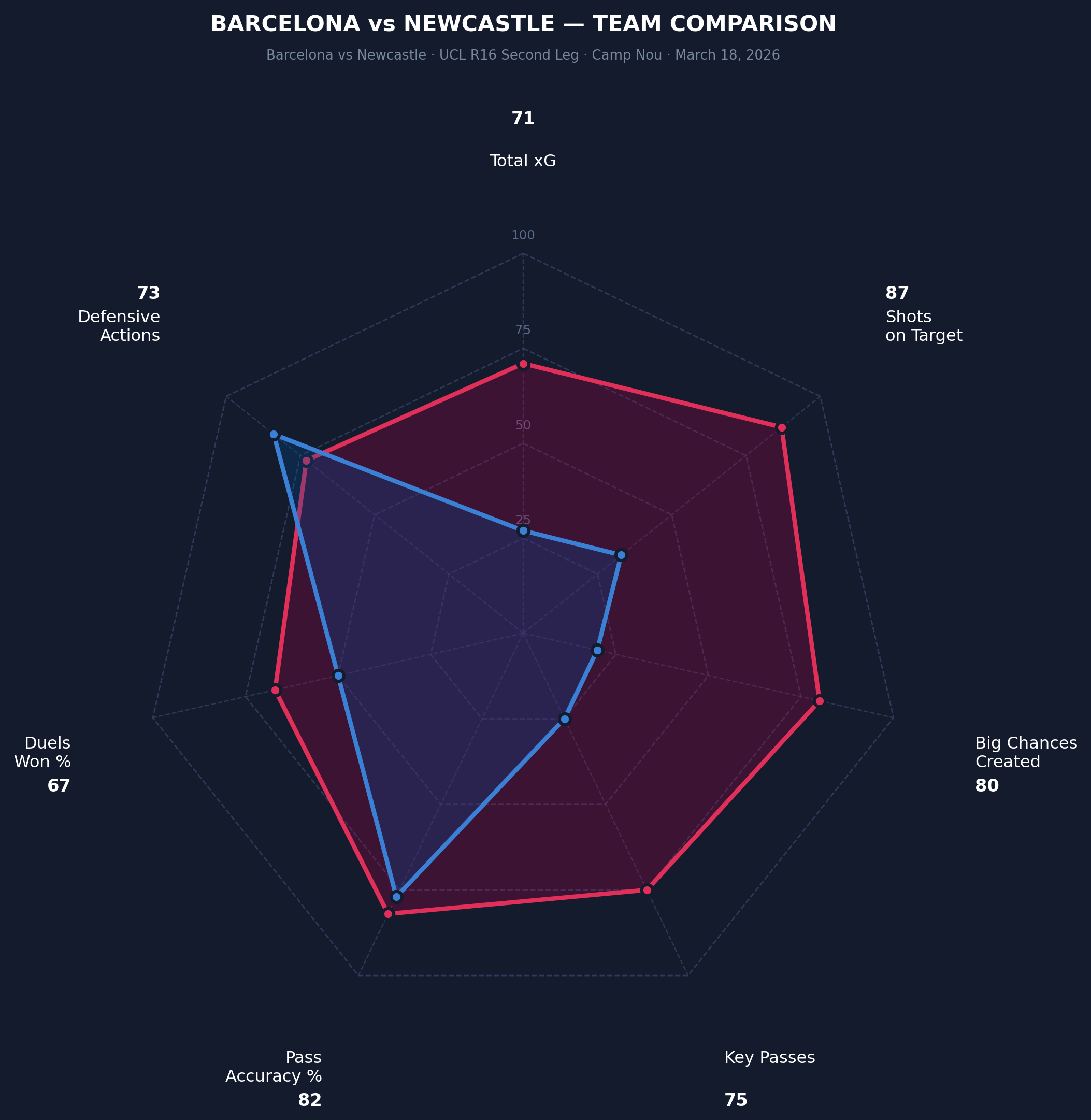
Newcastle competed on defensive actions and physical duels — not because they were absorbing pressure but because they were generating it. Barcelona's superiority in chance creation and xG is real, but the possession numbers and passing accuracy tell you that Flick's team was being made to work harder than they wanted to. Pedri, who gives Barcelona their tempo in possession, was pressed into rushed decisions repeatedly. Bernal, who would become one of the night's key figures, was sluggish in the opening exchanges — a player who wants time on the ball being denied exactly that.
Both Teams Scored. The Chaos Was Legitimate.
Raphinha opened the scoring in the sixth minute. The move began with Yamal turning Hall in midfield — one of the rare moments in the first period when he found the space to face forward — and ended with Raphinha finishing calmly inside the box after exchanging combinations with López outside him. It was quick, incisive, and over before Newcastle had settled.
Newcastle's response was immediate. The structure Howe had built was working not just defensively but in transition — and the transition was specifically designed to exploit Cancelo's attacking license. Hall carried from deep, released Barnes down the left, and Barnes found Elanga arriving at the far post. Elanga had not scored in thirty-five consecutive matches across the Premier League and Champions League. He finished this one like a man who had never missed.
The pattern of the next thirty minutes was a seesawing competition in which both teams scored twice more before the break, and the structural causes of each goal were almost entirely predictable. Bernal's goal was Barcelona at their best from dead balls — Raphinha's free-kick delivery, Martín heading it back across the six-yard box, Bernal arriving at the near post to finish. Newcastle's second, Elanga again, came from a Yamal error — a misplaced backheel in his own third that gifted possession to Hall, who released Barnes down the left, and Barnes found Elanga arriving at the far post to tap in. 2–2 and forty-five minutes on the clock.
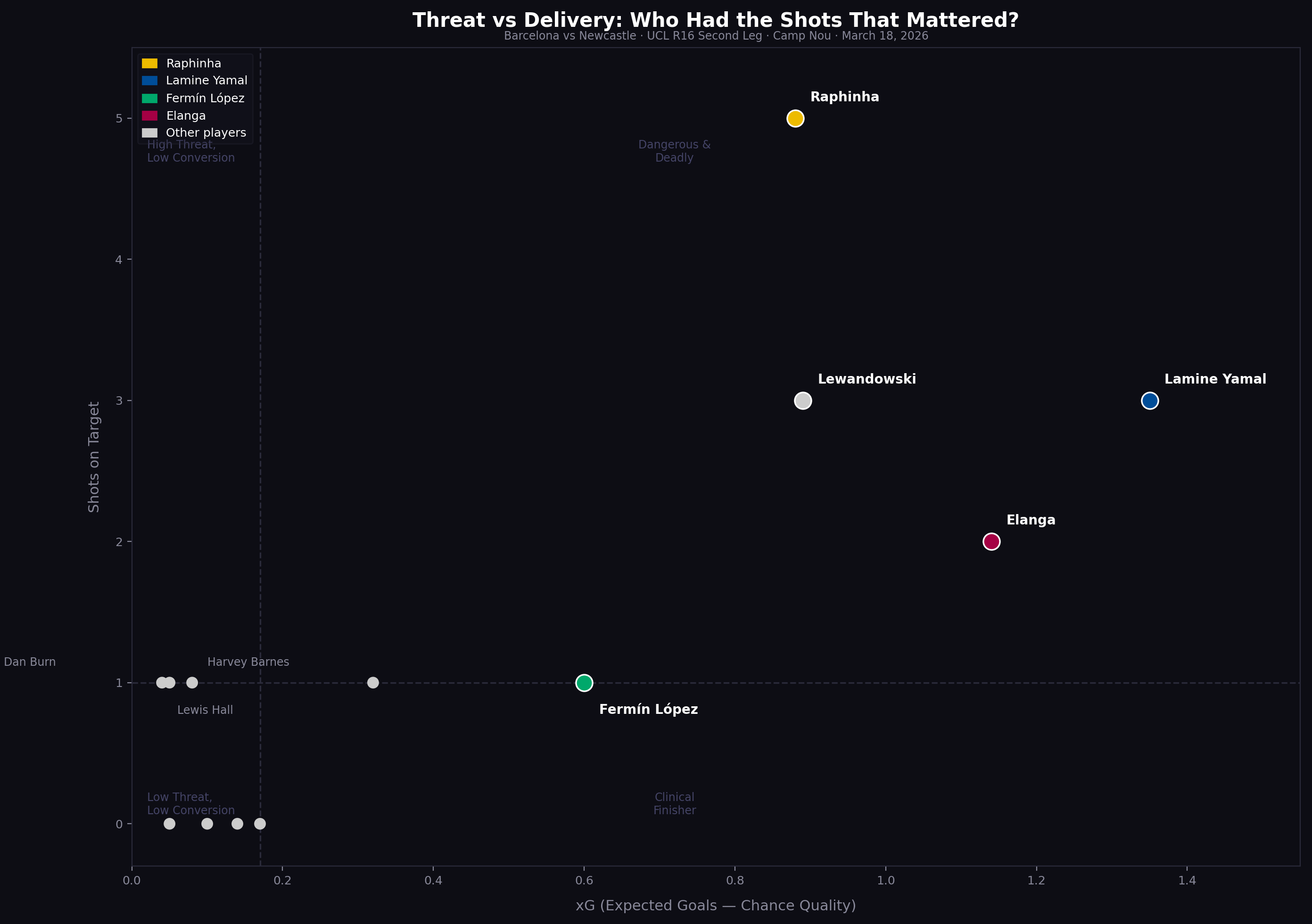
Elanga's position is analytically striking: low shot volume, high xG, perfect conversion rate. Both goals came not from individual brilliance but from the structural position Newcastle's press had engineered — Elanga running into danger zones that Cancelo's forward positioning had vacated. He did not create the space. The press created the space. He filled it.
Yamal carries the highest xG on the chart — 1.35, more than any other player on either side — but his finishing in the first half was the low point of his evening. A tap-in from six yards cleared the crossbar. The miss was bad enough to draw collective sharp breaths from sixty thousand people.
However just at the stroke of half time, Raphinha won a penalty that changed the game and the narrative of the tie. He passed the opportunity to Yamal who had a frustrating evening till then. Minutes later, Lamine stepped up for the penalty that changed everything.
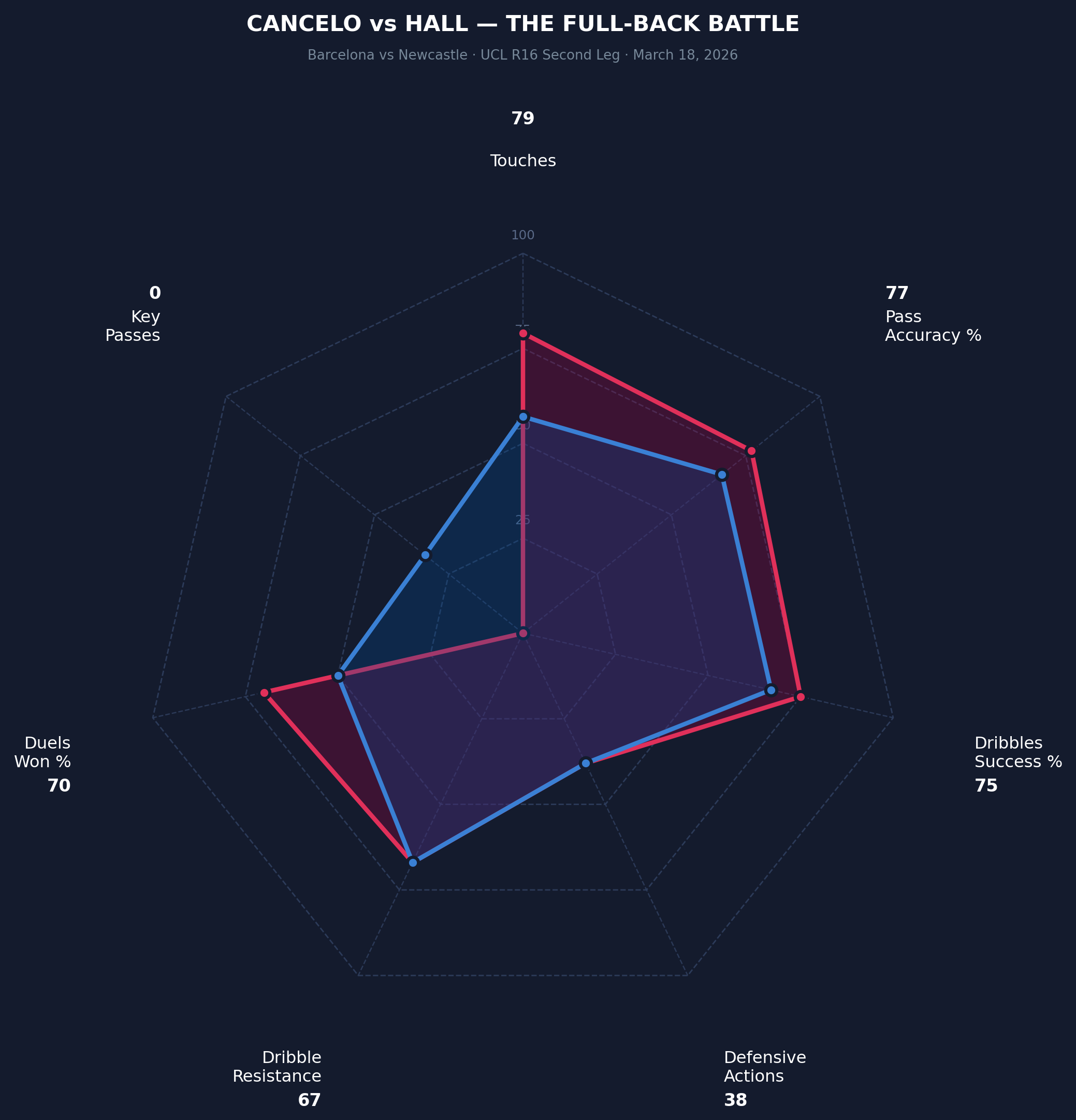
The Cancelo-Hall radar is the fullest picture of the night's defining individual battle. Hall was everything Howe needed: his pass accuracy was strong, his press resistance worked, his dribble success rate was competitive, and his positioning prevented Yamal from functioning freely in one-on-one situations. The assist for Newcastle's opener was the product of a player doing exactly what his manager had asked.
Cancelo's attacking qualities are real and visible on the chart — high touches, strong dribble success, genuine creativity in wide zones. What the chart also shows, honestly, is the defensive action count relative to the threat he faced, and the twice he was caught out of position. Both Newcastle goals traced back to the same gap. A scouting report had identified it. The goals confirmed it.
The goals confirmed it.
The Last Kick of the Half and What It Carried
Trippier fouled Raphinha just inside the box in the seventh minute of stoppage time. VAR confirmed the contact was clear enough to warrant a penalty and a booking. Yamal placed the ball, took his run-up, and drove it low to Ramsdale's right. 3–2. The youngest player ever to score ten Champions League goals walked back to the centre circle to change the game state.
It was not routine. It was, in sporting terms, devastating. Newcastle had played forty-five minutes of disciplined, structured, physically demanding football. They had led twice, recovered from going behind, and entered stoppage time level on aggregate. In the space of one passage of play — López's run, Trippier's foul, Yamal's nerve — the tie had shifted against them.
They would not recover.
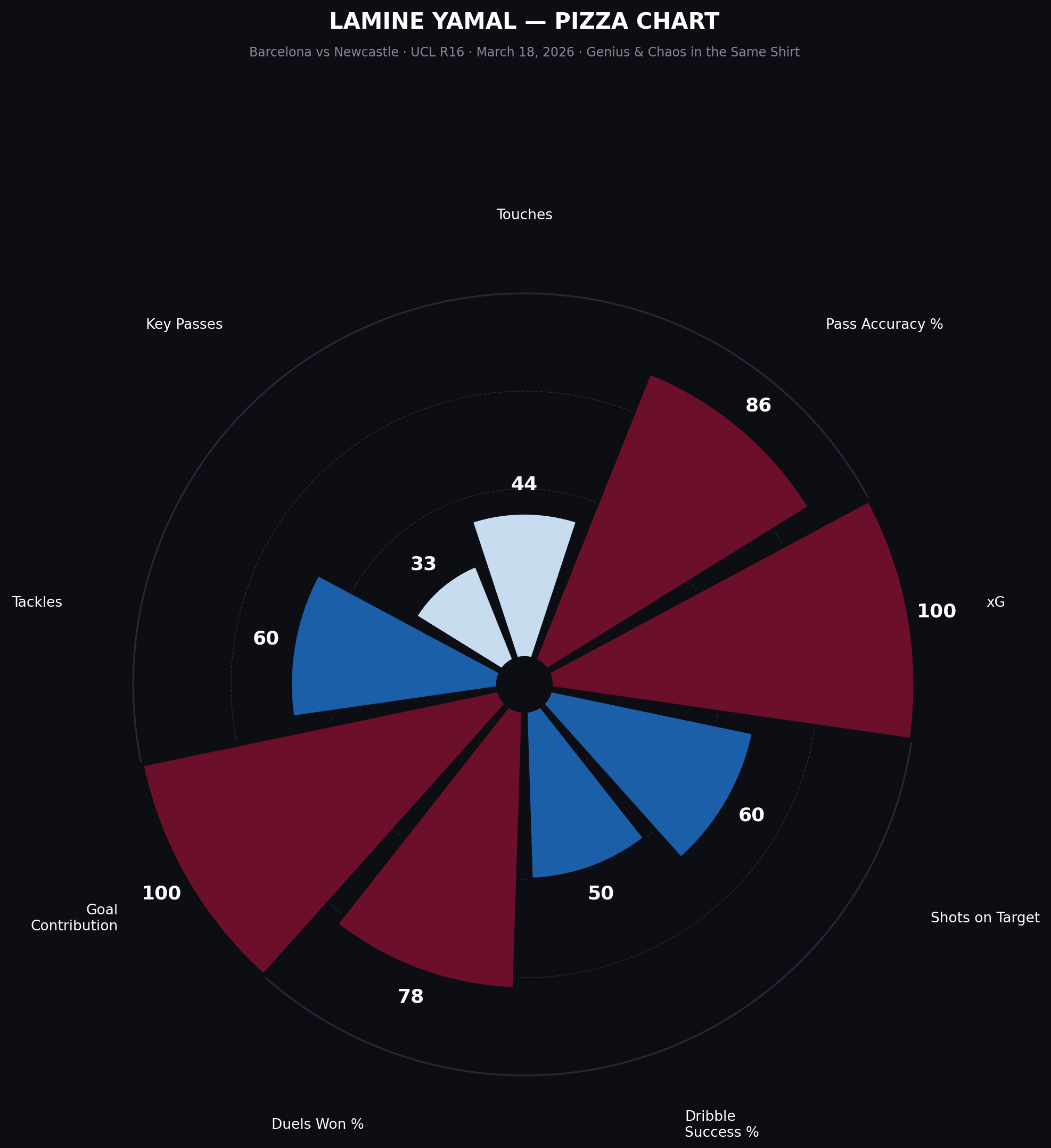
Lamine's profile from the nights play shows the contradiction at the heart of his season in a single image. The xG slice is maxed — 1.35 on the night, the highest of any player in the match. His goal contribution, pass accuracy, and duel win percentage sit in the elite or strong tiers. And alongside those numbers: two big chances missed, one error leading to a goal, a dribble success rate suppressed by Hall's discipline. He is simultaneously the most dangerous attacking player Barcelona possess and the most unpredictable. At eighteen, the chaos may be the price of the quality. What he becomes when that ratio shifts is truly breathtaking and awe inspiring.
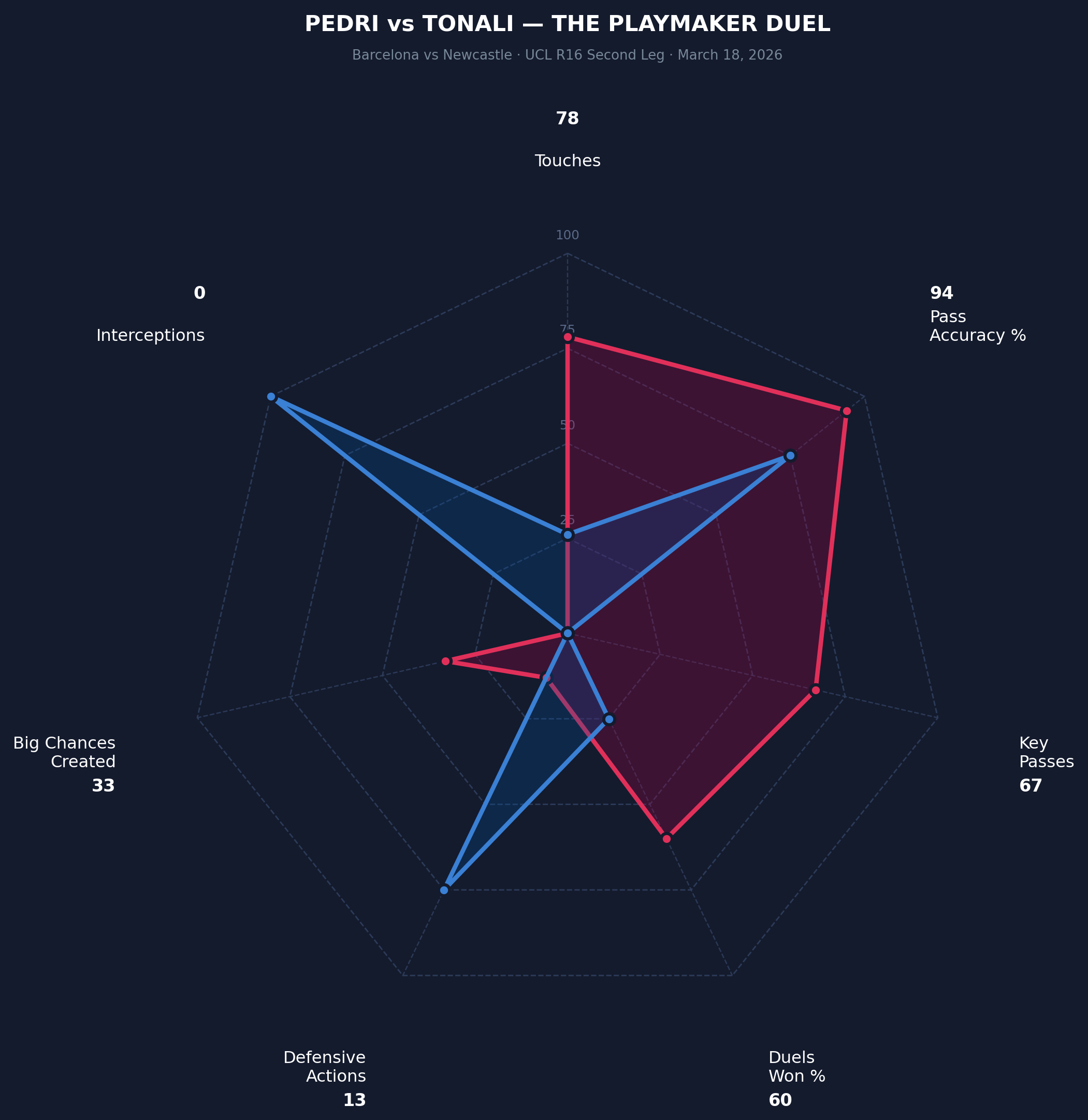
The Pedri-Tonali comparison makes the first-half midfield argument visible. Pedri dominated on possession metrics — touches, pass accuracy — but his ability to control tempo was significantly curtailed by Newcastle's press intensity. Tonali's chart runs the other way: strong on defensive actions, high interceptions, the profile of a midfielder who spent forty-five minutes winning the physical argument. Both players did what their manager asked. The problem for Newcastle was that Flick was about to ask his players for something different.
The Half-Time Instruction That Changed the Match
Fermín López has told us what Flick said at half-time, and the instruction deserves quoting for its precision: he wanted López to drop into the build-up phase, to become an option between the lines, and to drag Tonali away from his defensive position. The reasoning was specific: if Newcastle were committing to man-to-man assignments, the way to break them was not to dribble through the press — which Barcelona had been attempting with limited success — but to move the markers. Pull Tonali deep. Open the space behind.
Let Yamal rotate centrally into it.
The structural logic is worth explaining. In Newcastle's man-oriented system, every press trigger was based on the principle that each defender owned their man. The moment López dropped between the lines to receive, Tonali had two choices: follow him and vacate the space he was covering, or hold his position and allow López to receive unopposed. Either option hurt Newcastle. If Tonali followed, Yamal had space to drift centrally away from Hall. If Tonali stayed, López had time to play forward before Newcastle's second line could engage.
Flick had also identified a secondary mechanism — the positional exchange between Yamal and López in the right half-space. Throughout the second half, the two players crossed each other's paths with the purpose of a rehearsed movement.
López moving outward as Yamal drove inward, each player carrying their defender through the crossing action and creating separation for the other. It happened repeatedly. It created the free kick that preceded the penalty. In the second half, it unlocked the fourth goal. Newcastle had no answer for it because the answer would have required their man-oriented system to communicate in real time — and man-oriented systems, by design, do not communicate. They commit.
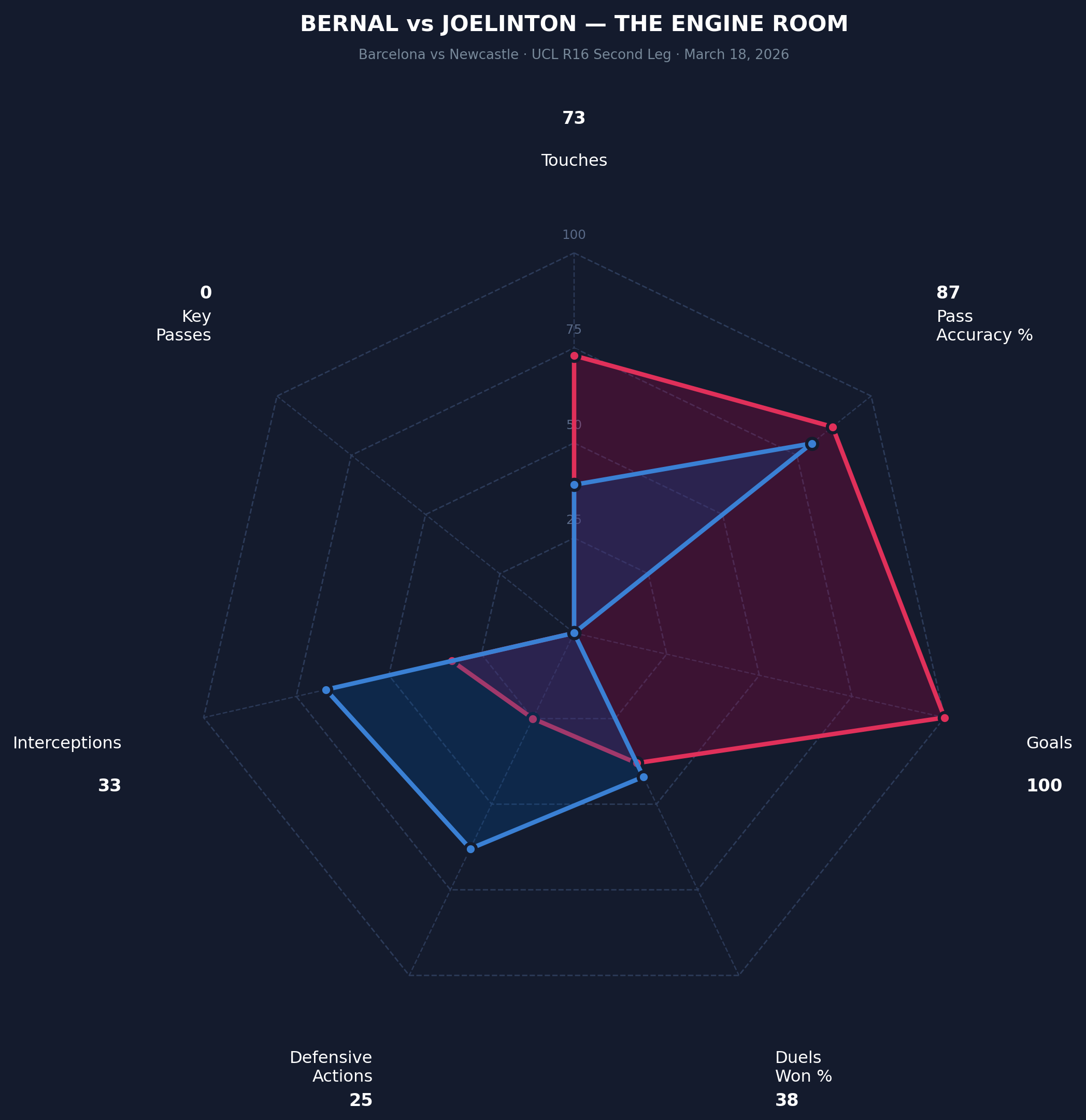
The Bernal-Joelinton radar captures what shifted in the engine room once López's drop-off role took effect. Bernal's polygon is dominant on possession metrics, and his goal and set-piece threat give him an attacking dimension Joelinton cannot match. Joelinton's chart is the profile of a player who gave everything physically — his duels count, his defensive actions, his pressing work rate are all visible. But a press requires structure, and once the structure was broken, Joelinton's energy had no architecture to plug into. He kept pressing. He was pressing into gaps.
Four Goals in Twenty-One Minutes
The fifty-first minute. López drops to receive between the lines, Tonali is three yards out of position, and the ball arrives at López's feet in space he should not have. He turns, drives, and finishes. 4–2. Aggregate 5–3. Newcastle's press, coherent and aggressive for forty-five minutes, was gone. The spaces it had been covering with individual bodies were now open territory.
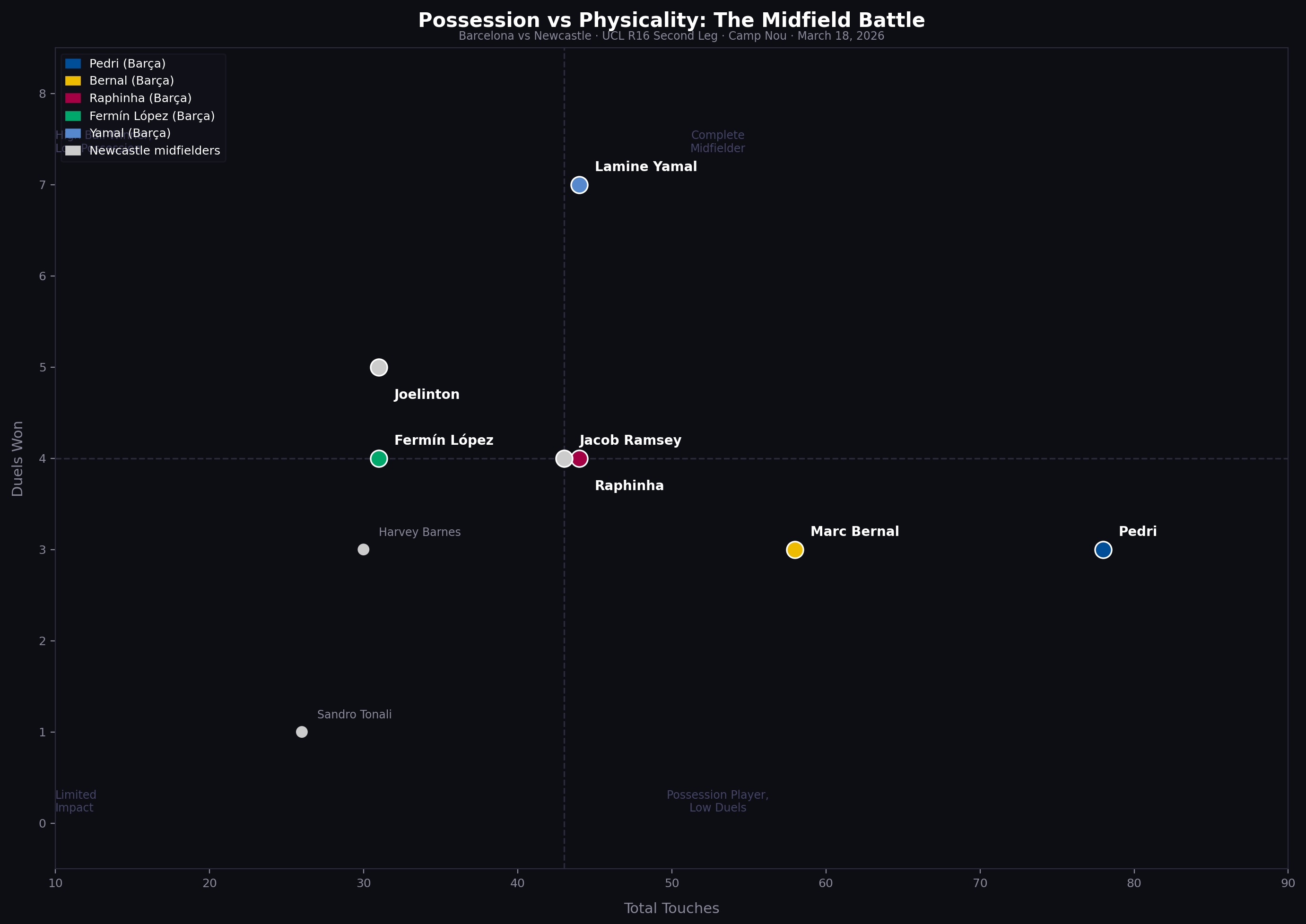
The chart above tells the second-half story across the whole group. Pedri — high touches, strong accuracy — is back to the player he normally is once Newcastle's structural coherence dissolved. Bernal, competitive across both axes, was the most complete midfielder on the pitch from the fifty-first minute onward. Joelinton and Ramsey had strong duel counts but declining relevance — players winning battles that no longer determined the outcome.
Raphinha's corner in the fifty-sixth minute found Lewandowski arriving at the far post. The header was precisely placed — not power but angle, the finish of a player who has been reading defensive lines for twenty years. In the sixty-first minute, Yamal, now operating as a free ten rather than a touchline winger, turned inside Hall and released Lewandowski with a perfectly weighted through-pass. The finish was across Ramsdale into the corner. 6–2. By this point the Camp Nou was not watching a match. It was watching a performance.
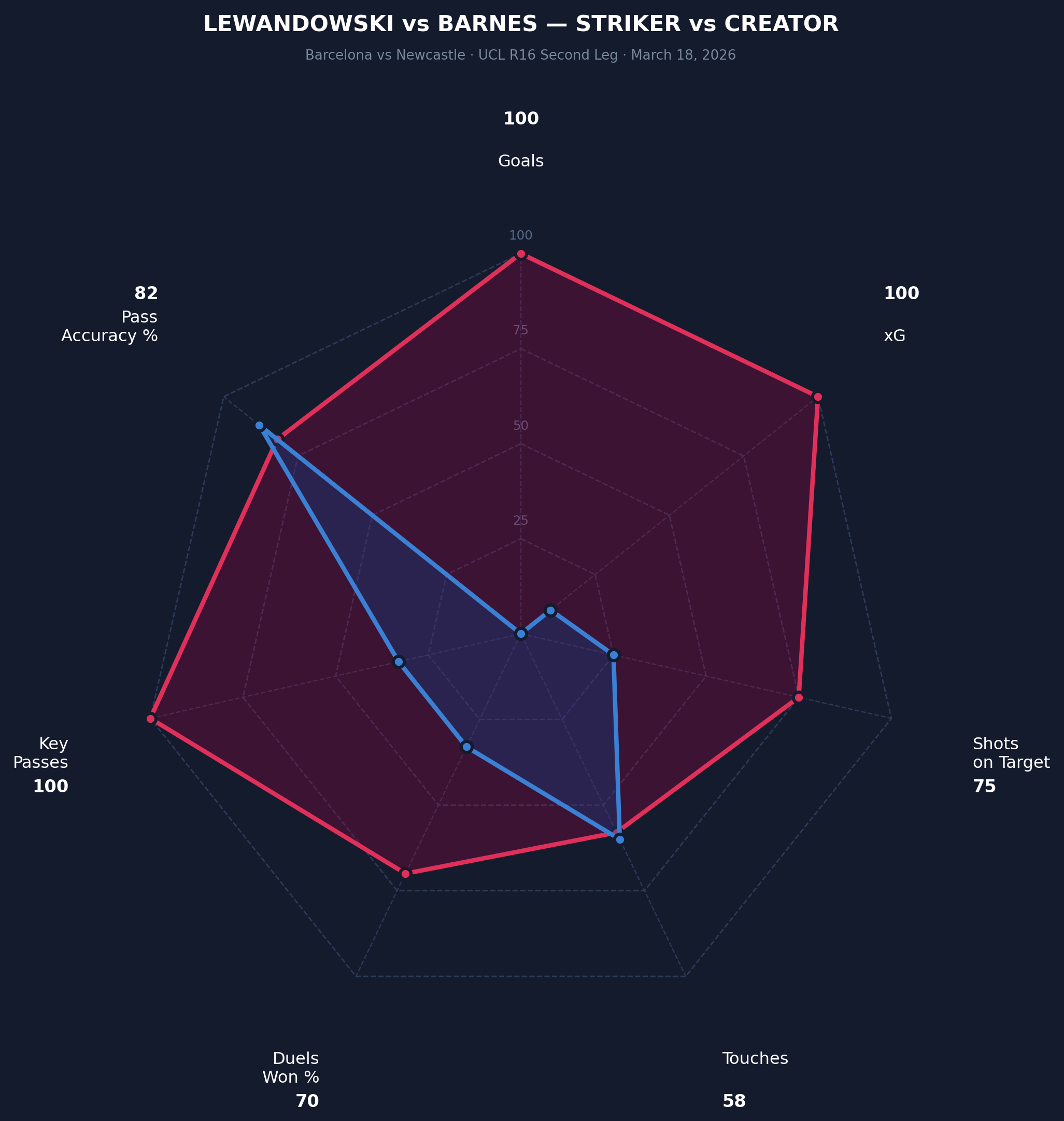
Lewandowski's game was concentrated entirely in the attacking and creative axes — goals, xG, key passes — the shape of a player who requires very little of the game and focuses on conversion. He broke Messi's record for scoring against the most different Champions League opponents that night — forty-one — without anyone pausing to register it because the football was too good to stop. Barnes was Newcastle's most dangerous outlet in the second half but outlets require open channels, and by the sixty-first minute those channels had closed.
Raphinha completed the scoring in the final minutes after Ramsey gave the ball away on the edge of the box. Seven goals. Equal to Barcelona's biggest Champions League knockout win since 7–1 against Bayer Leverkusen in 2012. Newcastle had conceded seven in a single match for the first time since December 2012 — a run of six hundred and ten consecutive games before this night.
The Men Who Made it Happen
Gerard Martín: Ninety Minutes of Double Duty
The plaudits will stay with Raphinha. And many will eulogise Yamal. And rightfully. But there was one other name tha deserves space in the same breath. And that was Gerard Martín.
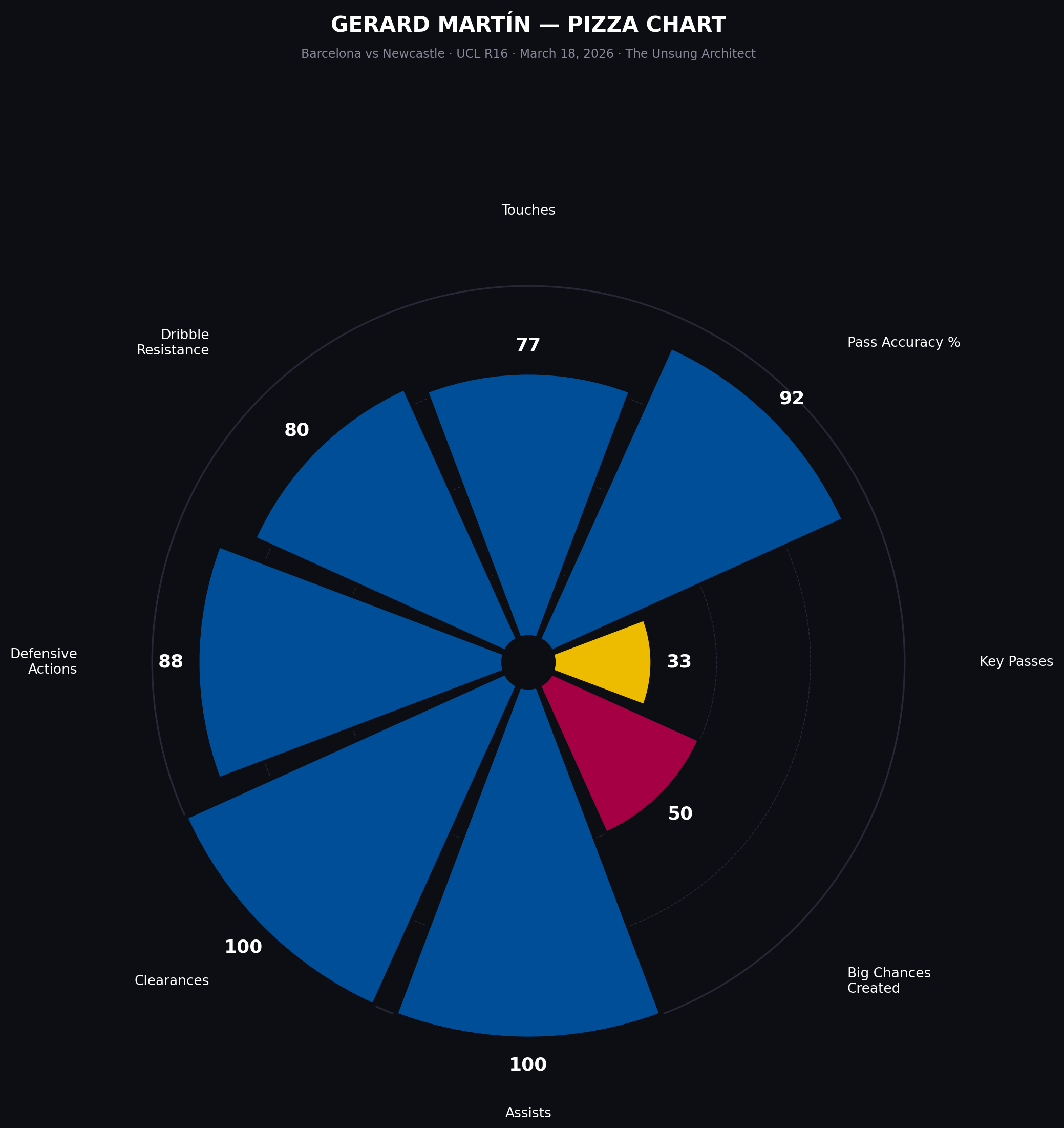
Ninety-two percent pass accuracy from seventy-seven touches — the third highest accuracy in the Barcelona starting eleven. One assist. Seven clearances. Seven defensive actions. Dribbled past once. He was operating under specific structural pressure all night: Cancelo's attacking license means the left-sided centre-back carries double defensive responsibility, because every time Cancelo advances there is a channel behind him that Martín must cover alone. Newcastle targeted that channel specifically and repeatedly. Martín was the last organised defender in that zone on multiple occasions.
He held it for ninety minutes. He passed accurately. He created. He defended. He is twenty-one years old and this was a night that should settle any remaining debate about his readiness for this level.
Fermín López: The Player Who Executed the Instruction
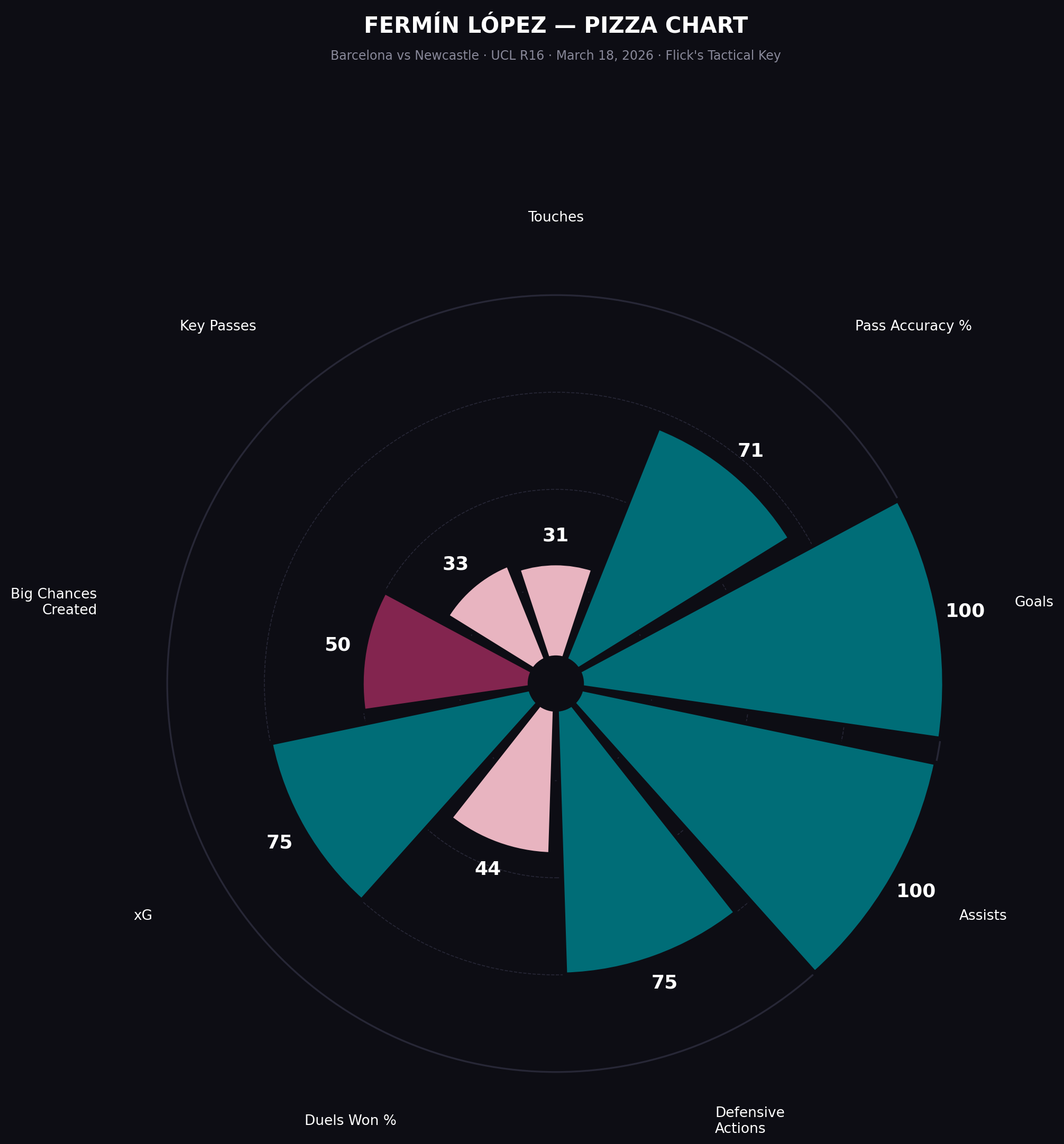
Fermín López's chart is the physical record of what Flick's half-time instruction required. Goals and assists in the elite tier. Six defensive actions. xG at 75. Duel engagement high and competitive. He touched every dimension of the game, which is exactly what the adjustment demanded — not a specialist running a single brief, but a player willing to be wherever the system needed him.
The most important contribution is the positional read that allowed him to drop at the precise moment Tonali could be dragged, receive in the precise space that created the overload, and finish when the chance arrived. The fourth goal came directly from that sequence. Everything that followed — three more goals in fifteen minutes — came from the structure that goal broke open.
Quality Versus Opportunism: The Winger Battle
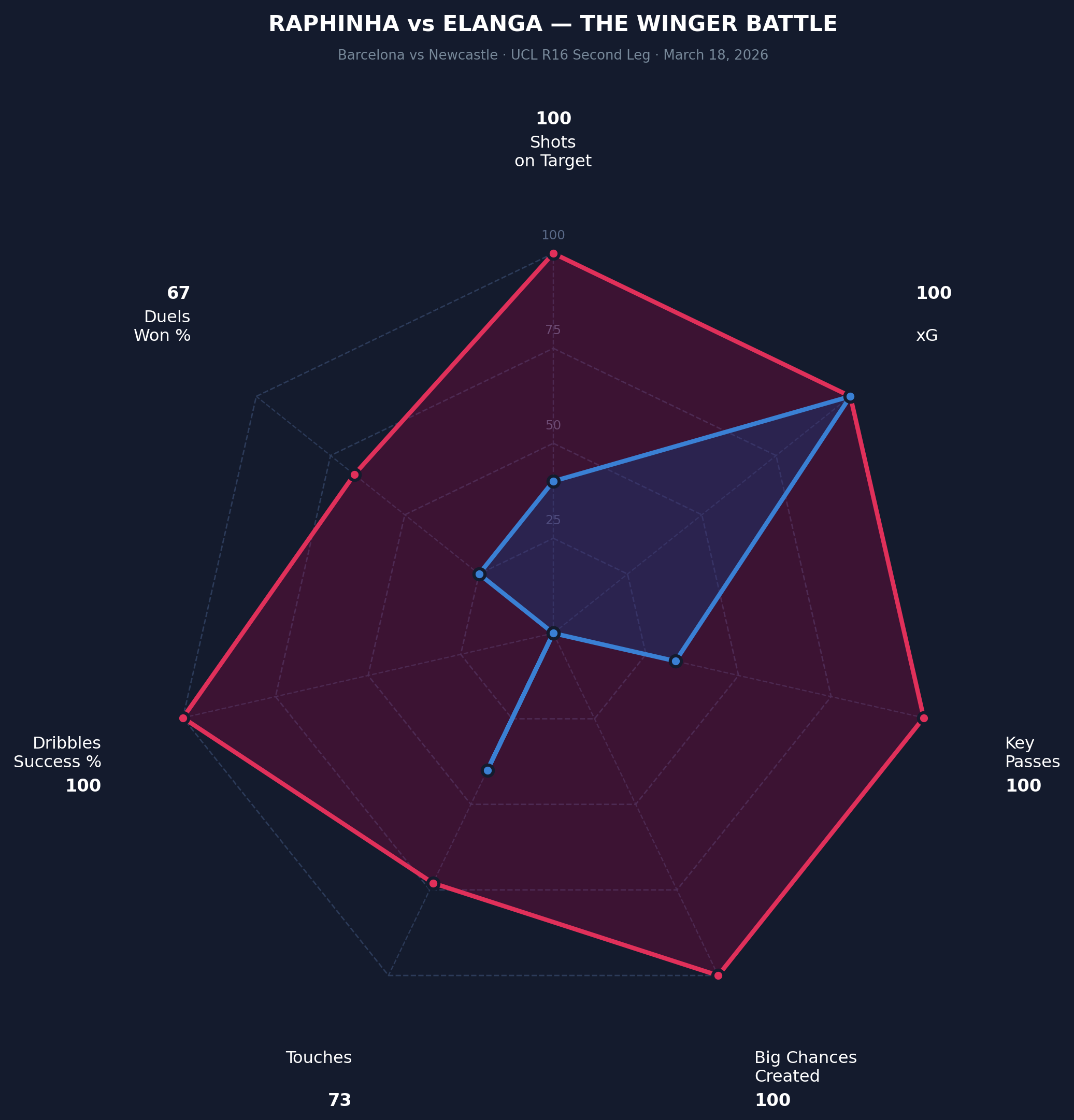
The Raphinha-Elanga radar is the most visually dramatic in this piece and it tells the two-half story cleanly. Raphinha's polygon is at or near maximum across the creative and finishing axes — five shots, all five on target, six key passes, three big chances created, two goals, two assists. He was the best player on the pitch for the full ninety minutes. The data reflects it without qualification.
Elanga's polygon concentrates on xG and finishing — the profile not of a complete attacking performance but of a specific, structurally enabled contribution. Newcastle's press had created two positions of genuine danger. Elanga converted both. When the structure was broken in the second half and those positions stopped being created, his contribution ended with it. That is not a criticism of Elanga. It is the honest consequence of what happened tactically.
The Defensive Register
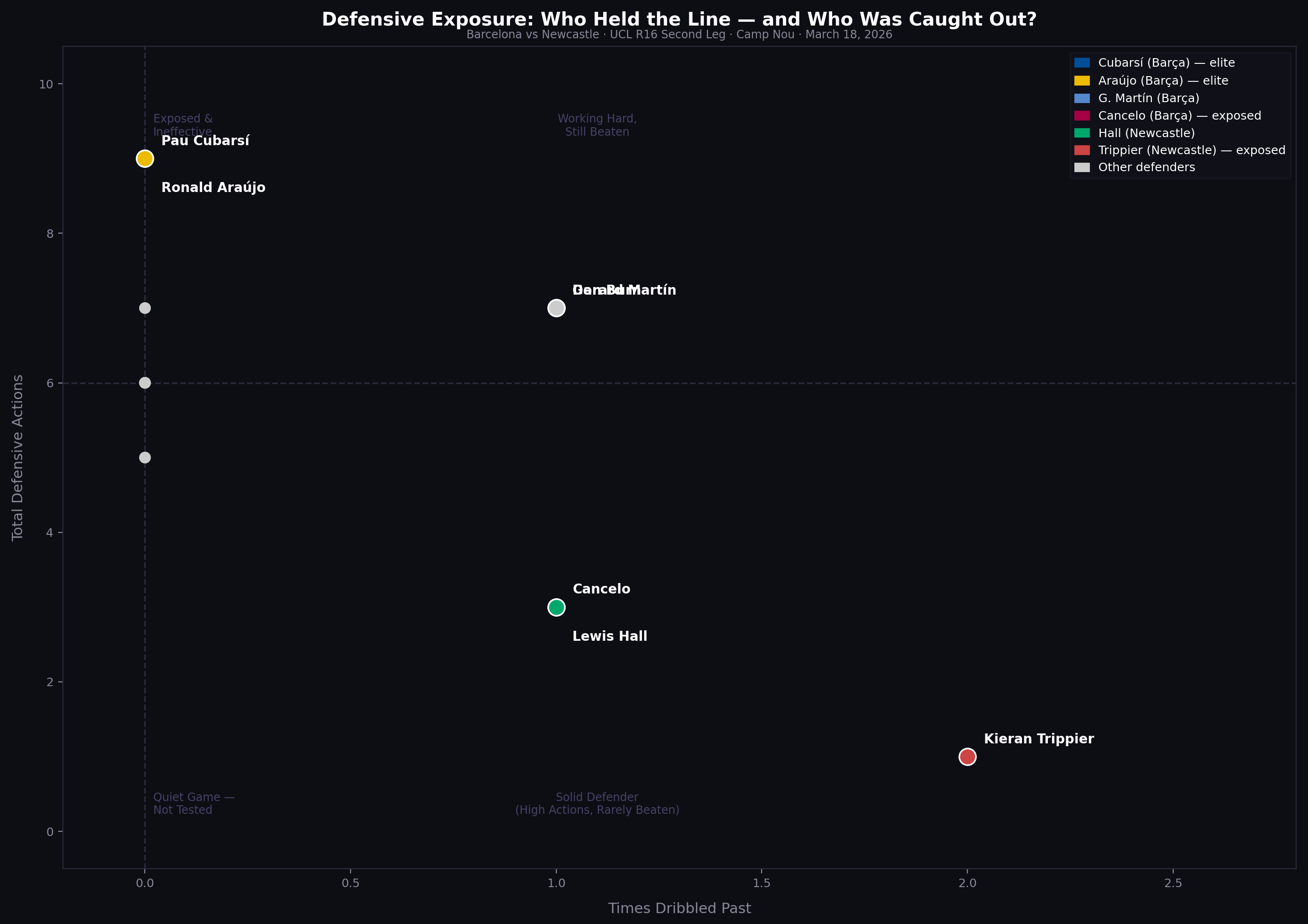
The defensive exposure is the chart that should most concern Barcelona before the quarterfinal. Barcelona fans have a lot of angst agaisnt Araujo, but on the night he was quite solid — high defensive actions, zero or near-zero times beaten. Araújo's authority once introduced for the injured Eric García was complete. Cubarsí, at seventeen starts in this Champions League campaign, continues to look like a player for whom the occasion has never been too large.
The concern is definitely Cancelo. I love him and his energy and what he brings to the attack but both Newcastle goals traced to the same channel. It is the same channel opponents will target across this season. Cancelo's talent is genuine and his attacking contribution to this team is significant — but the reliability in the defensive phase is a structural question Flick has not yet answered. Against Atletico Madrid, Diego Simeone will have the scouting report. He will know which channel.
He will know which runner to send.
What Barcelona Are Becoming
Barcelona have won consistently at CampNou from the time the stadium reopened. The home advantage seems to be back. What is interesting about this run is not the goals — though the goals are extraordinary — but the adaptability. Flick did not arrive at Camp Nou with a fixed system and ask his players to conform to it. He arrived with a set of principles and a willingness to solve the specific problem in front of him. When Newcastle's press was working in the first half, he identified the mechanism to break it. He communicated it clearly at half-time. One player executed it within ninety seconds of the restart. Four goals followed.
That capacity — to diagnose, to adjust, to execute — is what separates good teams from dangerous ones. Barcelona have the attacking quality to hurt any opponent in Europe. They have the tactical intelligence, at managerial level and player level, to adapt when an opponent has something prepared. Both of those things together are what makes them a genuine contender, not simply a team with good forwards.
The quarterfinal awaits. Atletico Madrid are the opponents, Simeone inevitably arriving with something prepared, his defensive structure built specifically to eliminate the spaces Flick's system creates.
It will be an incredibly demanding set of games. But a manager who solved Newcastle's press at half-time with one instruction, and a player who executed it before Newcastle had settled back into their shape, will not arrive at that fixture without ideas. Especially after losing the Copa Del Ray.
Visca el Barça.