How Joao Cancelo Fits Hansi Flick’s Barcelona
Joao Cancelo is back at FC Barcelona. What does that mean for Hansi Flick's team, their tactics and strategy?

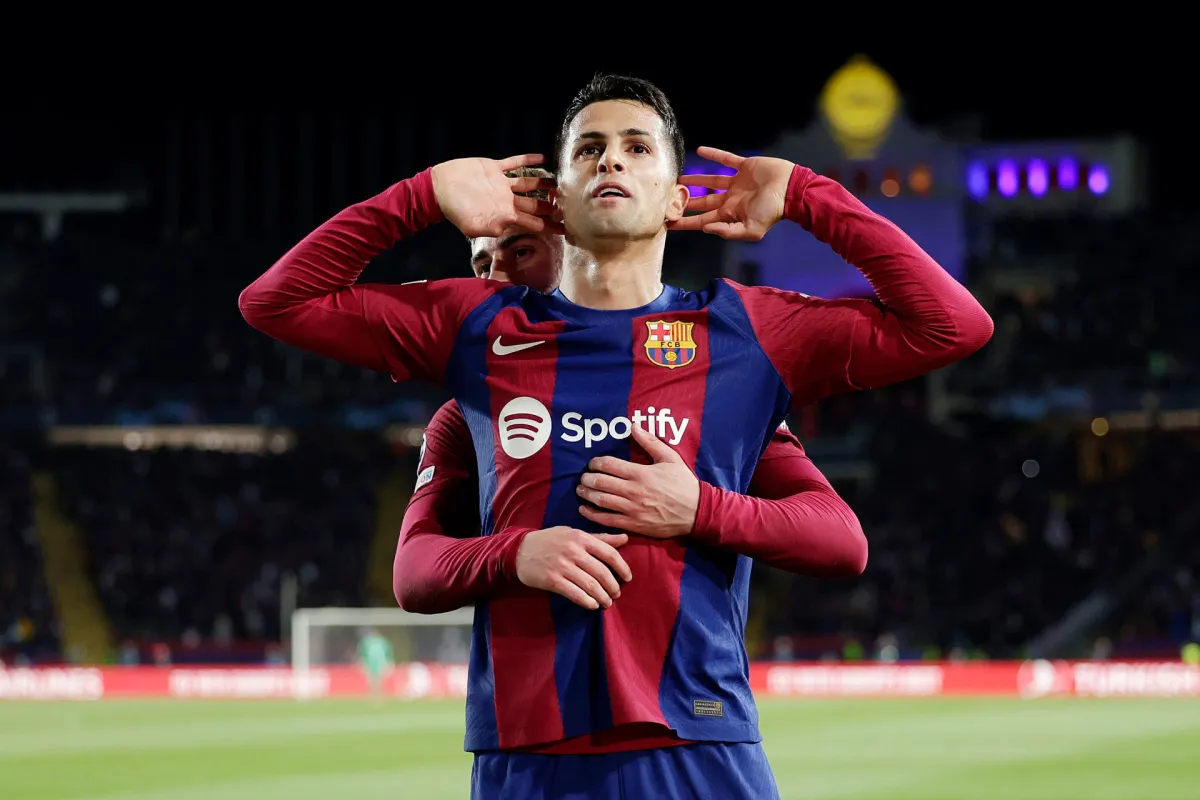
Barcelona’s January window was never going to be glamorous. The club’s financial straitjacket ensured that dreams of elite centre-backs or marquee signings were fantasy. Instead, the reality was pragmatic: a six-month loan for a 31-year-old full-back who hasn’t played meaningful football for months.
Joao Cancelo returns to the Camp Nou not as a saviour, but as a tactical wildcard in Hansi Flick’s high-octane blueprint; a system that thrives on organised chaos, verticality, and relentless aggression.
This is not nostalgia. It’s not romance. It’s cold arithmetic and calculated risk. Flick didn’t get the centre-back he wanted; he got a player who can stretch the pitch, invert into midfield, and create overloads against deep blocks. A player who, in the right game state, can tilt the balance.
But can Cancelo survive in a system that demands discipline at the back and dynamism going forward?
Let's find out.
The Context Behind the Move: Numbers, Not Dreams
Barcelona’s financial reality dictated this transfer. With Andreas Christensen sidelined long-term, the club could free up 80% of his salary under La Liga’s FFP rules, which, if reports are to be believed, is around €7.2 million. Add a temporary salary offset from Ter Stegen’s loan arrangement, if it happens, of course, and you have just enough room to squeeze in a short-term fix.
So instead of Schlotterbeck or Basoni, we get Cancelo on a six-month loan from Al-Hilal, with the Saudi club covering two-thirds of his wages. Which, in this context, is massive news. It also means Barcelona pay roughly €4–5 million for the privilege of re-signing the Portuguese full-back.
 Domagoj Kostanjsak
However, there's no escaping the fact that this wasn’t Flick’s first choice, no matter how much he claims otherwise to the press and the fans. He wanted a centre-back. Plain and simple. So Nathan Aké was discussed, Marcus Senesi and Marc Guehi too. But the numbers didn’t work. And how could they?
After all, Premier League clubs don’t subsidise wages, and Barcelona couldn’t stretch beyond their FFP ceiling. At the end of the day, Cancelo was the only realistic option: experienced, versatile, and willing to take a pay cut to return to a club he openly loves.
In short, this move is less about ambition and more about survival.
But survival can be strategic.
Cancelo’s Profile: The Duality of Chaos
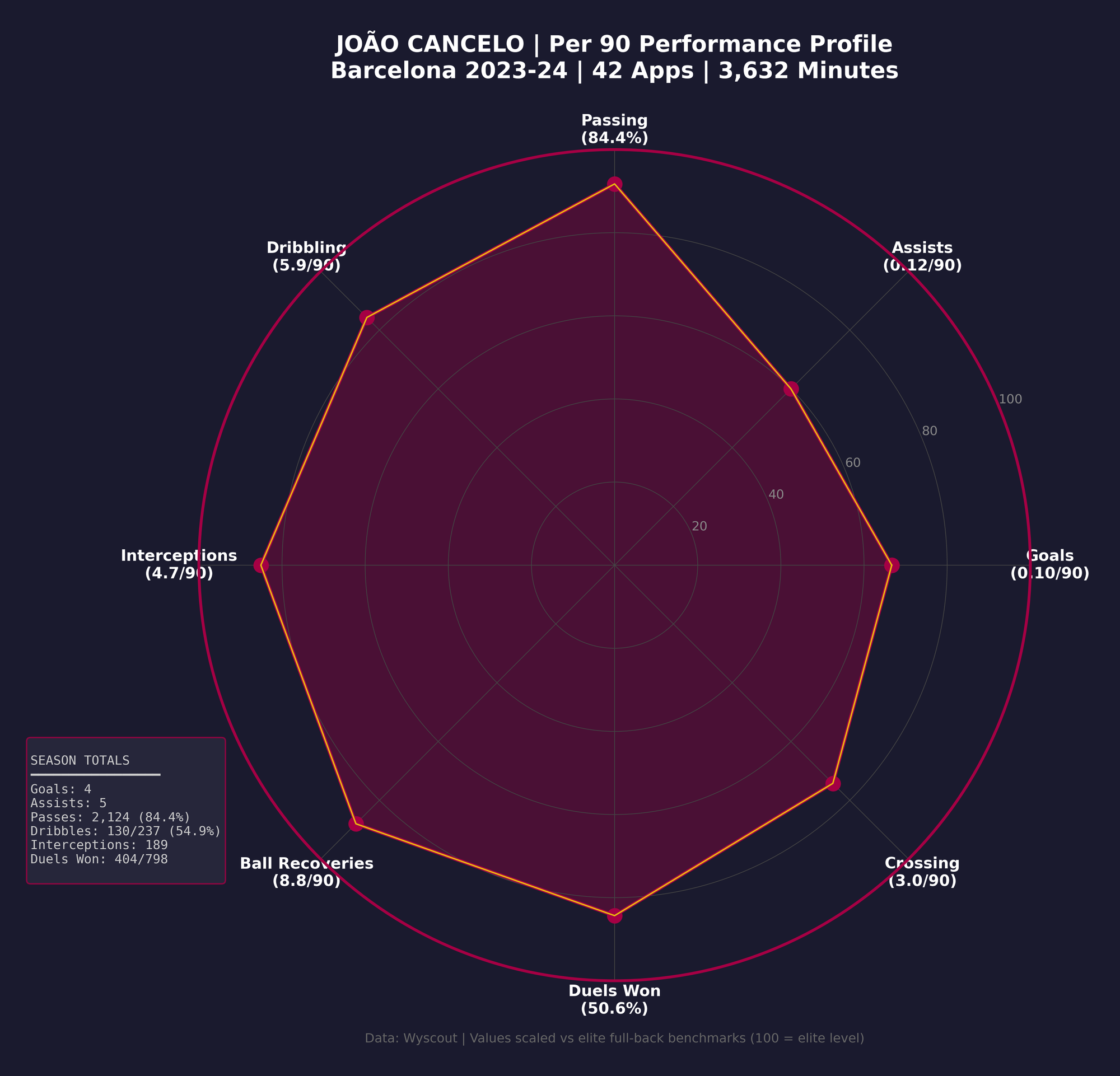
Cancelo’s first stint at Barcelona in 2023–24 was a paradox. On paper, he delivered: 42 appearances, four goals, five assists, deployed across both flanks and even as a winger in emergencies. His Champions League nights against Porto and Napoli were standout moments that culminated in goals, assists and celebrations kissing the badge. Yet the season ended with bitter memories: defensive lapses against PSG, a limp Clásico, and a narrative that painted him as unreliable in high-stakes games. He started as a hero but left a villain... Well, kind of.
Statistically, Cancelo was elite in progression. He ranked in the 94th percentile for expected assists, averaged 15+ passes into the final third per game, and completed over two dribbles per match, second only to Lamine Yamal in the squad. Now, that's saying something. He also won 76% of his duels and carried the ball into advanced zones more than five times per game. There's no denying it, offensively, Cancelo was a weapon.
But defensively? Yikes.
When asked to defend deep, where his concentration wavered and his risk-taking became self-destructive, the Portuguese flinched. A lot. And this duality defines him perfectly and inevitably: a player who elevates attacking ceilings but exposes structural cracks if the system doesn’t protect him. Under Xavi, Barcelona’s passive mid-block left him isolated. But under Flick... the context changes. And that’s crucial.
Cancelo is a right-footed full-back whose default body orientation is open to the inside lane. His first touch frequently sets him diagonally towards the half-space rather than straight down the touchline, which is why he’s so comfortable stepping in to act as an extra midfielder. That body shape also suits his trademark outside-of-the-foot deliveries (the trivela) from both flanks, allowing him to curve service across the box without changing stride or telegraphing the cross.
He’s a high-volume progresser by two means: carries and disguised passes. The carry is his most destabilising action: hips open, head up, gliding past the first line through feints rather than raw pace. When he draws a midfielder out, he’ll play a disguised wall pass into the pivot and immediately underlap into the vacated pocket. Against compact blocks, he prefers one-twos to bounce off Pedri or Dani Olmo, reappearing between lines for the next touch.