Barca take down Atleti at the Metropolitano to go 7 points clear
The Day the Pirate and the Pole Gave Barça the keys to the League

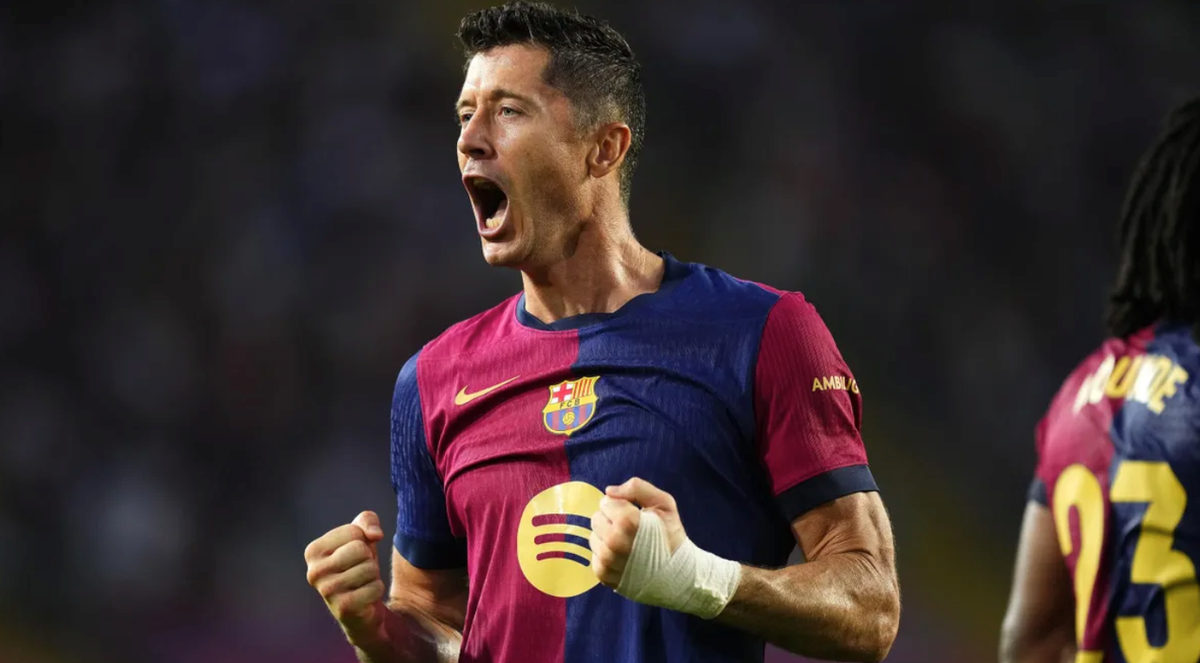
It began in Mallorca. Not in Madrid. Not at the Metropolitano. Five hours before Hansi Flick's side ran out under the evening lights of the Spanish capital, a 17th-placed side fighting to save relegation was holding a lead that nobody — not the television analysts, not the bookmakers, certainly not Álvaro Arbeloa — believed would last. Real Madrid had equalised through a Militão header in the 88th minute. The stadium had deflated. The points were gone. And then Vedat Muriqi — the Kosovan pirate, second-highest scorer in La Liga, still carrying the raw wound of Kosovo's World Cup elimination and a missed penalty the week before — converted a cross from Mateo Joseph in the 91st minute and sent Son Moix into delirium. He was in tears before he reached the corner flag.
His teammate Johan Mojica pointed at the camera and said, simply: "For Kosovo. For Kosovo."
By the time Barcelona's players walked out to face Atlético, they knew. Every one of them knew. Real had dropped points. The four-point gap was now seven if they won. The title race, which had felt genuinely alive forty-eight hours earlier, was being cracked open by a man weeping in Mallorca who had nothing to do with any of this. All Barça had to do was not waste the gift.
Diego Simeone sent out a 4-4-2 built for disruption: Musso in goal, Molina and Nico González wide, Le Normand and Lenglet inside, Koke and Vargas anchoring the middle, Almada and Giuliano Simeone providing width, Griezmann and Baena up front. It was a team designed to make the game ugly, to press the build-up, to recover the second ball, and to punish the single moment of lost concentration that always comes if you wait long enough. Flick answered with a 4-2-3-1 that prioritised pace and unpredictability: Eric García and Pedri as the double pivot, Yamal right, Rashford running inside from the left channel, Fermín on the right of the three, Olmo as a false 9, Lewandowski on the bench. The central question the match posed was simple and brutal: could Barça's combination play dismantle Atlético's block before Atlético's press dismantled Barça's composure?
For 38 minutes, neither happened. Then the answer arrived in the worst possible order.
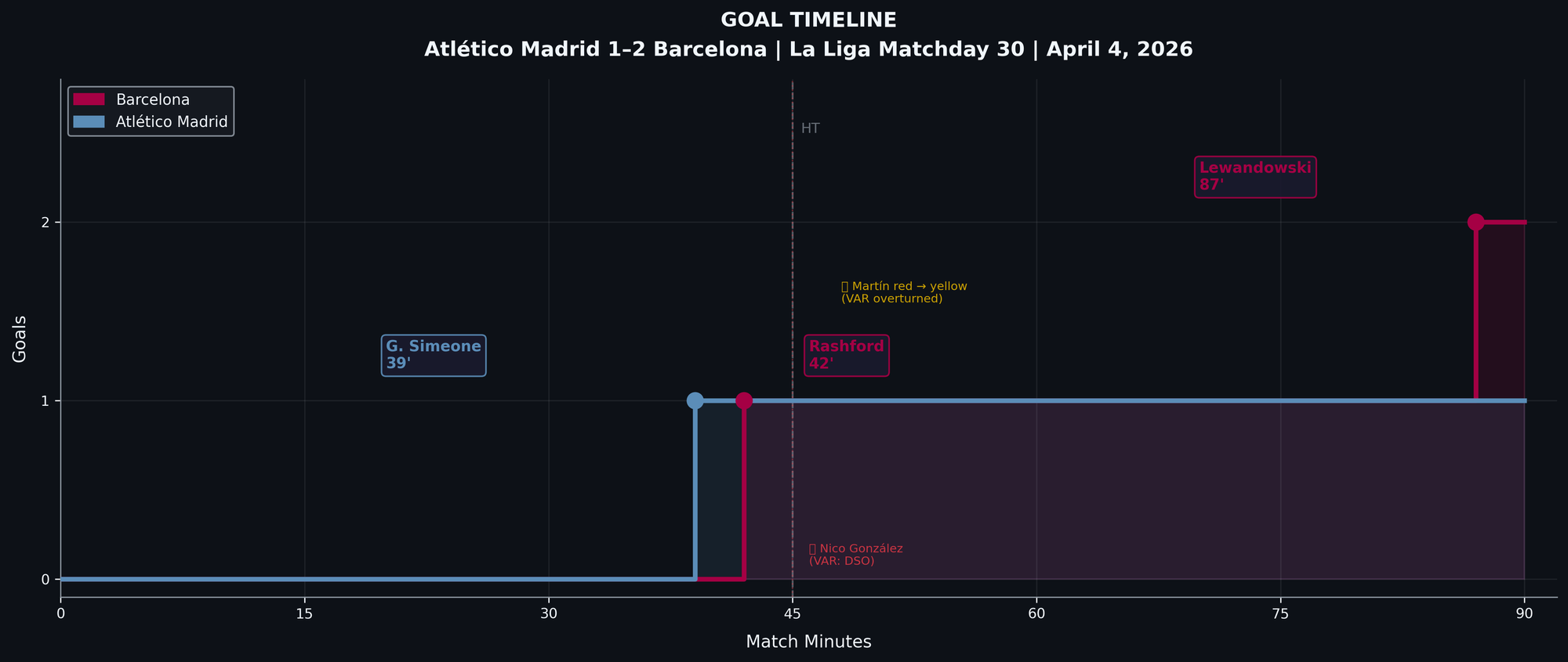
Look at the shape of those three steps and you have the match in its bones. A lead. An equaliser three minutes later. Then 45 minutes of cagey back and forth — Musso, VAR, tension, and ten men — before one shoulder, one rebound, and everything changed. The 39th minute was a lofted diagonal from Lenglet, finding Giuliano Simeone in behind, who took one touch and finished low to the right. That is the kind of goal Atlético score against the run of play, against probability, precisely when you think the moment has passed.
What happened next was eleven seconds of football that encapsulated why this Barça are different from the sides that came before them. Rashford drove inside from the left, played a one-two with Dani Olmo — no hesitation, no touch to settle — and didn't break stride. The return ball arrived exactly when he needed it. Left foot. Low. Through Musso's legs. 1-1.
Nobody came to the Metropolitano expecting Marcus Rashford to be the difference. That is precisely why he was. He wasn't waiting for the goal — he was building towards it, dragging defenders out of shape, finding pockets between Atlético's lines that a more static forward wouldn't see. The goal itself was clinical: a one-two with Olmo, one touch, left foot through Musso's legs. No drama, no hesitation. What the charts don't fully capture is the defensive work — close to 80 minutes of pressing in a system that demands total commitment without the ball. Tonight Rashford gave Flick both.
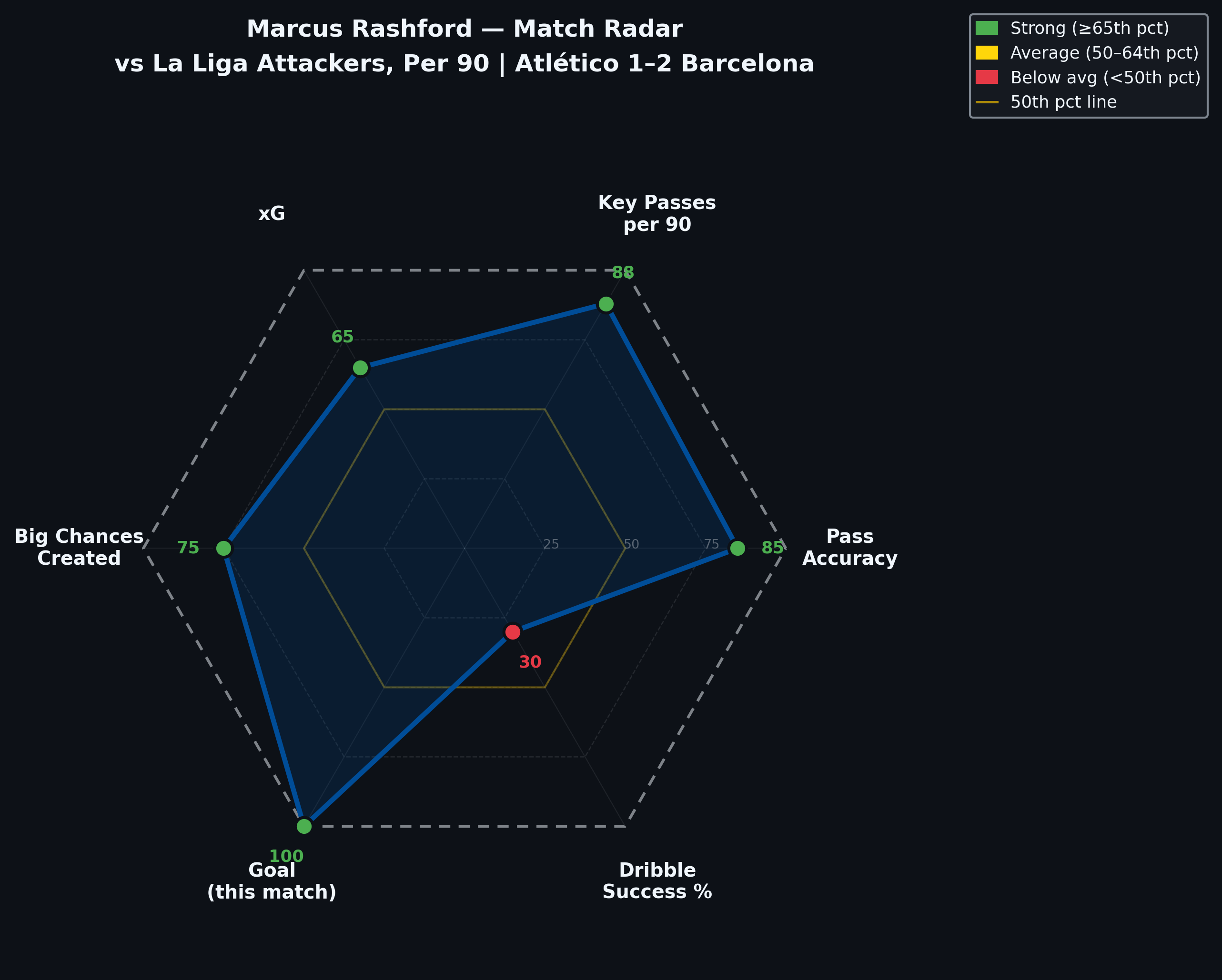
From Olmo's first touch to the net, eleven seconds. That is combination play working at its highest pitch: not beautiful in the way a slow build-up can be beautiful, but devastating in the way only speed of thought can be devastating.
Then came the first act of theatre. Nico González, already booked, lunged at Yamal on the edge of the box in first-half stoppage time. The referee showed a second yellow. VAR upgraded it: denial of a goalscoring opportunity. Straight red. Atlético went into the break level, a man down, and furious.
The numbers at halftime told two separate stories about the same game. One was Barcelona's — 67% possession, 92% pass accuracy, 89% of passes in the final third completed, five big chances created to Atlético's two. The other belonged to Atlético. They won the ground battle, 54% to 46%. They made 30 tackles to Barça's eleven. Their press resistance held across the first half despite being pinned back. This was a team that was dominated in every territorial and creative metric and still won the contest that happens below the surface — the one fought in the grass, with studs and shoulders and second balls. They were not outrun. They were not outmuscled.
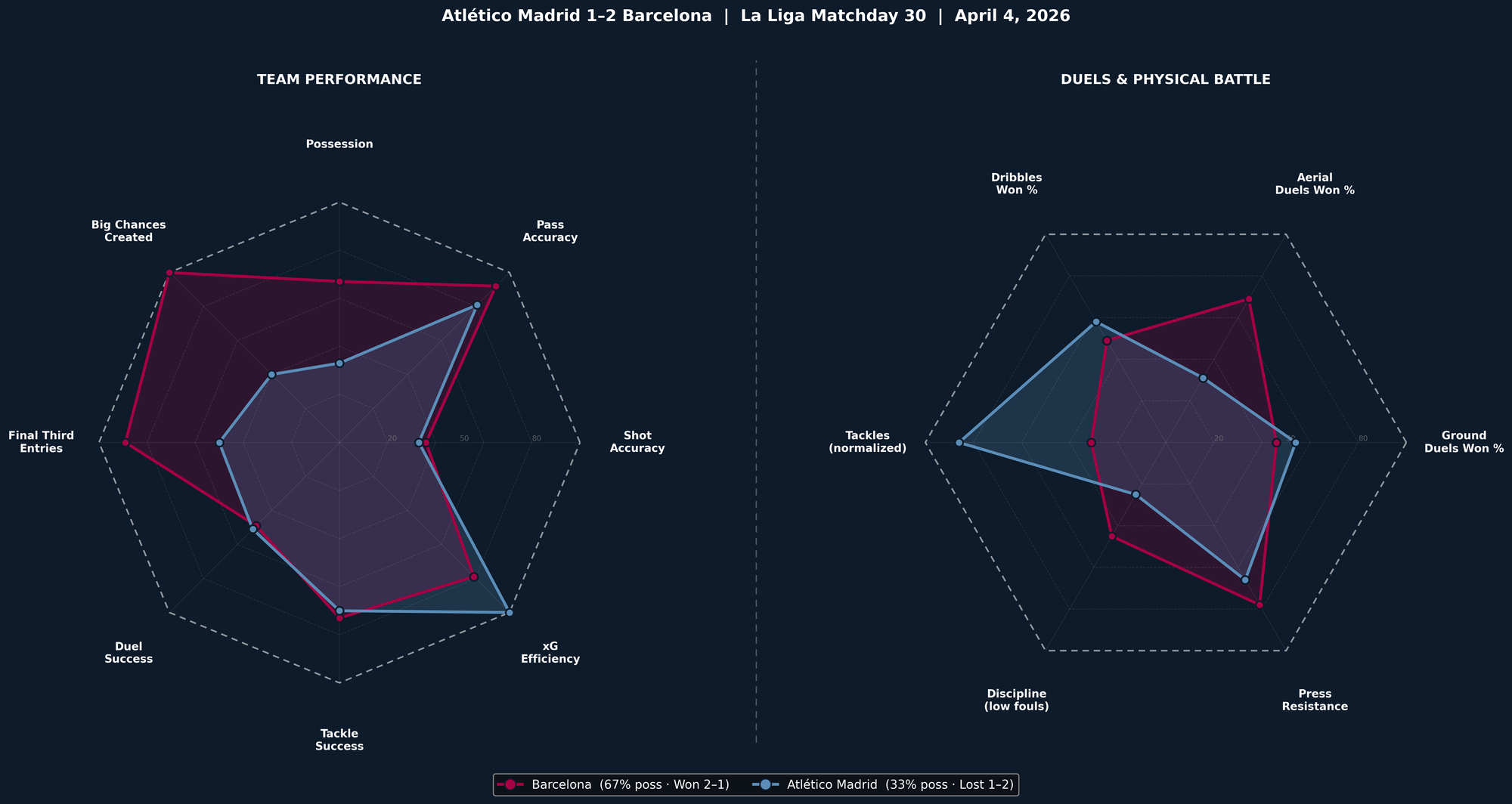
The red card to Nico, at the touch of half time changed the balance in favour of Barca and the second half should have been a procession. But It was not. With Diego Simeone it almost better to go 10v10 than 11 vs 10.
There was this brief moment when Gerard Martín was shown a straight red for a challenge on Almada — he won the ball first but followed through onto Almada's ankle with his studs. The Metropolitano erupted. Diego Simeone was on his feet. The stadium believed it had its equaliser in human form — eleven versus eleven again, everything reopened. The referee walked to the screen. VAR showed what replays confirmed: Martín had played the ball before making contact. Not a red card. The decision became a yellow. Barça stayed at eleven men. But the two minutes between red card and reprieve were among the most surreal this fixture has produced in years — the crowd swinging from eruption to disbelief, Simeone on the touchline barely able to process what he was watching.
What followed thereafter for long periods of the second half was Musso. Again and again and again. Ferran Torres came on and had three shots on target — all saved. Cancelo drove and struck — blocked, saved. Barça created 2.52 xG across the ninety minutes and had fifteen shots inside the box. Musso saved six. On another night, in different physics, this is 4-0 and nobody writes a word about drama.
But Musso was a wall, and the wall held until the 87th minute.
Cancelo found space down the left, dribbled into the box and created an angle to unleash a shot. Musso saved it. The ball cannoned back at pace. Robert Lewandowski — eleven minutes on the pitch, seven touches, not yet in the game in any meaningful sense — was precisely where a finisher of his calibre is always supposed to be. Behind the keeper. Ahead of the defenders. In the space that exists for exactly one second before it closes.
He shouldered it home. 2-1. Yes you can say its lucky, but it's the kind of luck Lewandowski has been generating for himself for over 15 years now.
There are two other heroes in this game who deserve naming before we go any further. Giuliano Simeone scored and worked and pressed for 61 minutes with the energy of someone who has something to prove every time he plays in his father's shadow — and he is proving it. His goal was impeccably taken and his work-rate without the ball was relentless. You don't see it in the line score, but you felt it every time Barça tried to play through the press and found him there. And then there was Musso. Six saves. The goalkeeper who had been questioned in recent weeks gave Diego Simeone 87 minutes of absolute defiance. There are performances on the losing side that deserve their own line. This was one of them.
But, none of this — not Musso's wall, not Simeone's disruption, not the red cards and the VAR drama — explains how the goal was made possible in the first place. For that you need to look at how the attack was built across ninety minutes, and who built it.
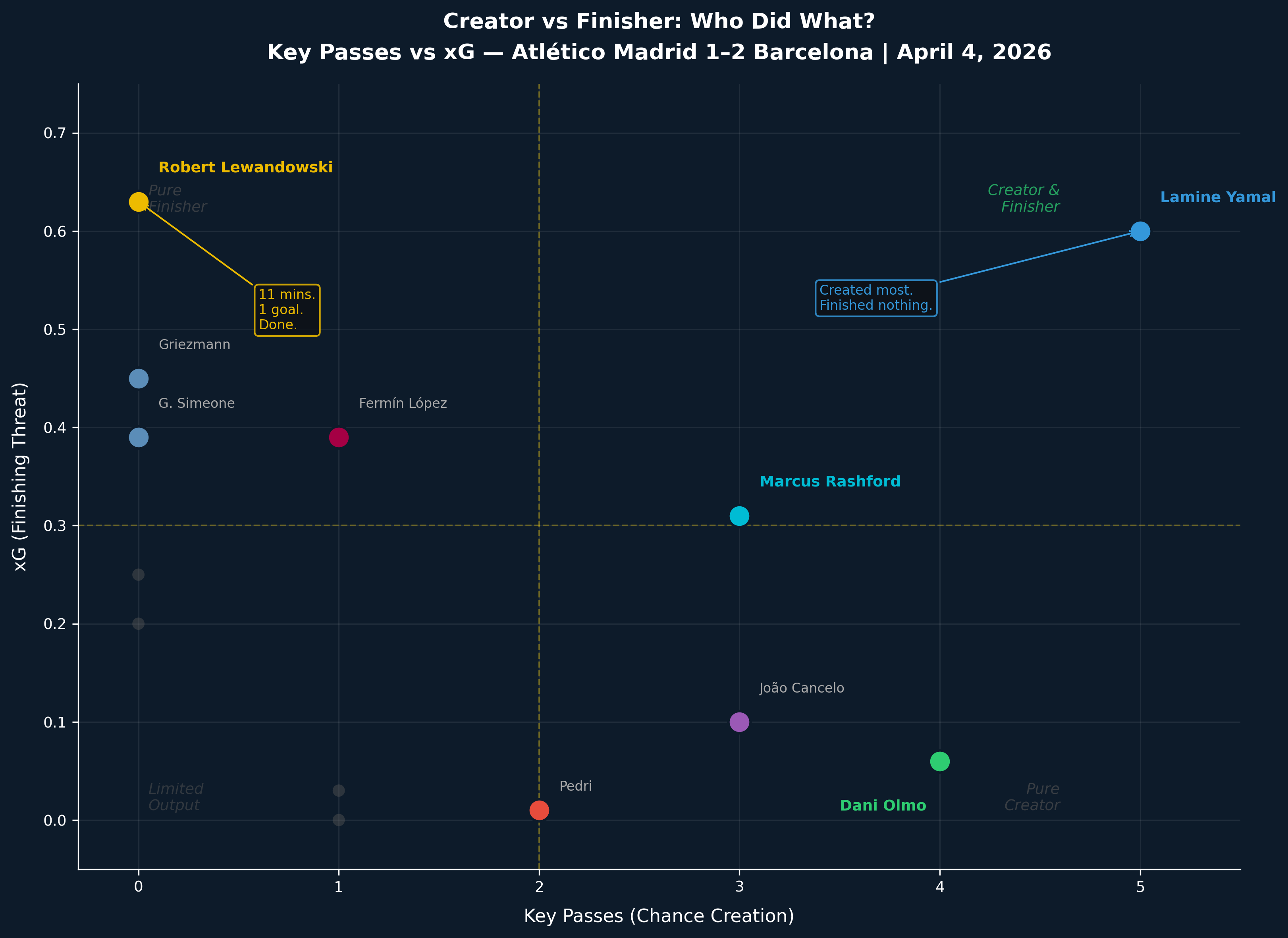
Lamine Yamal sits alone at the far right of that chart: five key passes, the highest of any player on the pitch. He hit the post, missed a big chance, generated 0.60 xG — the highest individual figure in the match. He also lost possession 27 times. More than anyone else. Both teams combined. That is the paradox of watching Yamal on a night like this: he was simultaneously the most creative and most chaotic player in the ground. Every cross failed — five attempted, zero accurate. Every run created danger. Every touch carried risk and reward in equal measure. He was the source of Atlético's greatest anxiety and Barça's greatest frustration, sometimes in the same moment.
And then there is Lewandowski's dot — alone at the top, zero key passes, 0.63 xG, one goal. He didn't create. He finished. The economy of it is almost offensive in its simplicity: come on, find the space, get it done.
Hitman extraordinaire.
But the person the data most quietly rewards is the one sitting between them: Dani Olmo. Four key passes. One assist. 87% pass accuracy. Not the goal. Not the headline. The architecture.
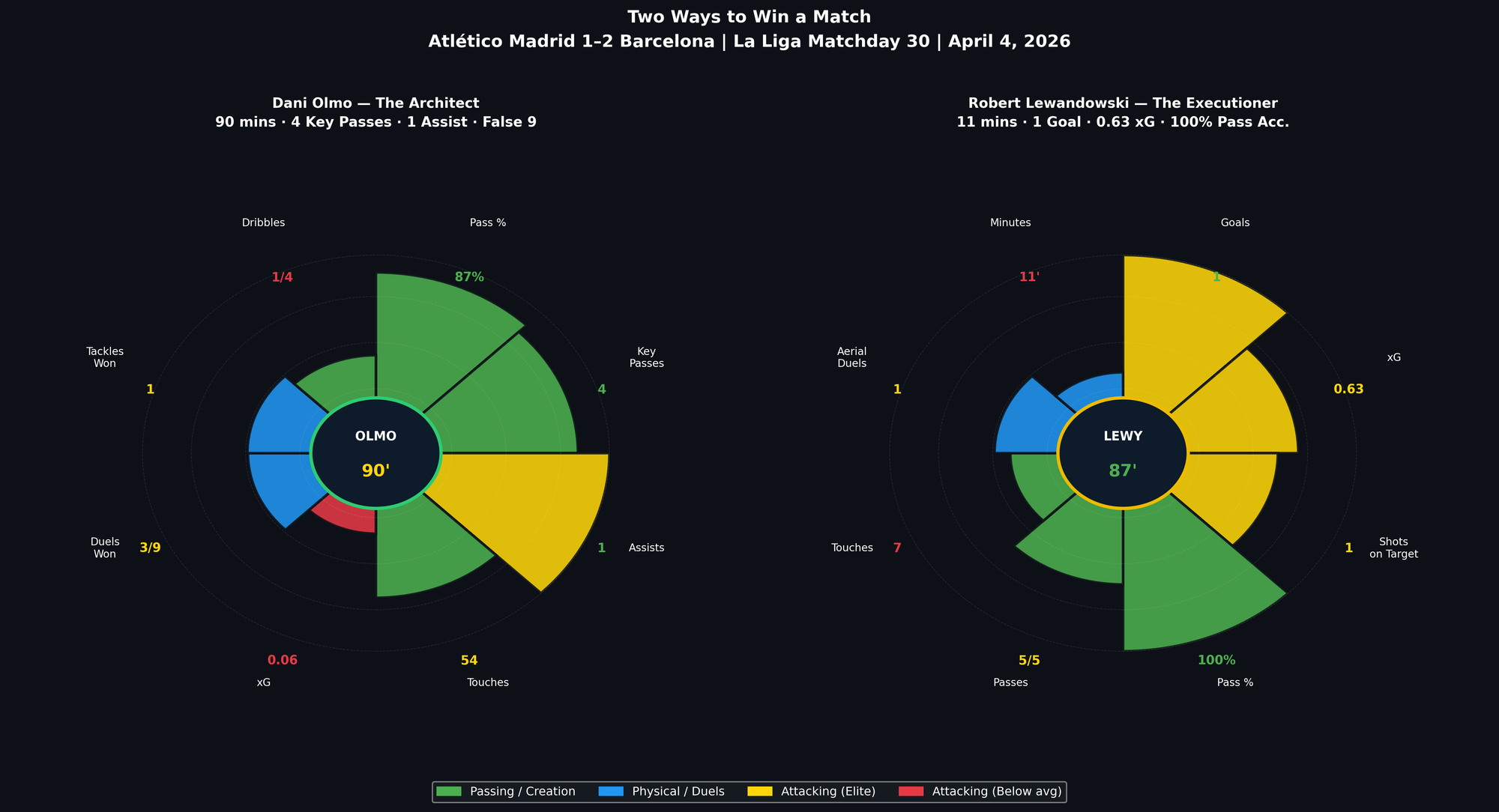
Put them side by side and the contrast is almost comic. Olmo's chart is wide and green — 90 minutes of constant involvement, key passes radiating outward, the assist wedge glowing gold. Lewandowski's is concentrated, almost spare — almost nothing except the two attacking metrics that matter most: xG and goal. He touched the ball seven times and one of them went in. Olmo touched it 54 times and unlocked the game three times over, including the pass that created the equaliser and the constant dragging of defenders out of position that gave Rashford room to finish. Neither man's contribution makes sense without the other. Olmo built the platform all evening. Lewandowski walked onto it and pressed the button.
The match statistics put everything in their final context.
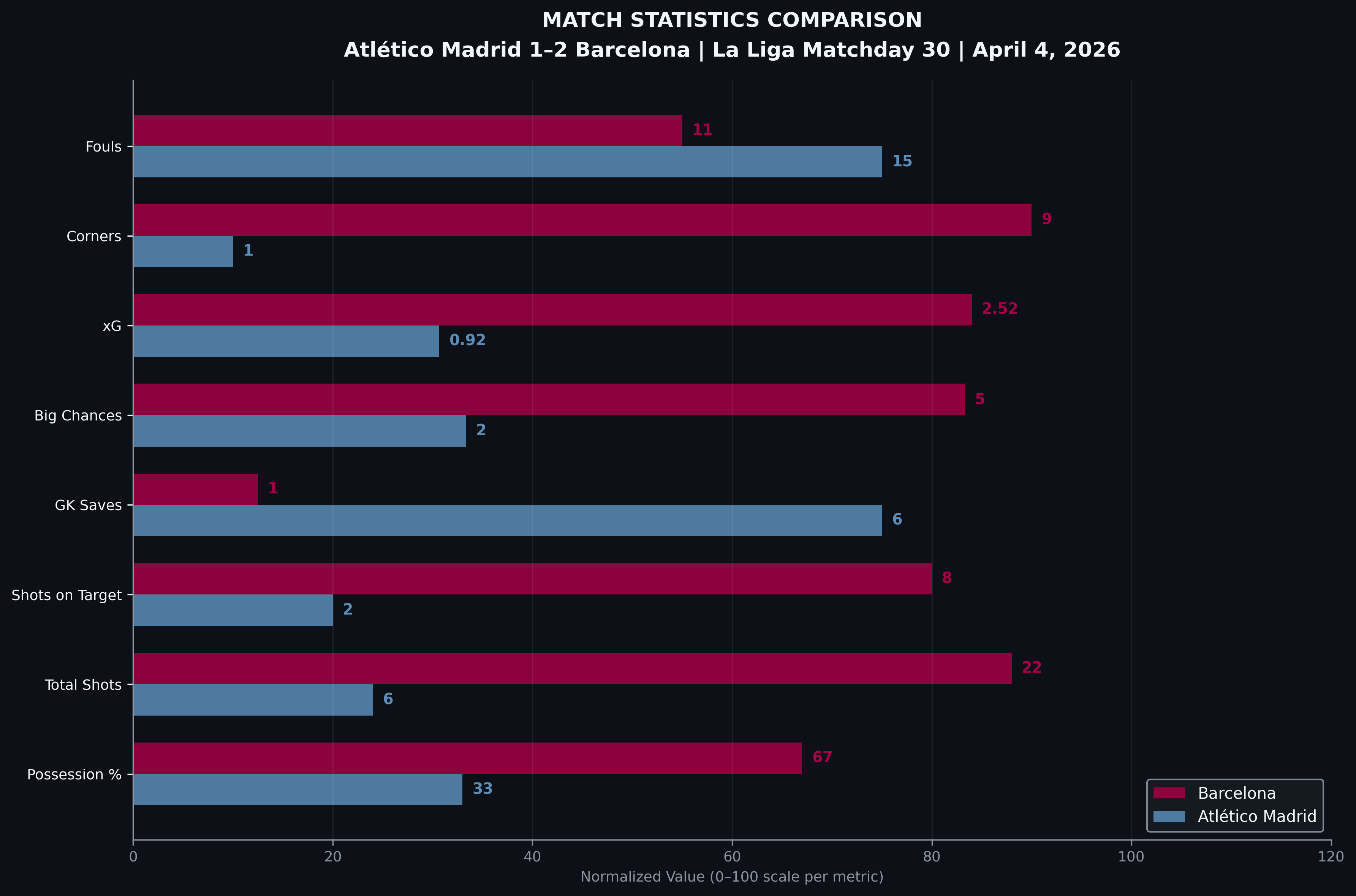
22 shots to 6. 2.52 xG to 0.92. One goalkeeper save to six. Barca played to Atleti's siege. The siege held for 87 minutes because Musso was exceptional and Atlético were organised and angry and willing to foul — 15 times to Barça's 11, six yellow cards to two. It didn't hold for 90. Sieges sometimes fail when the team on the outside is this patient and this dangerous.
When the final whistle came, Yamal was visibly angry — at the missed chances, at the post, at the crosses that went nowhere. Flick, speaking afterwards, said it was simply emotion. The emotion of knowing what this result meant. Seven points clear. Eight games remaining. The Clásico at home still to come on May 10.
On the same afternoon that a Kosovan striker wept in Mallorca, a Polish striker shouldered in a rebound at the Metropolitano and effectively almost decided a title race. Neither of them planned it that way. Football doesn't plan. Muriqi was fighting for survival. Lewandowski was doing what he has done his entire career — arriving, without fanfare, in the right place at the right moment.
But Barça cannot afford to exhale. Not yet. Not fully. They looked tired in the second half — the press not as sharp, the combinations a half-second slower, the decisions arriving a half-beat late. Against Atlético in the Champions League quarter-final on Wednesday, a half-second is a goal. Diego Simeone will have watched the entire second half with pen in hand. He has four days, a different competition, different stakes, and no obligation to protect any other result. Barça have swept Atlético in La Liga this season. Atlético knocked them out of the Copa del Rey. Three of those four games have come since February. Whatever happens at the Camp Nou on Wednesday will be the truest measure of what this team is made of — not the ability to win with eleven minutes left when the title is drifting towards them like a gift, but the ability to impose their game on the same opponent again, when there is no Muriqi doing the work five hours early in a different city.
The gift has been received. Now Barca have to do it all over again.
All match data , goal times and incidents based off reports from La Liga official, NBC Sports, and Barca Blaugranes, Wyscout and Sofascore. Muriqi/Mallorca result via ESPN and AFP/France 24. Chart data: BarcaFutbol Analytics. @Hackrlife © 2026 BarcaFutbol