Barca Won. Rayo Were Better For The Most Of It.
Rayo are not intensity merchants. Neither do they park the bus against Barça. They come to play. And more often than not, they make Barca suffer

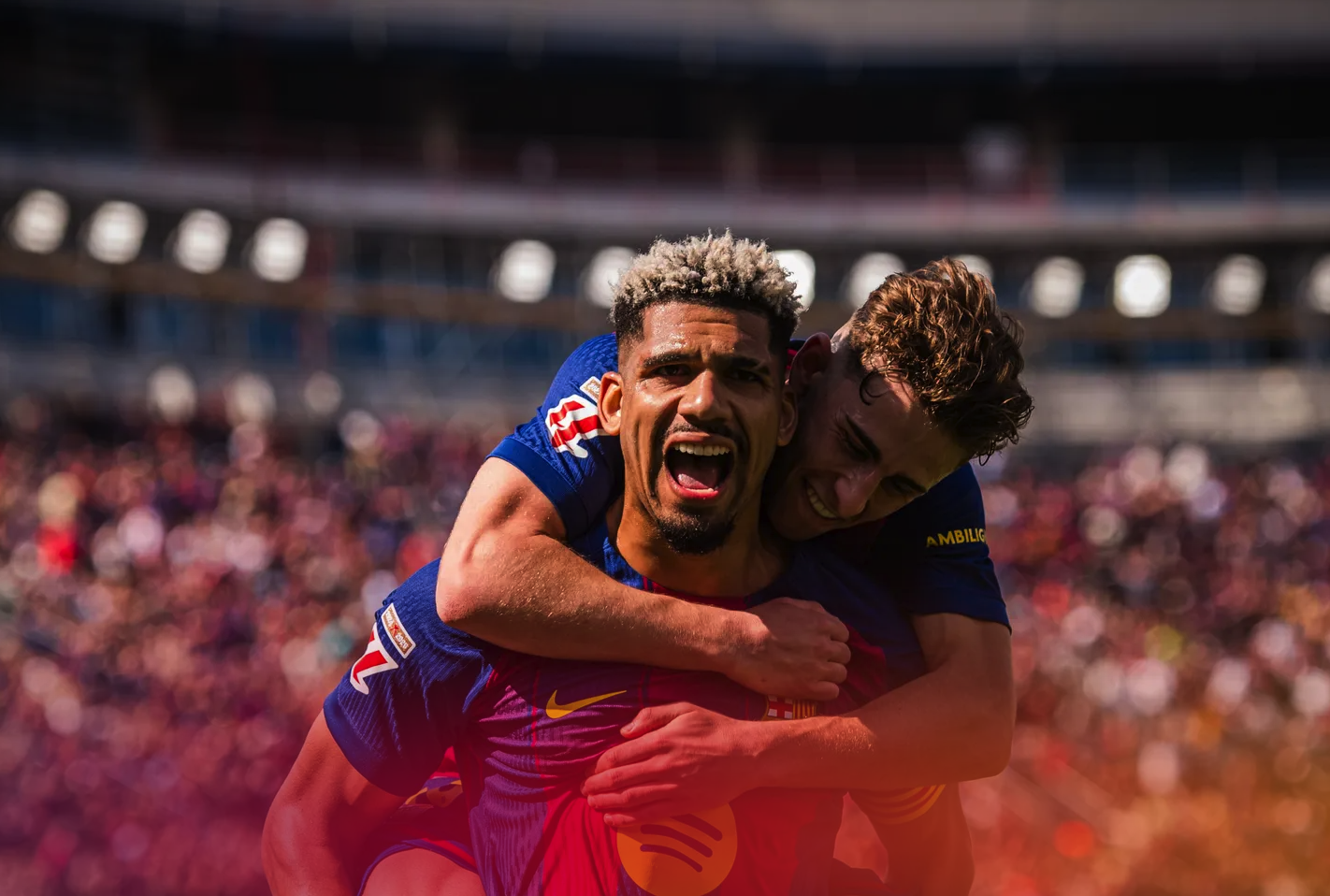
Few days ago, Barcelona dismantled Newcastle 7-2 in the Champions League. Camp Nou was humming. Flick's side looked unstoppable — fluid, ruthless, every pressing trigger firing in unison, every run timed to perfection. Then came Rayo Vallecano on a Sunday afternoon, and football reminded everyone it doesn't care about last week.
Sixty seconds. That's how long it took for Rayo to slice through Barcelona's defense and force Joan García into a point-blank save from Carlos Martín. The Camp Nou hadn't finished settling. The coffee cups were still warm. And already, Rayo had found the exact flaw they'd come to exploit.
This is what Rayo do. Every season, same story. They don't come to park the bus and absorb — they come to press high, run in behind the defensive line aggressively, and make life deeply uncomfortable in the spaces Flick's system deliberately leaves open. They've been doing it for years. And Barcelona, high on vibes and confidence after the Newcastle win, waded right into it.
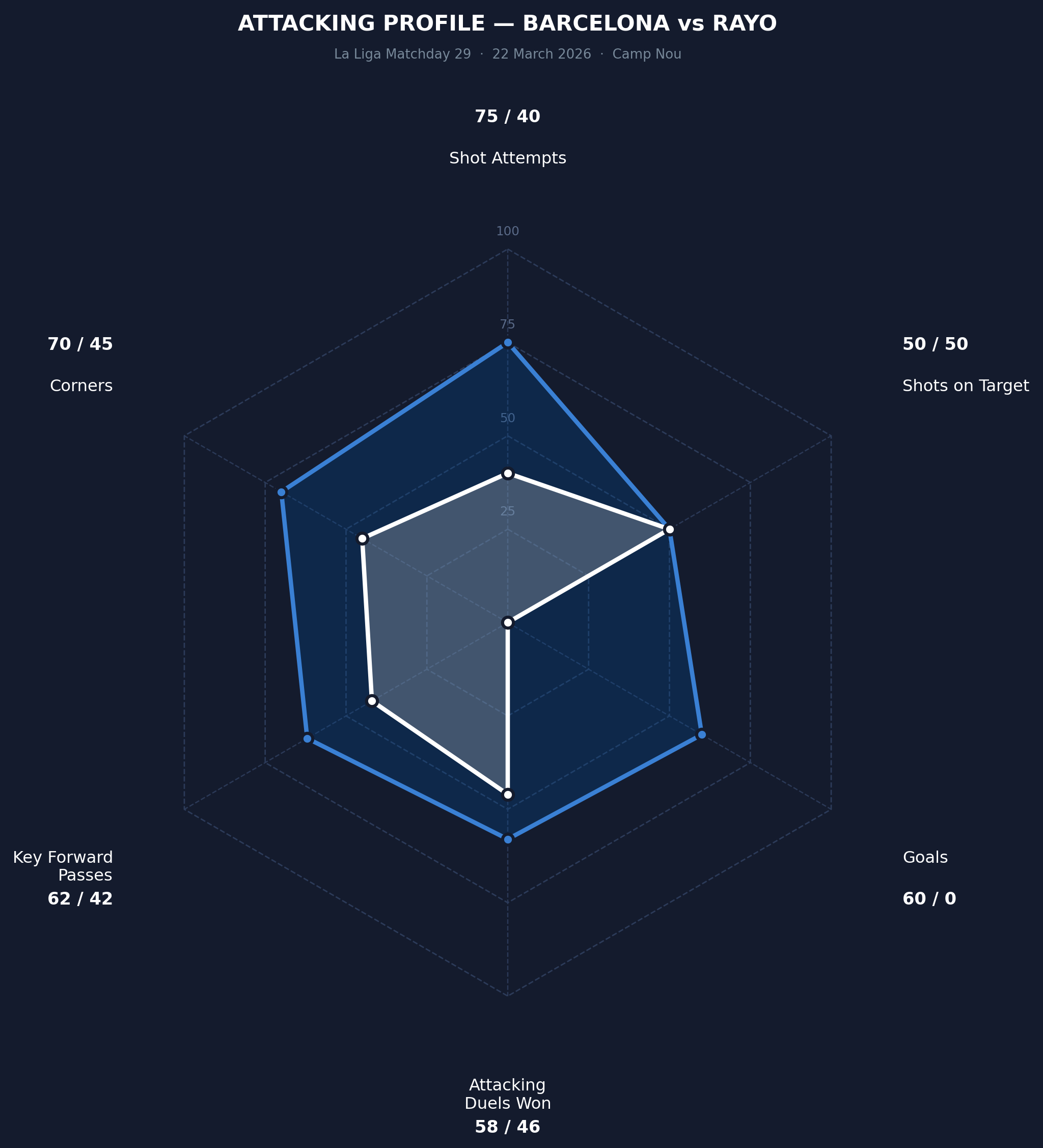
Barcelona generated more volume — 15 attempts to Rayo's 8 — but the xG story runs the other way. Rayo's chances were cleaner, better positioned, created by exploiting the exact mechanism that makes Flick's system both brilliant and brittle: the defensive setup that turns every ball in behind into a genuine crisis without the right players to master that system.
What does a team need to make Barcelona suffer the way Rayo did?
Four things: the courage to play out from the back under press, relentlessly press to win the ball high, runners who can time the run in behind a flat back four, and at least one player who can pick the key pass before Pedri or Bernal can cut the angle. Rayo had all four. For long stretches of this match, they looked like they deserved something from it.
Cancelo's Corner. Araújo's Moment.
Barça settled slowly. Raphinha went one-on-one with Batalla in the 13th minute and somehow, inexplicably, missed. Dragging his left foot across the ball, pulling it wide of the far post. The kind of miss that, in a different game, haunts you for months. Camp Nou groaned. Rayo exhaled. And for twenty more minutes it felt like one of those afternoons where the goal simply would not come.
Then Cancelo stepped up to take a corner.
The delivery was perfect — outswinging, pace on it, dropping into the six-yard channel where defenders hesitate and attackers commit. Ronald Araújo did not hesitate. One step, full commitment, a downward header that clipped the inside of the post, kissed the turf, and crossed the line. 1-0, 24 minutes.
Against Rayo at Camp Nou, you take it and you hold on.
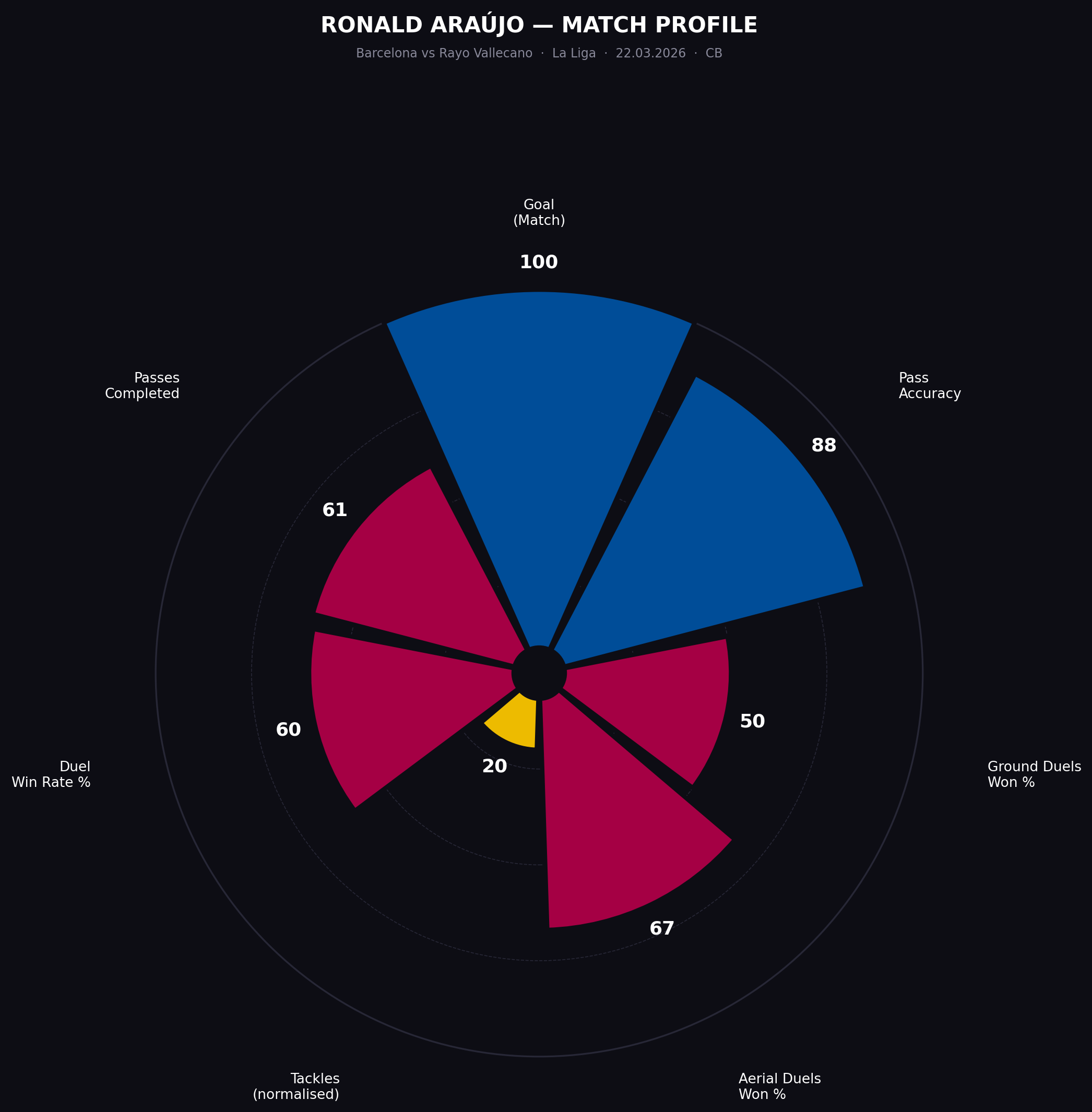
But the assist was merely the headline. Look deeper at Cancelo's afternoon and you find something more substantial: 20 duels contested — the highest of any player on the pitch. Eighteen of those were ground duels, pressing Rayo back down the flank every time they tried to build from their right side. His pass accuracy sat at 87% over 30 attempts. His defensive game is non-existent but the man is never shy of putting it all out there.
Right back, in Flick's system, is not a position for the cautious. It's a high-risk, high-reward role that requires the athleticism to get forward in support of Yamal and Raphinha, and the discipline to track back when possession turns. Cancelo, for 89 minutes, did both to the best of his capability.
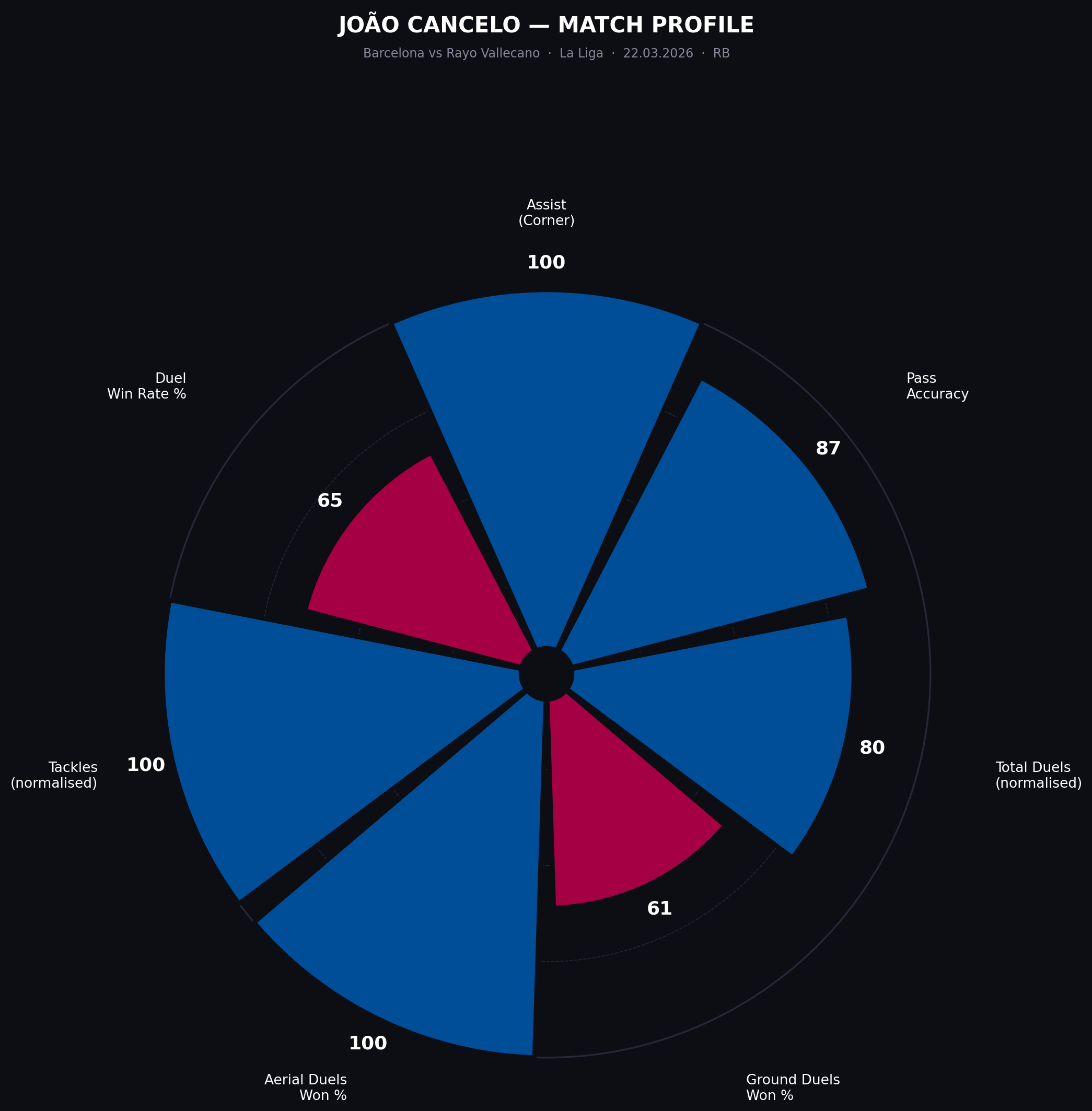
And then there was Araújo himself. The goal was the obvious headline. The rest of his performance was the real story. Six aerial duels, three won. Two ground duels won. One tackle. And above all, the organisational presence — calling runners early, dropping to cover García's sweeps, reading Rayo's delivery patterns in the second half when the pressure mounted. Araujo has had his demons and his bad days, but on this day when Barcelona's defense was being prised apart at will, Araújo was the one who kept it together.
What the Numbers Hide — and What They Reveal
61% possession. That's the number Barcelona's data team will file away, the one that appears in league tables and comparative analyses and makes Flick's side look dominant. But possession percentage, divorced from context, is a lie. What it doesn't tell you is that for large portions of the second half, Rayo had the ball in the areas that mattered more and Barcelona were scrambling.
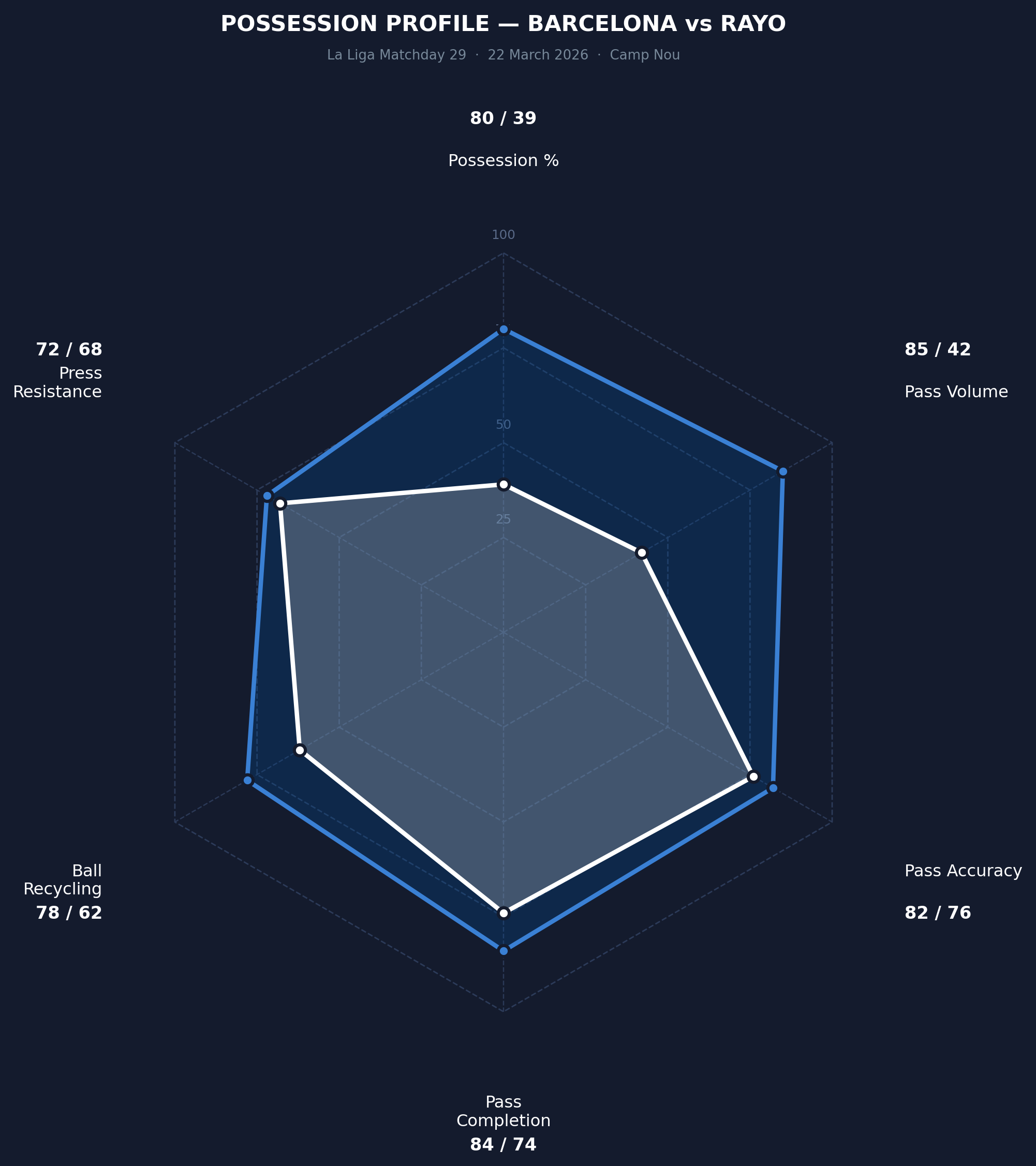
Barcelona recycled the ball more, completed more passes, kept the ball for longer sequences. But Rayo's accuracy under pressure was remarkable. 76–78% pass completion against a team that presses as aggressively as anyone in Europe. This is not a side scrapping for survival — Rayo sit comfortably mid-table, a club with a fraction of Barcelona's budget and none of their headline names. Their wage bill is a rounding error on Barca's squad. And yet here they were, moving the ball with discipline, structure, and genuine intelligence against the league leaders.
More telling still was the defensive comparison. Rayo's numbers aren't the numbers of a team that came to absorb. They're the numbers of a team that contested every duel, every challenge, every aerial ball with the ferocity of a team that plays this way every single week. This is Rayo's identity. Not survival football. Not chaos. Structured, technical, relentless — the kind of football that makes opponents uncomfortable regardless of the league table.
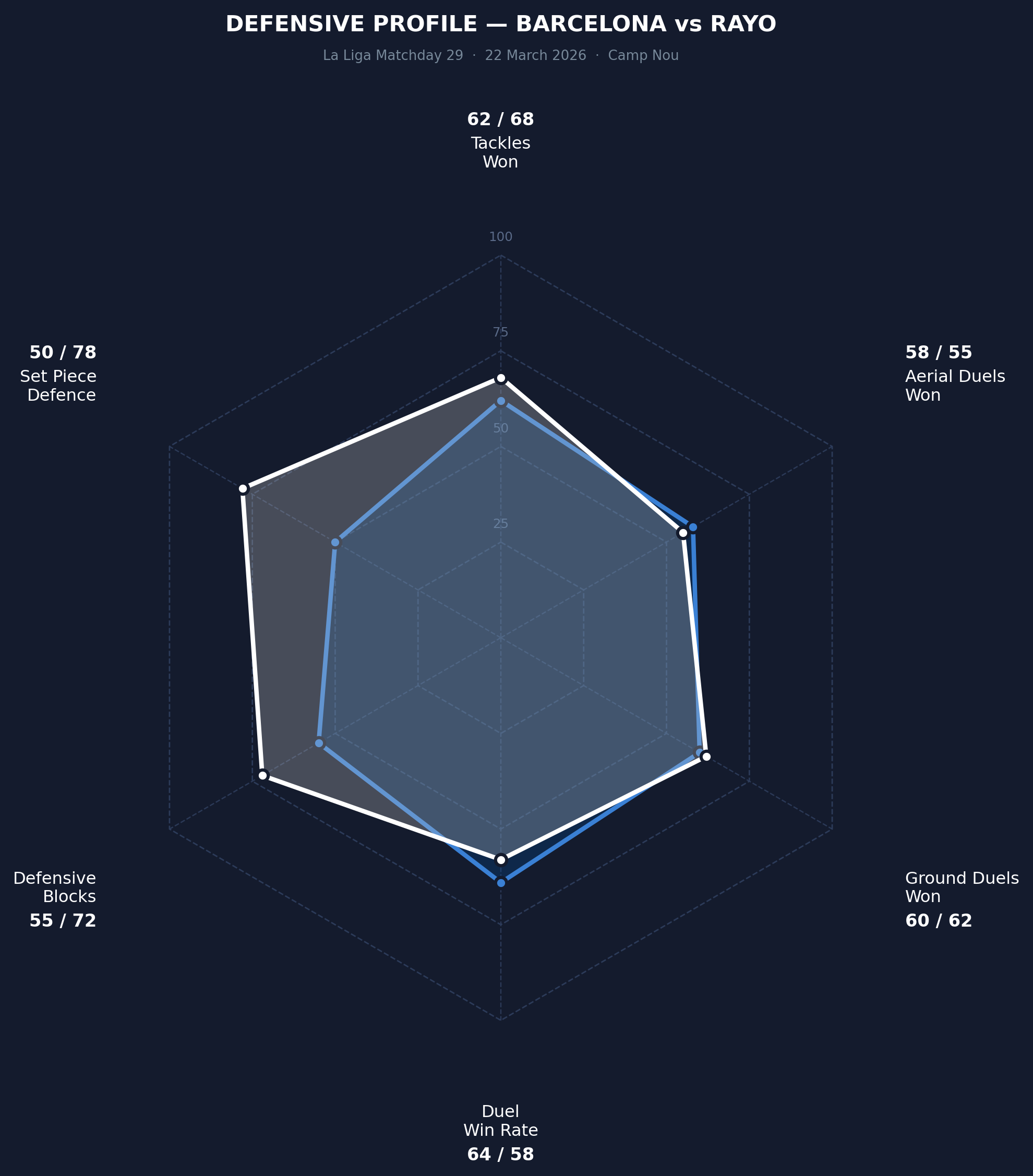
This is where the match narrative gives an idea of how organsied Ray0 were. They won more defensive duels. They were more organised from set pieces — and putting balls into the box that García has to punch, tip, claw away. Barca couldn't connect the stages of play and even sublime ballplayers like Pedri struggled to find the connections.
The question Flick will be asking during this international break: why does his side so often lose the thread against compact, physical, organised opposition that is willing to live dangerously behind the ball and explode in transition? Against Newcastle, there was space. Against Rayo, there was none. And Barcelona, for all their beauty, struggled to create without it especially in the second half.
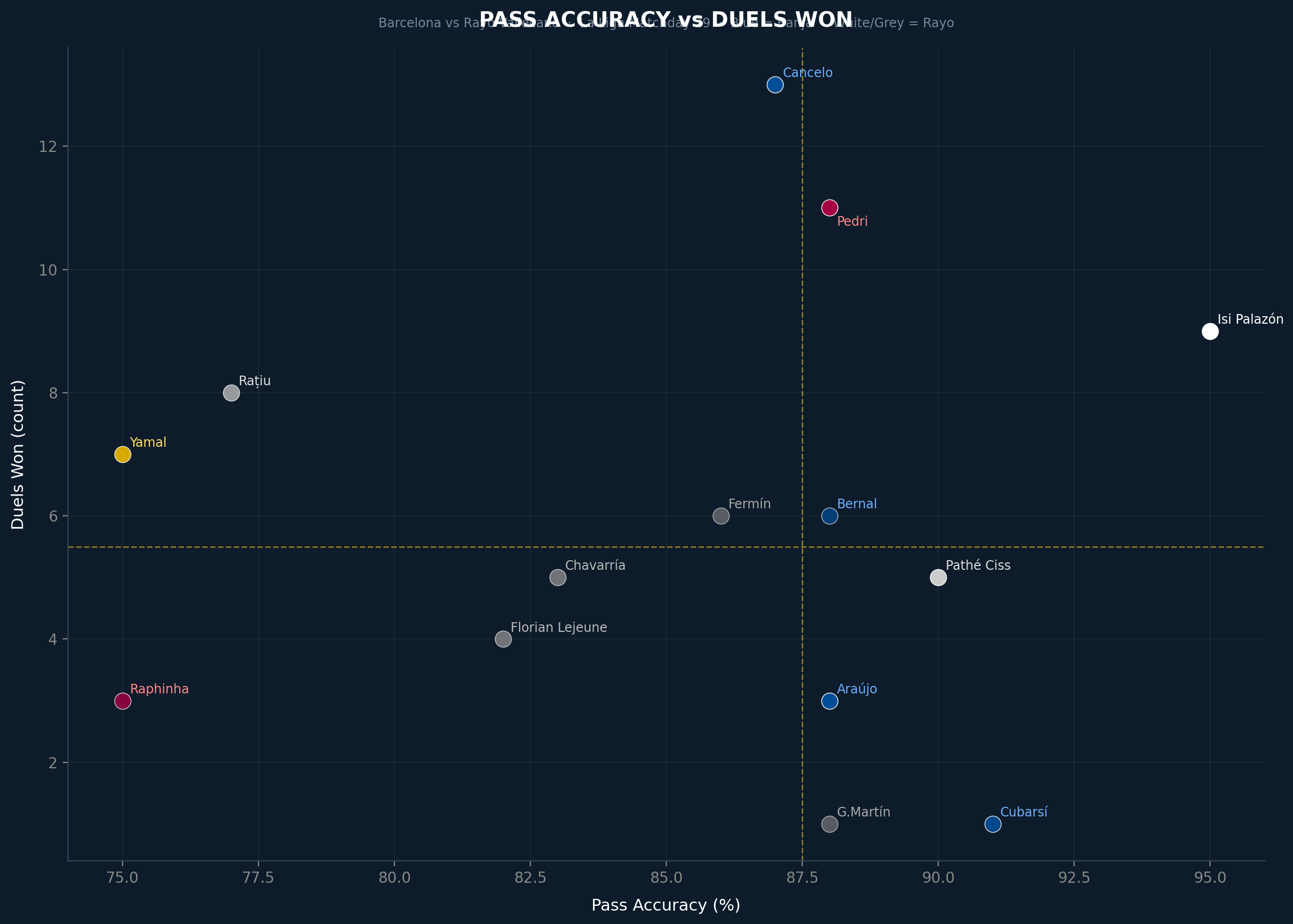
The visualisation tells you something about why this was made possible: Barca's bête noire from so many games, the remarkable Isi Palazón sits in the top-right quadrant alongside the best passers on the pitch. He wasn't the most technically gifted player in the match — Pedri and Cubarsí hold that distinction. But he was the most efficient, the most disciplined, the most effective in terms of what his team needed from him. 95% pass accuracy. 17 duels contested. 4 tackles won. That is the profile of a match-controlling midfielder who simply happened to be on the wrong side of the scoreline. In a league where the narrative is always about the top two, Palazón is the reminder that La Liga's middle tier is technically extraordinary — underreported, undervalued, and deeply difficult to play against.
The Blueprint: What Rayo Showed the Rest of La Liga
Flick's substitutions — Lewandowski off, Bernal off and Ferran Torres on — didn't change the dynamic if the match in the second half. The tempo dropped. Barcelona's midfield lost its shape. And Rayo, who had spent the first half probing, suddenly had the space and the momentum to really ask questions.
The two players who made that possible were Isi Palazón and Pathé Ciss. And both deserve more than a footnote if you want to rewatch the game.
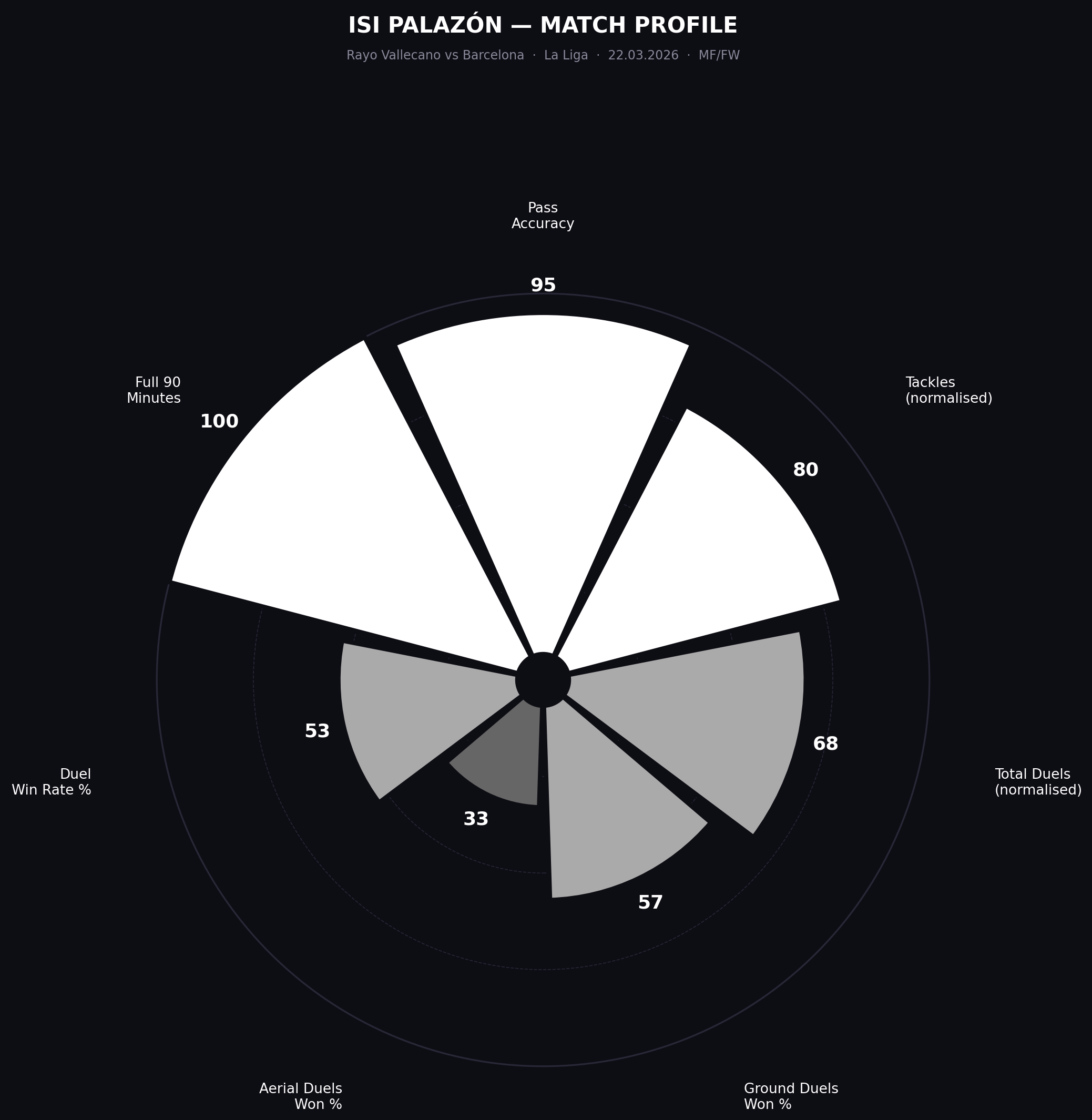
Palazón ran the game for stretches of the second half. Not flashy, not spectacular — just relentless. Pressing triggers timed precisely to cut off Pedri's usual angles. Positioning himself between Barça's lines to receive, turn, and drive. Winning duels in the middle third and winning them cleanly. He was a nuisance in the best possible sense — the kind of midfielder who doesn't get into the headlines but makes everything around him work better.
His final stat line — 95% pass accuracy across 22 attempts, 17 duels, 4 tackles won, 90 minutes — is a masterclass in positional discipline. Against a team that presses as aggressively as Barcelona, maintaining that level of accuracy requires not just technical quality but tactical intelligence: knowing when to play quickly, when to hold, when to draw the press and release.
And what a team needs, if they want to replicate what Rayo did, is someone exactly like him. A midfielder who can function as both valve and engine — absorbing Barcelona's press, recycling quickly, and releasing runners in behind before Bernal or Pedri can recover. Palazón did it repeatedly. The fact that Barça survived owes more to Joan García than to any defensive adjustment.
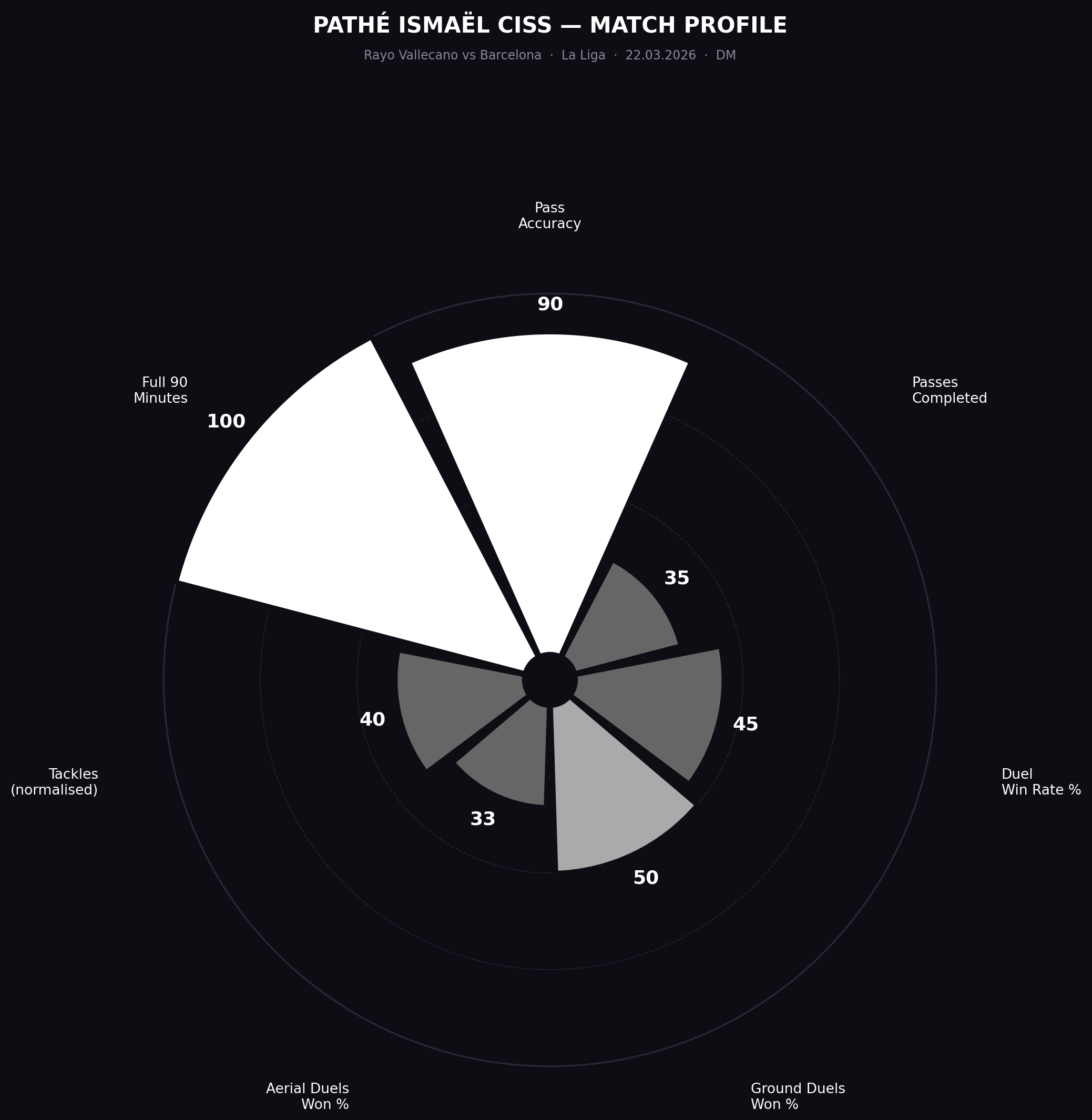
Alongside Palazón was another player who did not make the headlines. Pathé Ismaël Ciss. The Senegalese defensive midfielder who never does anything spectacular and therefore never gets mentioned. 35 of 39 passes completed. 90 minutes. 11 duels. Two tackles won.
Ciss was the spine. Every time Palazón pressed high and left space in behind, Ciss covered it. Every time Rayo lost the ball and Barcelona looked to counter, Ciss was in the lane, slowing play, forcing Barça to reset. Without him, Rayo's press doesn't work — it becomes reckless, openings emerge, and the scoreline gets ugly quickly. With him, it became a structure. A plan. Something that, for 90 minutes, gave Barcelona real problems.
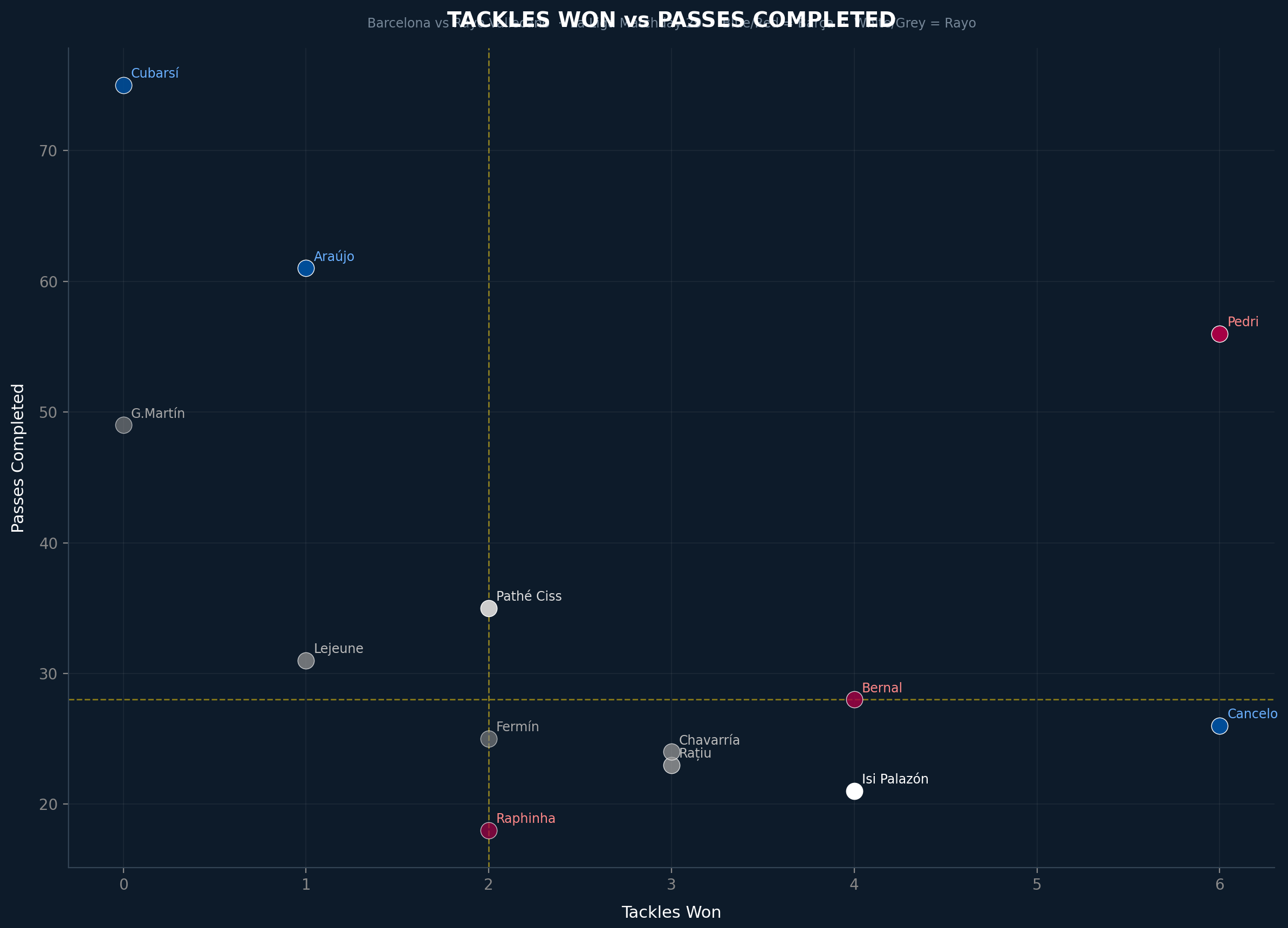
The tackles vs passes scatter crystallises it. Palazón and Ciss both sit in meaningful positions — high passing volume, active defensive contribution. In the same quadrant as Pedri. In a match against the league leaders. A mid-table club, playing their game, on their terms. La Liga clubs alway pay attention , and the blueprint is right here. It's just that some of them do not have technical profile to execute this for 90 minutes.
Joan García and the Second Half That Wasn't
Raphinha nearly doubled the lead just before half time. His shot — deflected, dangerous — forced Batalla into a flying save that pushed the ball onto the crossbar. The noise it made was enormous. Had it gone in, this becomes a different article. It didn't. And the second half that followed was a reminder of how thin the margins are at the top of any league.
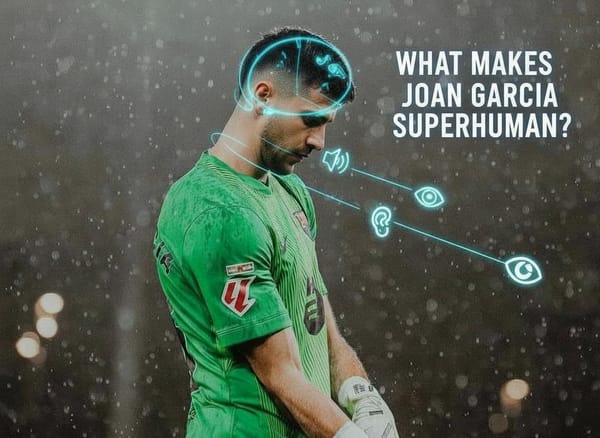
Three saves. That's what Joan García needed to make in the second half to preserve a clean sheet and, with it, three points that now separate Barça from Real Madrid. First, Álvaro García driving across goal, forcing García into a full-stretch dive. Then Unai López, arriving late at a set piece, heading cleanly towards the corner — García reading it and palming over. Then Jorge de Frutos, who'd been a threat all afternoon, cutting back and shooting low: García down, smothering. Match-winning goalkeeping. Player of the Match, and it wasn't particularly close.
Yamal was replaced in the 82nd minute by Marcus Rashford, the January signing who is still finding his rhythm at the club. Six minutes of stoppage time. Cubarsí, already on a yellow card, had to be careful. The Camp Nou was nervous in a way it never was against Newcastle. Six minutes felt like sixty.
The players who kept Rayo competitive weren't just tactically disciplined. They were athletes who ran hard for 90 minutes against the best pressing team in the division.
FC BaThat takes something.
The Title Is Barça's. Until It Isn't.
Three points clear of Madrid, who played the derby that same evening. A catalogue of goals that speaks to the relentlessness of Flick's attacking identity. All the numbers say champions-elect. All the numbers say this is done.
But die-hard Barça fans — the ones who watched every minute of this, who know every pass pattern and every pressing trigger by instinct — saw where it can get difficult. They saw a team that came off the highest of highs and then struggled, genuinely struggled, to contain a side as organised as Rayo for the better part of ninety minutes. They saw a team whose second-half performance was, in the words of Barca Blaugranes, "an abject disaster."
They saw a goalkeeper win a match that the outfield players could not.
And amidst teams in La Liga, coaching staffers also watchied this back on a loop. Noted the spaces behind the line. Noted how Rayo's two central midfielders — one pressing, one covering — dismantled Barcelona's rhythm. Noted that 4 shots on target is entirely achievable against the league leaders if you have the courage, the organisation, and two players willing to run themselves into the ground for 90 minutes.
Rayo came with a blueprint and Someone else will arrive with the same plan.
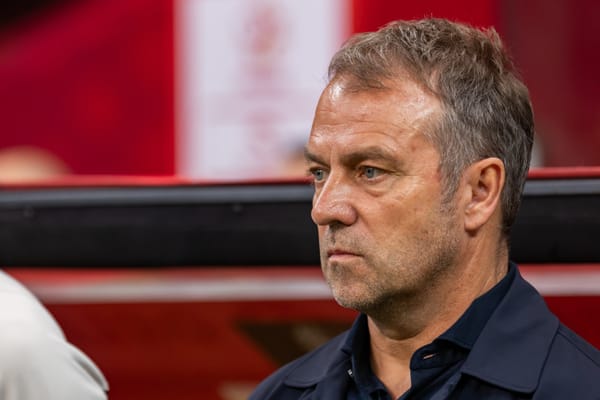
The title is Barcelona's to lose. Today, against a Rayo side with nothing to lose, it got complicated. Flick will take the three points, bank the lead, and use the international break to fix what needs fixing. He has to. Because the next team with nothing to lose will be watching every frame of this match.
And they will be ready.