The Science Behind Joan Garcia's Genius
We all know Joan Garcia is almost superhuman. But what is the actual science behind his superpowers?

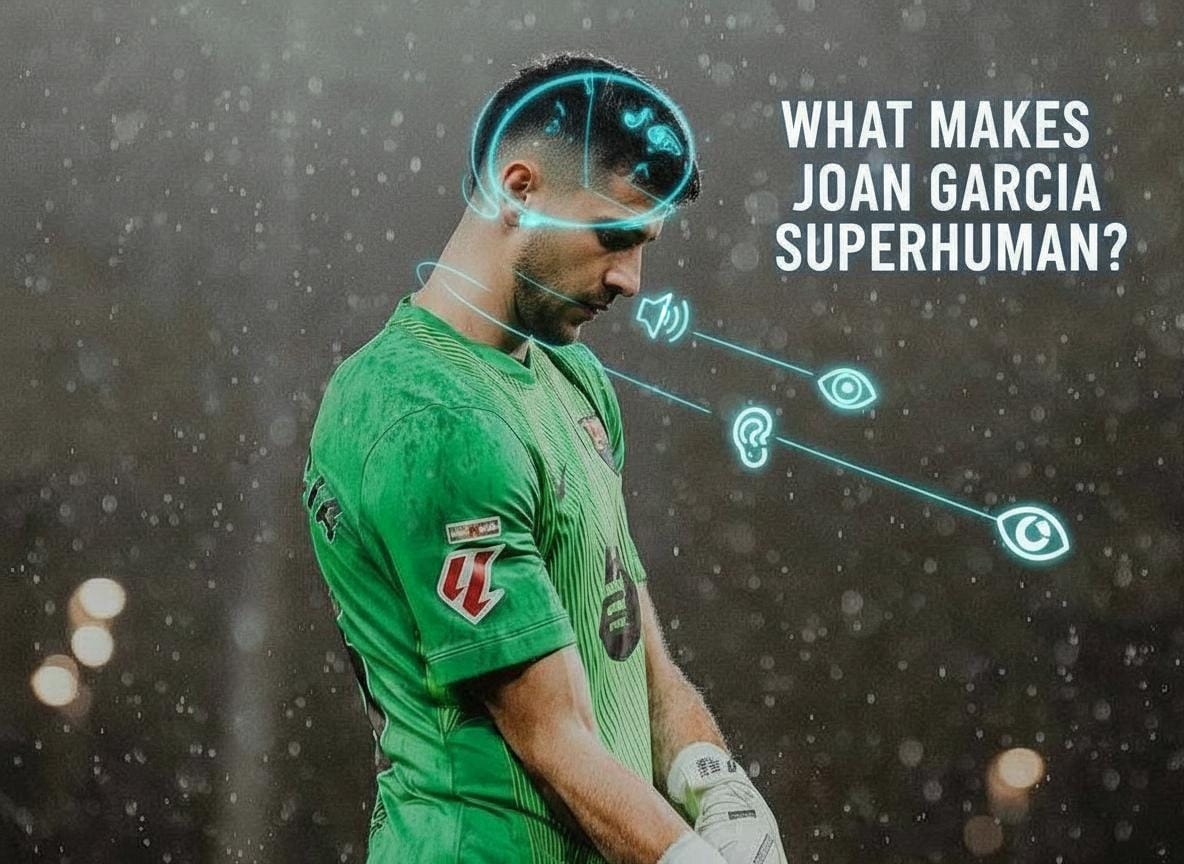
Football is a game of moments.
To be more specific, moments in your box and moments in the opposition’s. And it’s those moments that often decide who wins and who loses. Interestingly enough, when you strip goalkeeping down to its core, it too becomes a story about moments. You know, those tiny fractions of a second where the mind does the heavy lifting before the body even has a chance to catch up.
And modern neuroscience has started to show something that coaches and keepers have sensed for years but couldn’t really put their finger on: elite goalkeepers don’t just react faster. They perceive faster. They predict faster. They understand danger sooner than everyone else on the pitch. Football, after all, is played with the mind. The feet are just the tool.
The beauty of this research is that it finally puts language and structure around traits we’ve watched in keepers like Joan García but couldn’t properly explain. I mean, we obviously knew he was sharp. We also knew he had that strange calm; that presence that sends a shiver down an attacker’s spine. But neuroscience and contemporary research help us understand the why behind those instincts.
And once you see these three systems in the following sections of our analysis, you won’t be able to unsee them in García’s performances. Or in performances of other elite goalkeepers of the beautiful game, for that matter. Each one feels like a missing piece of the puzzle.
So let’s break them down one by one.
The Three Brains of Elite Goalies
Multisensory Integration: Seeing and Hearing the Game Faster
We’ll kick things off with one of the most fascinating discoveries about professional goalkeepers I’ve ever stumbled across. It turns out their brains merge different sensory cues, like the shooter’s run-up, the sound of the ball being struck or even the direction of the first bounce, much faster than outfield players. Sounds crazy but it’s actually backed by science.
A 2023 study by Quinn and colleagues in Current Biology found that elite goalkeepers fuse audiovisual information about 20–30% quicker than outfield players. In practical terms, their brains ‘lock onto’ reality sooner. In even plainer words, they pick up the threat earlier, and that gives them a fraction of a second more to decide and act. But that fraction makes all the difference.
Now, bear with me as this is tied to something called the temporal binding window. Without overcomplicating things, the TBW is essentially the tiny window of time your brain uses to combine separate sensory events into one coherent picture. Goalkeepers, for example, have a much narrower window, meaning their perception refreshes more quickly. They’re updating their internal map of the world in almost real time, with a window that is 100–200 milliseconds tighter than in other, ‘ordinary’ people.
Once you understand that, García’s style starts making a wee bit more sense. Think of those rebound saves where he seems to bounce back to his feet before the striker even reacts. Or those close-range low blocks where he doesn’t so much dive as just kind of snap into position, for lack of a better word. Only now we know those aren’t just reflex drills. They’re the natural outcome of a brain that processes chaos faster than everyone else around him.
This also explains why García thrives in all those cluttered, chaotic situations where players on TV seem nothing more than a mess of scrambles, deflections and second balls. Where many keepers freeze or overreact, he seems to see order. His brain cuts through the noise, merges the cues instantly, and gives him a clear picture of what’s coming next.
And that? That’s not luck. It’s actually his internal wiring.
Predictive Processing: Reading Attacker Intentions Before the Shot
If multisensory integration is about perceiving the world faster, predictive processing is about projecting it forward. I mean, I’m not exactly saying Garcia can tell the future from a magic ball but a 2022 paper by Gagl and his team in Frontiers in Human Neuroscience explored how elite goalkeepers don’t simply respond to what they see, they simulate what attackers are about to do. The brain runs a kind of internal model: ‘If I were striking from that angle with that body shape, what would I do next?’ It’s both impressive and a little bit crazy at the same time.
But it also explains why the very best keepers look early rather than late in 1v1s. Or why so many shots look like they are always aimed straight at them. Well, they’re not. And they’re not guessing where to go either. They’re anticipating based on these internal models. Their brains recognise patterns, posture, stride length, hip angle, shoulder tilt… All those tiny cues attackers give away without even realising. That’s where the magic happens.
But back to Barcelona’s new no.1, though. All of this describes García perfectly. When you watch him in 1v1 situations, there’s a striking lack of panic. He doesn’t get caught halfway, he doesn’t overcommit, and he doesn’t fall into the trap of reacting to the finish. Instead, he moves almost in harmony with the attacker, almost guiding the duel into his advantage. And when the shot finally comes, he’s somehow already there. And that’s when folk watching at home go: ‘Ah, that shot went straight at him. Easy save.’ Except it didn’t. And it wasn’t.
You see this in his positional discipline. García rarely gets beaten by the first fake or the first drop of the shoulder. His movement is clean and economical because his brain has already filtered the likely actions. He already played the movie several times, analysing the tape in seconds to make that clutch decision to dive this or that way, to stand his ground or to move forward. And that’s how he turns high-xG moments into saves that feel like… routine.
His +5.63 PSxG this season is just a tiny fraction of a bigger, cognitive, scientific and supernatural picture.