Femení Demolish Madrid. Raphinha gets injured and a quick look at Fisnik Asllani
Barça Femení make history again — their eighth straight UWCL semi-final. Barca double down on their moneyball approach and the dysfunctional club country debate

Fifteen-Two. Eight in a Row. The Clásico That Was Never a Contest.
There is a version of the Women's Clásico that exists in theory — fiercely contested, tactically tight, the kind of match that arrives wrapped in genuine menace and leaves you wrung out. Then there is the version that keeps actually happening, which is this: Barcelona systematically, methodically, and sometimes brilliantly reducing Real Madrid to rubble, over and over, until the scoreline stops feeling like a result and starts feeling like a weather report.
The quarterfinal second leg at the Spotify Camp Nou was watched by 60,067 spectators — the largest UWCL crowd since Barcelona hosted Chelsea at the same venue in 2023. Combined with the 6-2 first leg at the Alfredo Di Stéfano a week earlier, the aggregate reads 12-2. Including a 3-0 league win over Madrid the previous Sunday, Barcelona beat their oldest rivals by a combined score of 15-2 in nine days. At some point, a rivalry requires competitive parity to earn the name. Whatever this is, it is something else entirely.
The first leg had the look, briefly, of something the neutral might invest in. Pajor opened the scoring early, finishing calmly after a precisely weighted Putellas pass, before López's cross found Brugts to make it two — and the cushion felt like the floor, not the ceiling. Linda Caicedo, the Colombian winger who has occasionally made Barça's defensive structure look fallible, produced a moment of individual quality to cut the deficit to 2-1. For perhaps ten minutes, Madrid had a pulse.
Irene Paredes ended that. The veteran centre-back arrived late at a Claudia Pina corner, her movement unmarked, her finish clinical — the kind of set-piece execution that has become a recurring feature of Barça Femení's attacking repertoire. Pajor struck again, Graham Hansen set up López for a fifth, and Putellas converted a late penalty to seal a first leg that was more emphatic than even the final scoreline suggested. Caicedo's second goal came in that strange territory where matches are already decided but must still be completed.
The tie was, functionally, over. The second leg existed to confirm the arithmetic.
Romeu's system at Barcelona Femení tends to operate from a base 4-3-3 that morphs into a wider overload in possession — a structure designed to stretch opposition midfields and create numerical superiority in the half-spaces. Against Madrid at Camp Nou, the mechanism was legible from the first minute. Patri Guijarro anchored the build-up as the deep pivot while her midfield partners rotated around her, drawing Madrid's press before releasing the ball into the channels. Pressing from the front line is central to how Romeu's side defends without the ball — Pajor led the chase, Brugts and Graham Hansen stayed wide to pin the full-backs, and every time Madrid attempted to play through the lines, a Barça midfielder was there first. The defensive shape held equally firm: a high line, sharp triggers, and the kind of collective structure that Madrid's transitional game could find no entry point into. By half-time, the contest was over. What remained was execution.
What no one quite anticipated was the manner in which confirmation would arrive. Barcelona Femení returned to the renovated Camp Nou for the first time, and the club marked the occasion with a performance of almost insulting authority. There was no creeping into the match, no respecting the occasion's gravity at the expense of intent. Putellas, Graham Hansen, Paredes and Pajor all found the net before half-time; Graham Hansen and Brugts added two more after the break. Madrid — suffering what ESPN confirmed as their 24th defeat in 25 meetings with Barça — could find no way back across the entire 90 minutes.
But the night — and it should be said plainly, because it deserves it — always belonged to one person.
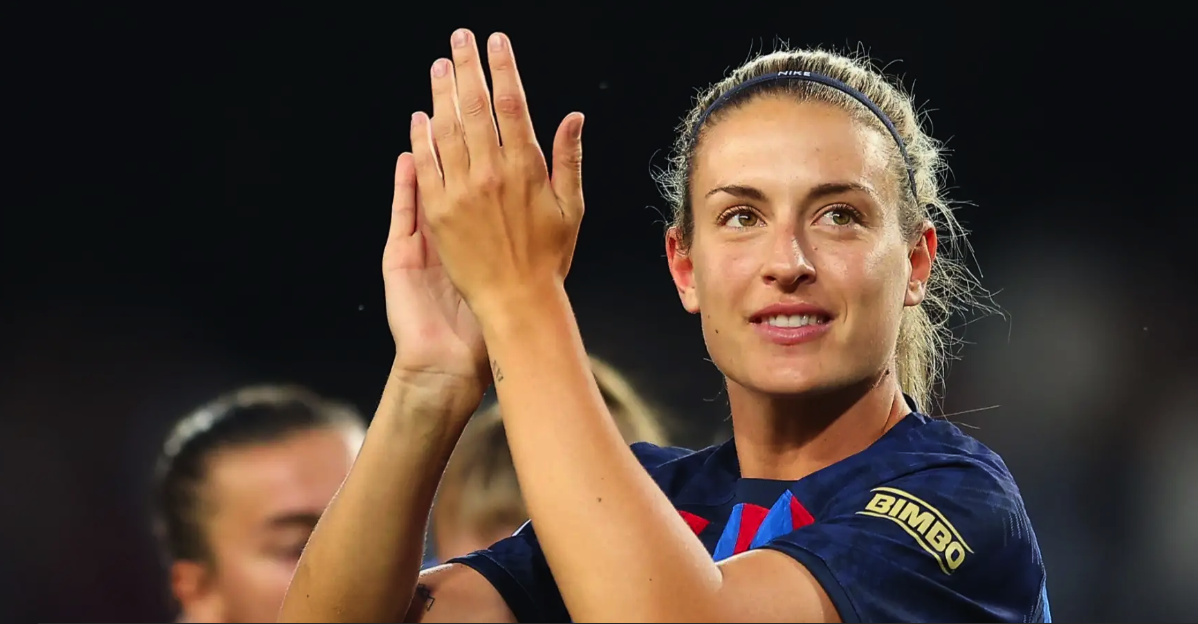
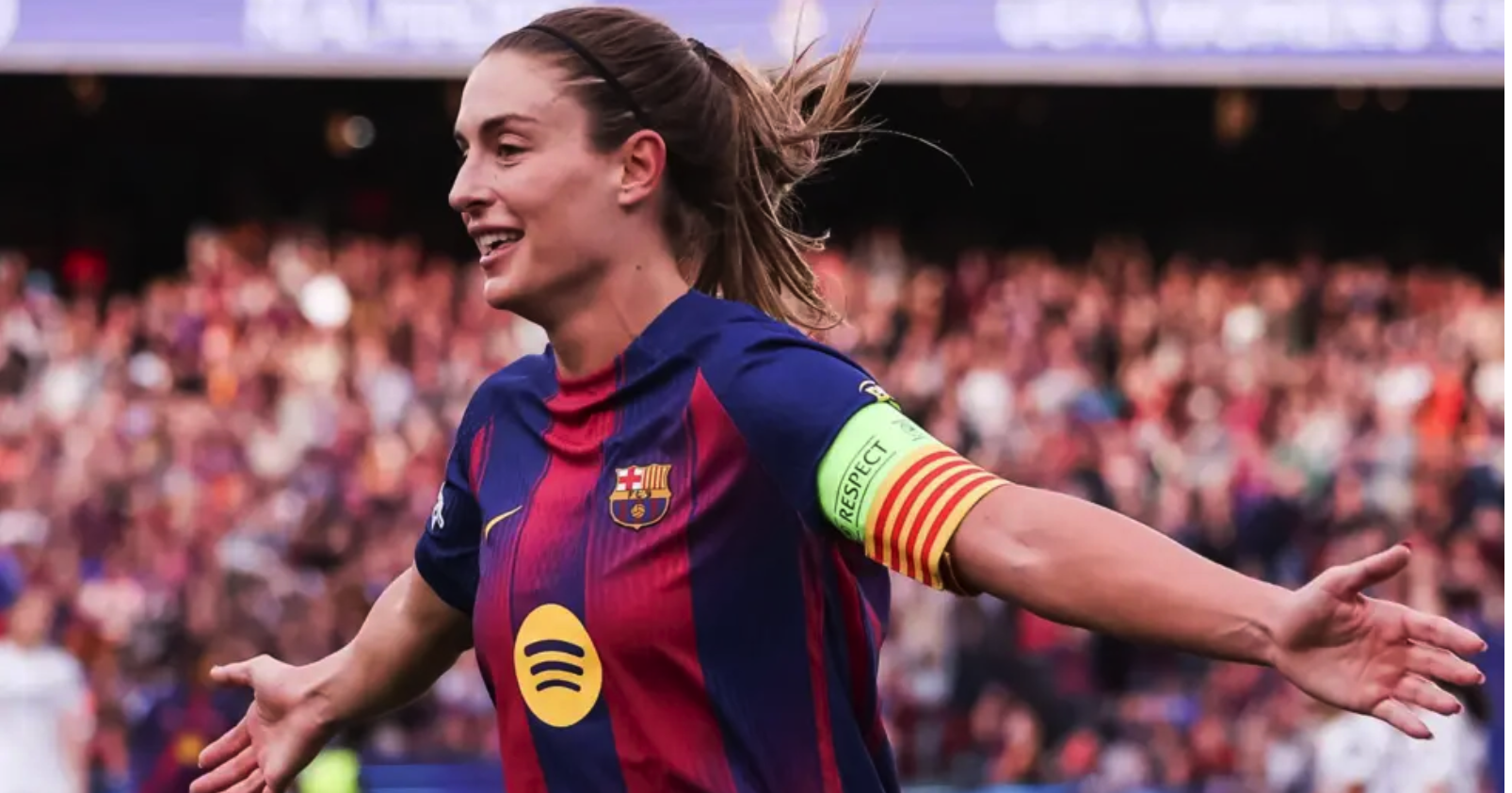
Alexia Putellas took the field at the Spotify Camp Nou for her 500th appearance for Barcelona Femení, and within eight minutes, she had scored. Not in a showy, contrived way. Not in the way of someone playing to a script. She reacted to a rebound after Pajor's attempt from the left of the box was saved, pressed her advantage before the goalkeeper could reset, and finished with the composure of someone who has spent 15 years converting exactly these situations. The Camp Nou erupted in the manner of a stadium that understood it was watching a landmark.
She is now just 16 matches from overtaking Melanie Serrano as the club's all-time appearance leader. She is the club's most decorated player, with 35 trophies lifted as captain, and the all-time leading scorer — her goal on Thursday night her 230th for the club. With it, she became the first Spanish player to reach 30 goals in Women's Champions League competition. These are not statistics — they are, in aggregate, the biography of a player who rebuilt herself after a serious knee injury, returned to win more than she had won before, and kept accumulating at an age when many players had already begun their second careers.
That she did it on this stage — a UWCL Clásico at Camp Nou, 60,000 watching, her team sweeping Madrid aside with the kind of ease that makes you wonder whether the scoreline was even a full expression of the difference in quality — felt scripted in the way that life occasionally, generously, offers to those who have given the most to a club. She left the pitch late on to a standing ovation, having scored and created throughout an evening that was, in every meaningful sense, hers.
If Putellas provided the emotional centrepiece, the structural work of the victory was distributed across a squad that has developed extraordinary collective depth.
Caroline Graham Hansen was exceptional across both legs. The Norwegian winger, whose combination of pace, directness and technical precision makes her one of the hardest assignments in European women's football, scored twice on Thursday — opening from close range in the 15th minute, then producing a delicate chip over the goalkeeper in the 55th. She also provided the corner from which Paredes headed the third, demonstrating that her contribution to Barça's attacking patterns extends well beyond her own goal tally.
Irene Paredes has become one of the most quietly underrated attacking threats in European football from set-piece situations. Her header from Graham Hansen's corner for the third goal was the product of intelligent movement and split-second timing — qualities that don't appear in a box score but define how dominant sides are built. Across both legs, her work at dead balls was consistently one step ahead of Madrid's defensive organisation.
And Ewa Pajor. Her goal in the second leg was her seventh in the Champions League this season, and her 40th in European club competitions — a remarkable accumulation for a player still in the relatively early stages of her peak. Across both legs she scored three times, and her off-ball movement — dragging centre-backs out of position, creating the spaces through which Putellas and Guijarro operated — was as valuable as anything she put in the net.
Barcelona will face Bayern Munich for a place in the Oslo final on May 23, having beaten the German champions 7-1 when the two sides met in the competition's league phase last October. The record books offer a caveat — league-phase encounters carry a different pressure to knockout football — but there is nothing in the current landscape of the women's game that suggests Bayern can impose themselves on a team playing at this register.
Barcelona topped the UWCL league phase unbeaten, with 20 goals scored and just three conceded. That is not the profile of a team that requires good fortune to advance. They lost last season's final to Arsenal — a defeat that left a mark on a squad that measures itself against the highest possible standard. The hunger to reclaim what was taken from them is not decorative. Eight consecutive semi-final appearances is a record, and records are the kind of thing this squad treats with polite indifference. The real objective is the trophy, and they are four games from it.
Fifteen goals scored against the same opponent across nine days. Sixty thousand at Camp Nou for Femení's return to the renovated stadium. An eighth straight semi-final. And Alexia Putellas, in her 500th game, scoring in the eighth minute.
Some weeks, the numbers do all of the talking.
Who Is Fisnik Asllani? The €30M Bundesliga Striker Barcelona Are Keeping Tabs On
A deeper look at the Hoffenheim forward who wants to play for Barça — and why Flick and Deco think he might actually fit.
The whisper became a rumour. The rumour became contact.
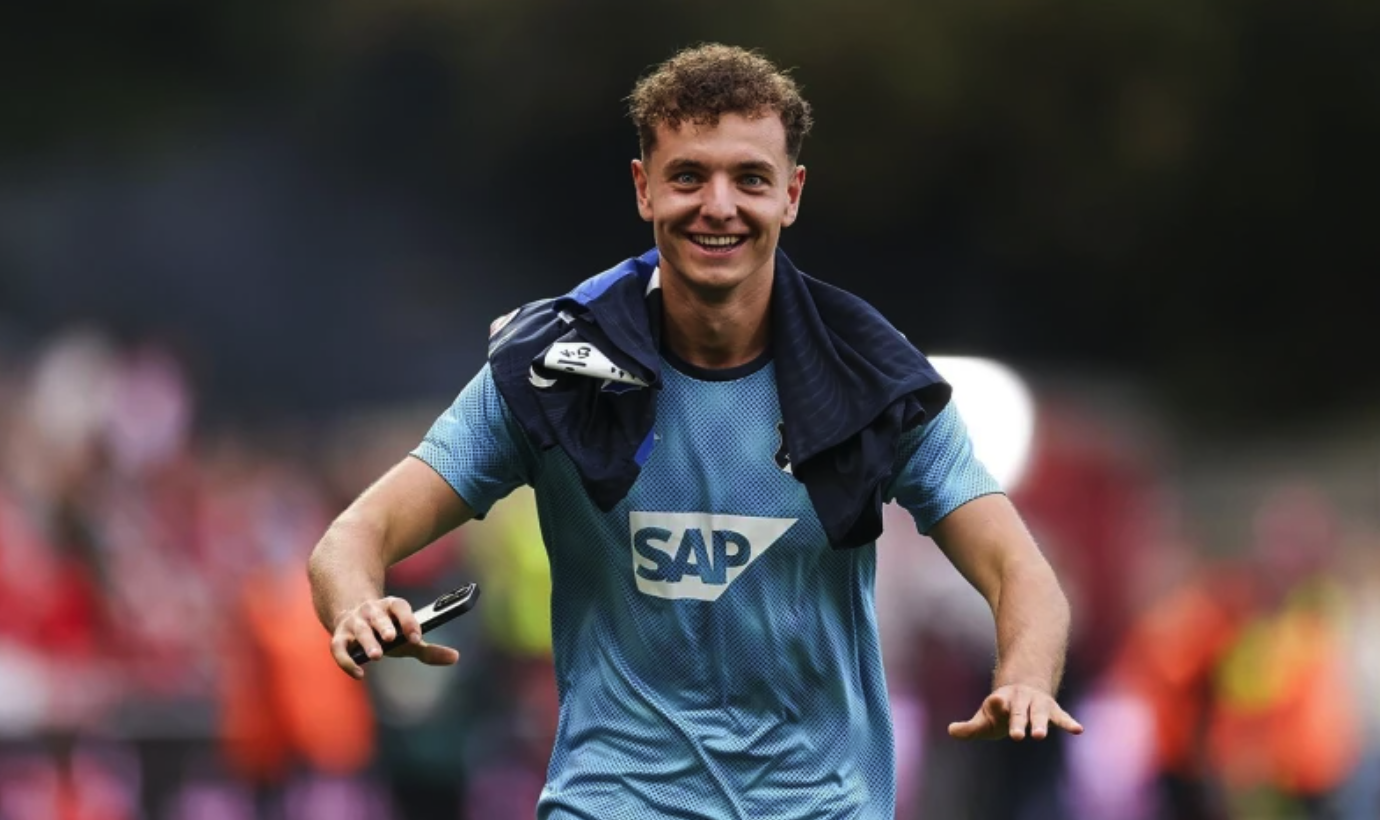
In late March 2026, Fisnik Asllani's agent Ayman Dahmani confirmed to Erem News what had been circulating in German and Spanish football circles for months: "Barcelona's interest in the player is valid, and there has been contact from the Catalan club." Sky Germany's Florian Plettenberg had already confirmed that Hoffenheim's 23-year-old striker carries a written release clause — somewhere between €25 and €29 million depending on the buying club — and that Barcelona have been fully briefed on its terms. Bayern Munich stepped away earlier in the year, deciding he didn't fit their immediate planning. The runway, for now, is clear.
This is not a speculative transfer link. This is a club identifying a very specific archetype — modern, mobile, technically sophisticated, affordable — and working quietly to understand whether it can be acquired. The question worth answering is not whether Barcelona are interested. It's whether Asllani is actually good enough, and whether he fits the system Hansi Flick has built. This piece attempts to answer both.
Background and the Career Arc
Born in Berlin in August 2002 to Albanian parents who had fled Kosovo shortly before his birth, Fisnik Asllani began his football life at BFC Dynamo before joining Union Berlin's academy as a teenager. At 17, Bayern Munich came calling. By his own admission, he spoke with youth coach Sebastian Hoeneß before deciding against the switch — he wasn't sure he was ready for a club of that size. A year later he was a Hoffenheim player instead. What followed was a slow, patience-demanding development curve disrupted by a swollen pubic bone, then ankle and knee injuries that limited him to just ten first-team appearances across two Bundesliga seasons without a senior goal to show for them.
The loan to Austria Wien in 23/24 produced four goals in 19 appearances — modest, but enough to suggest the engine was finally running. It was the 2024/25 loan to SV Elversberg in the 2. Bundesliga that changed everything. He scored 18 goals and eight assists in 33 league appearances — no player in the entire 2. Bundesliga contributed to more goals across the whole campaign. He returned to Hoffenheim in the summer of 2025 a different animal, signed a contract extension to June 2029, and was immediately handed a starting role in the Bundesliga.
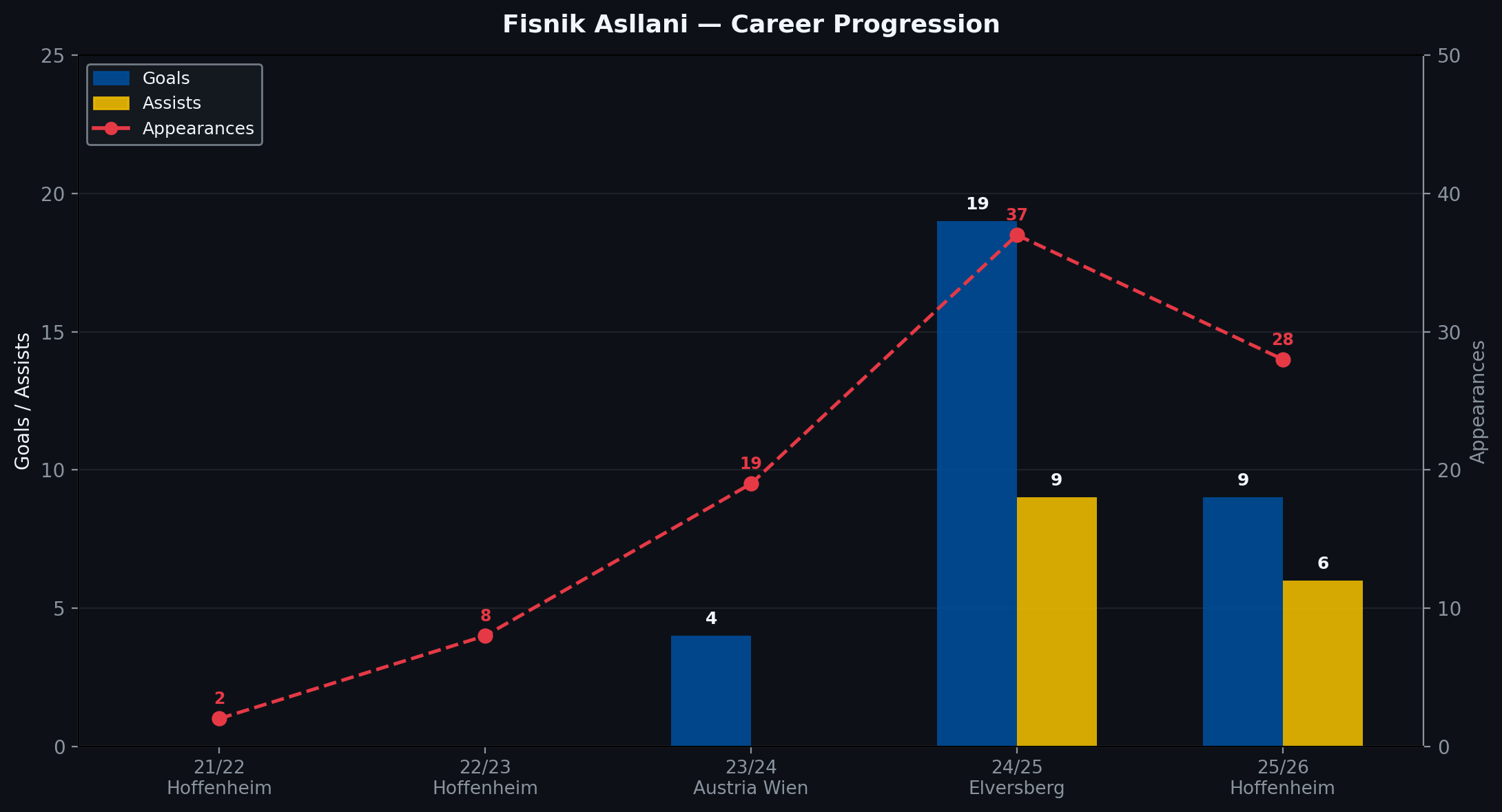
The step from the second division to the Bundesliga is not trivial. Many players who demolish the 2. Bundesliga disappear when the intensity ratchets up. Asllani has not disappeared. In the 2025/26 Bundesliga season, he has registered eight goals and five assists across 26 appearances in approximately 1,806 minutes — a combined goal contribution every 139 minutes. His FotMob average rating of 7.09 places him among Hoffenheim's most consistent performers. He opened the season with a brace in a 4-2 win over Union Berlin, scored against Leverkusen, against Freiburg. He has not folded when the matches have mattered.
Overall Statistical Profile
Overall Profile — vs Bundesliga Forwards, Per 90 | 2025/26 | Blue = above average (≥50th pct) | Purple = below average (<50th pct)
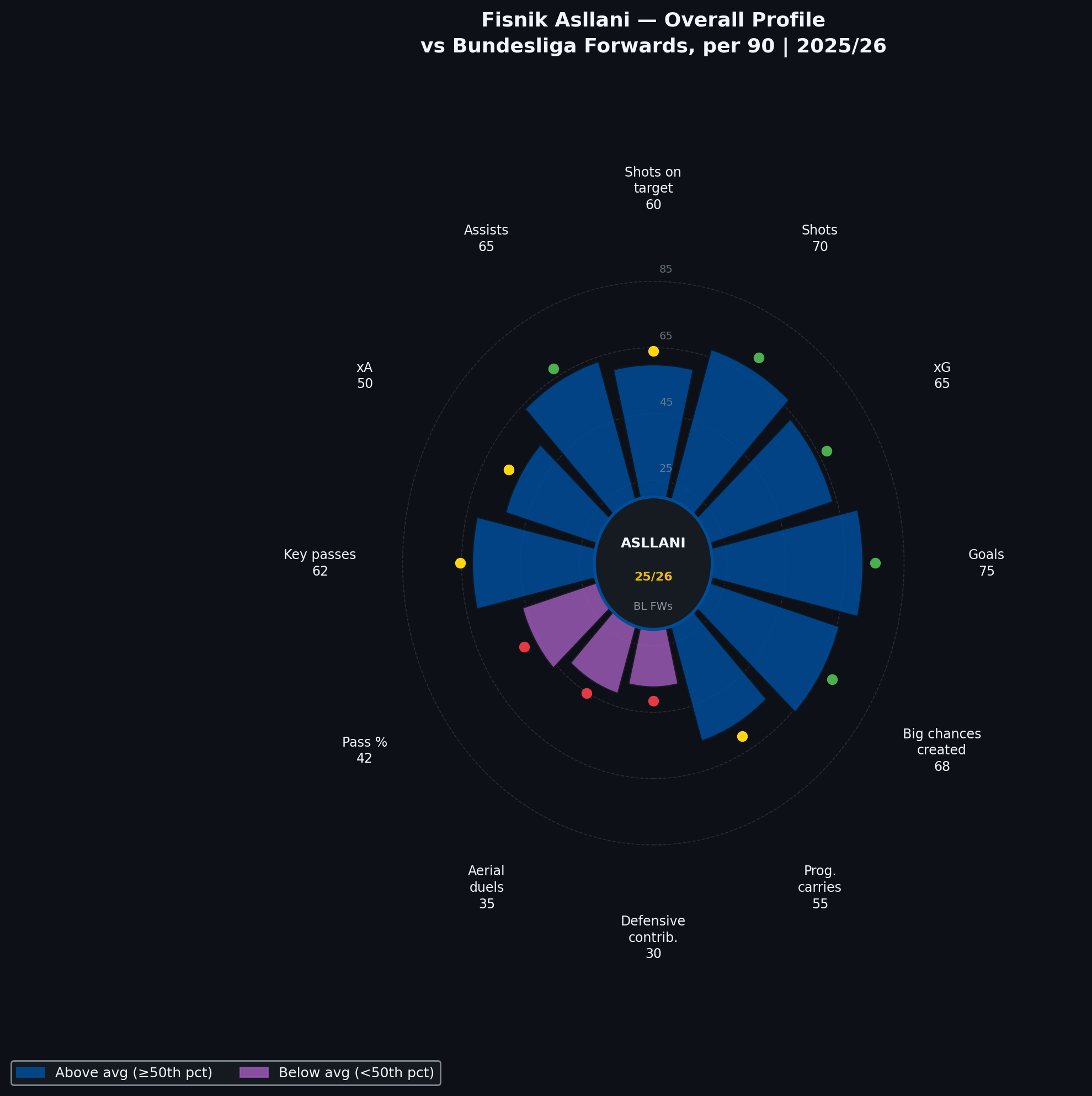
The overall percentile pizza, benchmarked against Bundesliga forwards per 90 minutes in 2025/26, tells a story that is both encouraging and honest about where the gaps are.
His offensive production grades well above average. At 0.4 goals per 90 and an xG of 0.30, he is converting at a rate that slightly exceeds his expected output — a sign of clinical efficiency rather than statistical fortune. His shot volume of 2.8 per 90 and shots on target of 1.1 per 90 sit around the 60th-70th percentile for Bundesliga forwards — meaningful, not elite. Big chances created at 0.3 per 90 grades above average, suggesting he is not purely a finisher but a player who generates quality moments for others.
His passing and possession metrics are more mixed. A pass completion rate of 68.5% in the Bundesliga grades around the 42nd percentile for forwards — which sounds alarming but requires context. Asllani plays in a system that asks him to operate in high-pressure zones where completion rates are inherently lower. He attempts 16.6 passes per 90, a moderate volume. His long ball accuracy at 62.5% is reasonable. The concern is that his passing profile skews functional over creative — he does not generate progressive passes or through balls at the rate a possession-obsessed coach demands as standard.
The clearest weakness is his defensive contribution. Tackles at 0.6 per 90 and interceptions at 0.3 per 90 place him in the bottom third among Bundesliga forwards — confirmed by WhoScored's algorithmic assessment, which flags "defensive contribution" as an explicit weakness alongside "holding on to the ball." In a system that demands the number nine be the first line of a team's defensive shape, this matters and should not be minimised.
Shooting and Attacking: The Final Third Operato
Shooting & Attacking Radar — Per 90 Percentiles | Bundesliga 2025/26
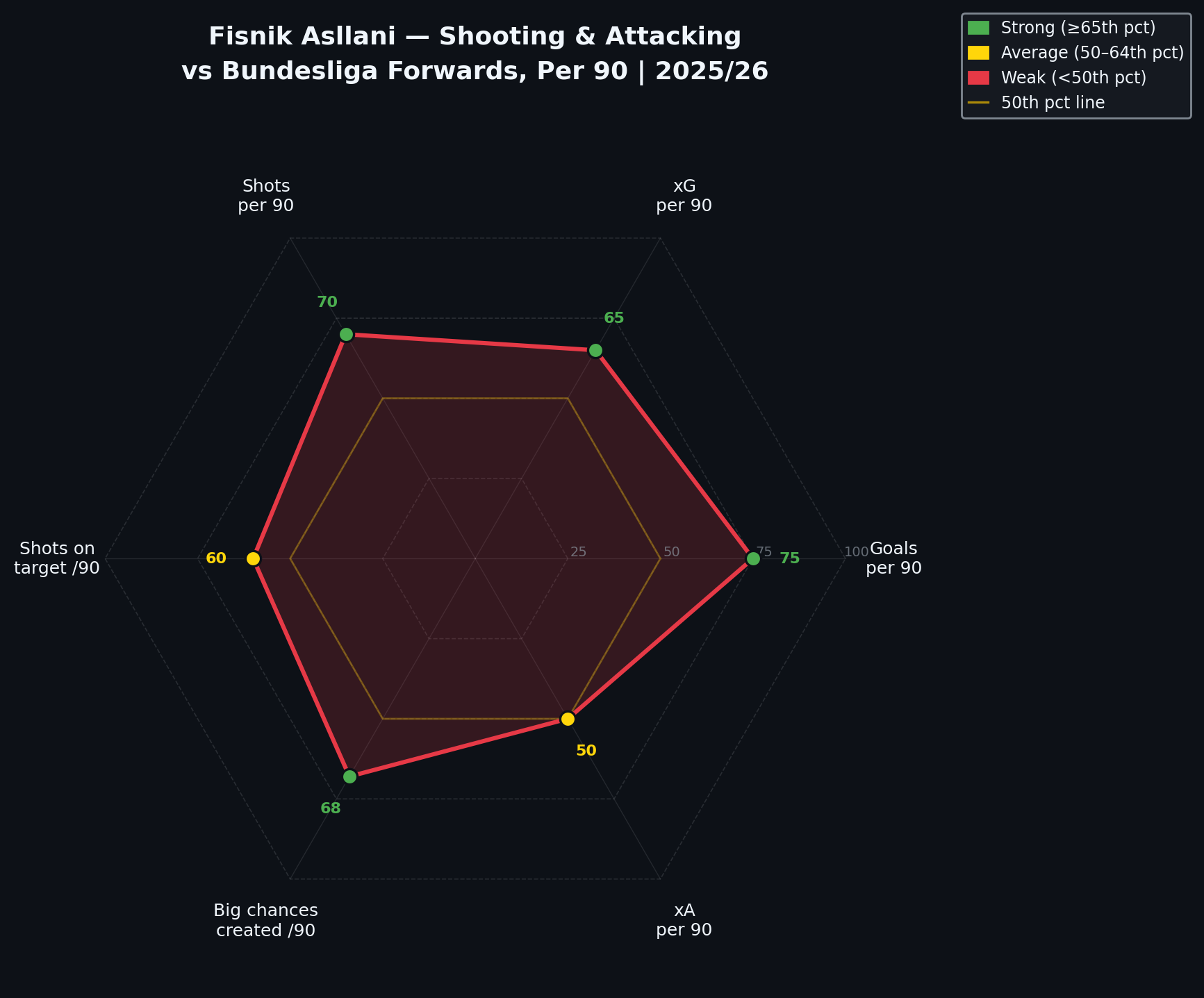
The most compelling part of Asllani's profile is what happens when he is in and around the penalty area. At 191cm and both-footed, he is physically imposing but does not play like a traditional target man — which is precisely what makes him interesting. As the analyst CounterPressers put it when the Barcelona links first emerged: "Fisnik Asllani is of the school of a Kai Havertz — the faux 9s or 9.5s. Long-legged centre-forwards that start up top but bring so much value through their combination play. Well-rounded technicians who can drop deep, combine with teammates and score goals."
Spencer Mosmann, who assessed his profile directly in the context of the transfer speculation, was characteristically precise: "High involvement in the final phase: touch-dominant in the penalty area, finds shots like a ST, finds teammates like an AM. Running and carrying numbers don't stand out. Poor in the air for his height. Interesting and valuable archetype — but Barcelona might be a level too high for him at the present."
That last line requires honest engagement, and we will return to it. First: his height. At 191cm, Asllani is a tall striker who does not win aerial duels at the rate that height would suggest — his aerial win rate sits below average for Bundesliga forwards, a genuine limitation if you deploy him as a target man. But that framing misunderstands what he actually is. He is not a target man. He is a link man who happens to be tall — a player whose value comes from intelligent movement between the lines rather than winning flick-ons at the far post.
His xG per 90 of 0.30 and xA of 0.15 give a combined xGI of 0.45 per 90 — top third among Bundesliga forwards this season. More revealing still: his actual goals have consistently exceeded his xG across multiple seasons and divisions. That is not variance compounding. That is a player who knows where to be when it matters.
Passing and Possession: The Link-Up Dimension
Passing & Possession Radar — Per 90 Percentiles | Bundesliga 2025/26
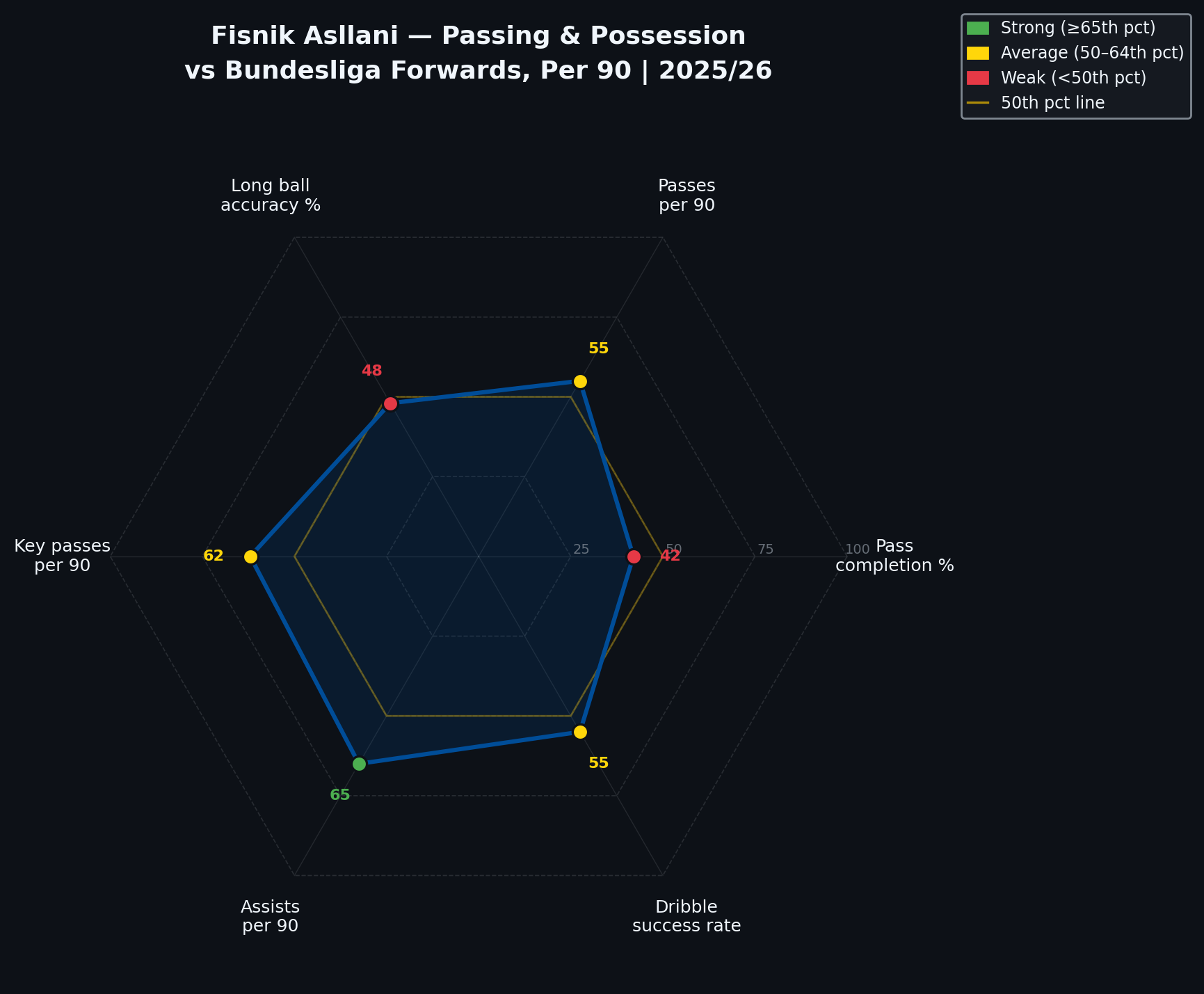
This is where Asllani's profile diverges meaningfully from the traditional Bundesliga number nine, and where it begins to intersect with Barcelona's requirements. He creates 1.4 key passes per 90 — solid for a forward, particularly one operating in pockets between opposition lines. His assist totals across competitions (six this season) reflect a player who is not purely selfish in the final third, and his layoff quality — flagged by WhoScored as a stylistic strength, alongside through balls and long shots — is a technical attribute that separates him from pure finishers.
The Hoffenheim data confirms what the eye test suggests. Christian Ilzer has deployed Asllani in multiple partnership configurations across a tactically flexible system — alongside the veteran Andrej Kramarić or the mobile Bazoumana Touré. In both pairings, Asllani is typically the player who drops short, receives under pressure, and either lays off quickly or turns to face goal. Ilzer himself, speaking to the Bundesliga official site, was direct: "Fis is one of those players. He came back to us in the summer after his spell at Elversberg in the second division and has taken another step forward." Unsolicited praise from a coach Flick will have watched closely carries weight beyond the statline.
His overall pass completion of 68.5% remains the number Deco's analysts will scrutinise hardest. In La Liga, where positional cycles are longer and retaining possession is near-sacred, this would need to improve. It is not disqualifying — it is developmental.
Defensive Contribution: The Honest Conversation
Defensive Contribution & Duels Radar — Per 90 Percentiles | Bundesliga 2025/26
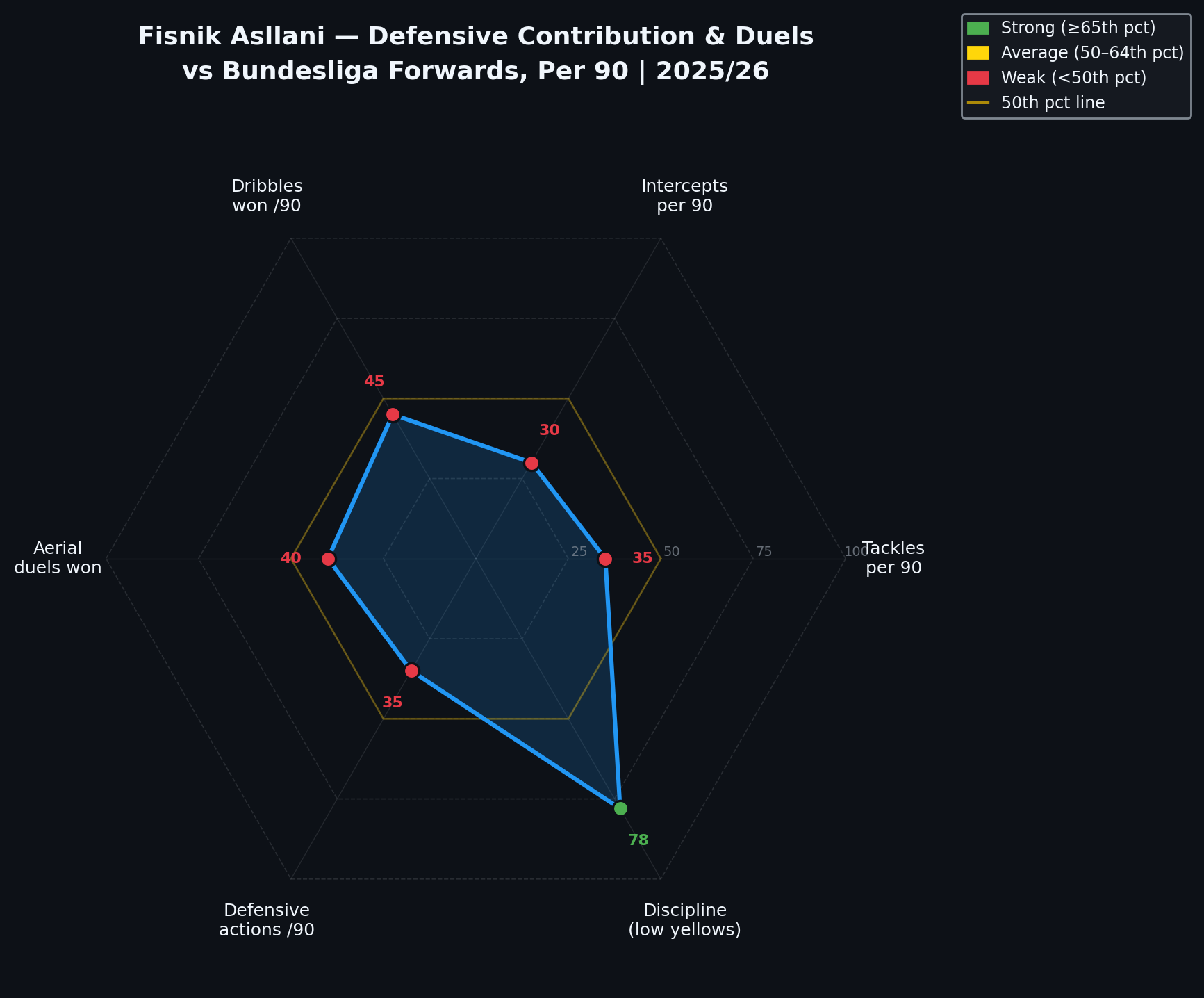
The defensive chart is the least flattering section of this profile, and it should be engaged with honestly rather than explained away. At 0.6 tackles and 0.3 interceptions per 90, Asllani's out-of-possession numbers sit in the bottom third of Bundesliga forwards. His clearances are essentially zero — expected for a forward, but worth noting in the context of any team playing an aggressive high line. WhoScored is unambiguous: "defensive contribution" and "holding on to the ball" are both flagged as weaknesses.
The counterargument — that Hoffenheim under Ilzer has been one of the Bundesliga's more aggressive pressing sides, and Asllani has operated within that structure — is valid but limited. He positions himself to press and his off-ball running lines are generally correct. What he does not do is win the ball in those press scenarios at a high rate. For Flick, whose system depends on the press beginning from the striker's first movement, this is something to coach — or to accept as an inherent ceiling. It is the most significant question mark on this profile.
Connecting the Dots: Does Asllani Fit Flick's Barcelona?
This is the crux, and it requires separating what Barcelona need from what they want.
Robert Lewandowski's departure this summer leaves a specific vacancy. The Pole was not merely a goalscorer — he was a physical reference point who could hold the ball with his back to goal, link midfield to attack, and occupy two centre-backs simultaneously. His 37-year-old version has declined in those second-phase actions, but his positional dominance and finishing remain at a level that very few strikers in world football match. Replacing him directly with Asllani would represent a significant downgrade in proven quality. Anyone who tells you otherwise is not being straight with you.
What Asllani offers is something different: a 23-year-old in ascending form, contracted until 2029, available for sub-€30 million — aligned with Transfermarkt's current valuation of €30 million — who fits a future version of Flick's system rather than a guaranteed starter in the present one. He is not Lewandowski. He is not Álvarez. But at this price point and developmental stage, he is precisely the kind of signing Deco's moneyball philosophy is built around.
It is worth understanding what that philosophy actually is. Deco has been consistently misread as a constraint-driven sporting director — someone forced into youth by financial pressure rather than conviction. He has pushed back on this directly. Speaking to The Times in late 2025, he was unequivocal: "People say to me, 'Because of the financial situation, Barcelona are using young players'. It's not true. We are using young players because they are good enough." The approach is internal-first, surgical externally, and laser-focused on acquiring young talent before the market catches up to them. Bardghji — signed from injury, on potential — is the template. Barcelona's current strategy under Deco is explicitly to "secure top young talent in Europe before they are scooped up by major clubs." An affordable, ascending 23-year-old with a written release clause and Bundesliga pedigree is not peripheral to that strategy. It is the strategy.
Flick brings something else to this equation. His Bundesliga knowledge is not theoretical — it is intimate, granular, and current. He will have watched Asllani not as a rumour to evaluate but as a footballer he has seen operate at close quarters in a league he understands profoundly. That inside information is worth more than any external scouting report, including this one.
The fits are real. Asllani's link-up play in tight spaces maps directly onto the demands placed on Barcelona's number nine by Olmo, Pedri and the late-arriving midfielders in Flick's fluid positional system. His willingness to drop deep and combine aligns with the positional fluidity Flick encourages throughout the forward line. His aerial weakness matters considerably less in a team that builds through the floor and creates through positional rotation rather than long-ball delivery. And his both-footedness gives him flexibility in tight receiving situations that a right-footed specialist would lack.
The concerns are equally real and should not be glossed over. His pass completion rate will be tested hard in a possession-dominant system where recycling efficiently is non-negotiable. His aerial duels at set pieces remain a below-average output for a striker his size. His defensive work rate — the most important outstanding question — must improve or Flick's press structure is compromised. And Mosmann's assessment stands as the most sobering on record: Barcelona may be a level too high for him right now.
That last caveat is a calibration, not a verdict. The better question is not whether Asllani is ready for Barcelona today, but whether he will be in two years, surrounded by the best players of his generation. His trajectory answers that question more convincingly than any static percentile chart. From ten Bundesliga appearances across two seasons without a goal, to 18 goals in the 2. Bundesliga, to eight goals and five assists in a full Bundesliga campaign — this is not the trajectory of a player who has found his ceiling. This is the trajectory of a player still finding it.
The Final Verdict
He has said publicly: "The club of my dreams has always been FC Barcelona. I've always wanted to play there." He attended Barça vs Espanyol in person this season. His social media activity during the UCL run has not been subtle. These details do not win arguments about football. But they do not hurt either, and they matter to the humans making these decisions.
What wins arguments is what is visible every weekend in the Bundesliga. A 23-year-old striker — born in Berlin to Albanian parents who fled a war, who turned down Bayern Munich at 17 because he wasn't sure he was ready for a club that size, who spent two seasons accumulating ten senior appearances before grinding his way through a 2. Bundesliga loan — who returned to the top flight and opened his account with a brace against Union Berlin, scored winners against Leverkusen, and plays with the technical sophistication of a player who should cost significantly more than his release clause. At €25-29 million, with Bundesliga intelligence baked in through Flick, a sporting director who has staked his reputation on identifying young talent before the market does, and a player whose stated dream is to wear Blaugrana — Fisnik Asllani is not just a rumour.
He might be a plan.
Visualisations: BarcaFutbol / The Barça Weekly. @hackrlife
The Club Country Dysfunction In European Football
Raphinha's hamstring, Italy's third World Cup miss, a $155,000 compensation cheque, and a system that keeps breaking its most important asset — the players.
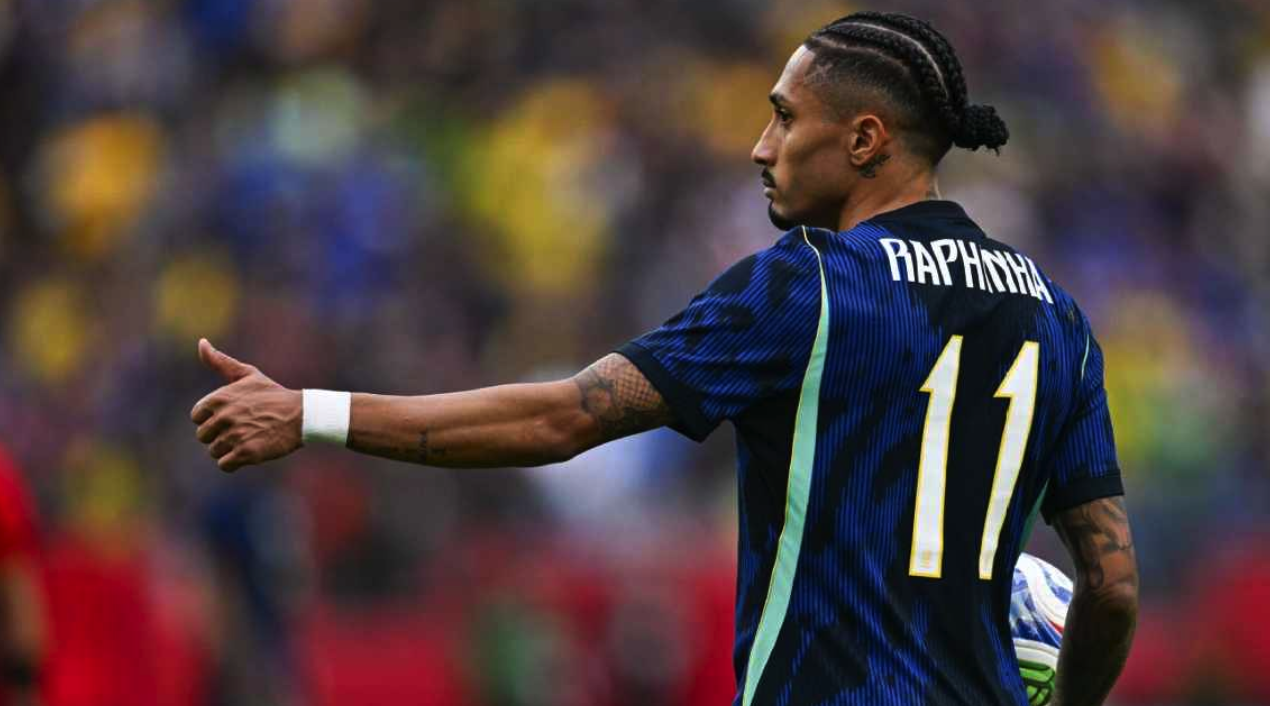
It happened in Foxborough, Massachusetts, on a Thursday night in late March, in a friendly football match between Brazil and France that had no competitive consequence for either nation. The World Cup was already decided for both sides. The score — 2-1 to France — will not appear in any record that matters. What will appear in a record that matters very much is this: Barcelona's Raphinha, the club's second-highest scorer this season with 19 goals in 31 appearances, walked off at half-time and did not come back. Tests confirmed a biceps femoris injury to his right hamstring. Recovery time: five weeks.
For Barcelona, those five weeks encompass three matches against Atlético Madrid — one in La Liga, two in the Champions League quarterfinals. They represent the decisive weeks of a title race they currently lead by four points. They are, in any honest reading of the situation, irreplaceable in competitive terms. And the financial compensation Barcelona will receive from FIFA's Club Protection Programme? According to World Soccer Talk, approximately $155,000 — a figure the club's own sources described, with barely concealed fury, as "insufficient and bizarre." Club president Joan Laporta publicly raged at FIFA over the injury, demanding the governing body address the structural failure it represents.
This is not a new story. It is a very old story told again, with a new cast.
A pattern, not an incident
What makes the Raphinha injury particularly hard for Barcelona to absorb is that it is the third time this season he has injured his right hamstring. He missed 13 games between September and November with the same muscle group. He missed another three in January and February. Now this. A player whose physical availability has already been fragile across his Barcelona career — he has accumulated a significant history of thigh, hamstring, ankle and calf injuries since arriving from Leeds in 2022 — was sent to play in a pre-tournament friendly on a continent 5,000 miles from home, in the final week of March, when his club was on the cusp of the most demanding stretch of their season. The Brazilian Football Confederation needed him for preparation. FIFA's calendar made space for them to ask. Nobody had the power to say no.
That is the structural problem. Not the injury itself — muscle injuries happen in football and always will. The problem is that a system designed around FIFA's commercial and administrative logic routinely compels clubs to release their most important assets into environments over which those clubs have no control, at moments when those clubs have the most at stake, with a compensation mechanism that doesn't begin paying out until day 29 of an absence and caps at a daily rate of €20,548 — a figure that, for a player of Raphinha's standing, represents a fraction of the actual financial damage. FIFA will distribute a record $355 million to clubs tied to the 2026 World Cup — a 70% increase from 2022. The direction is right. The scale remains a gesture.
The March problem specifically
The March international window is the most contentious fixture in the football calendar, and in a World Cup year it is particularly hard to justify. By late March, every major European league is in the final third of its season. Champions League knockouts are underway. Title races are alive. Relegation battles are at their most brutal. And yet in 2026, with the summer tournament in North America drawing close, the window produced two rounds of friendlies — not qualifiers, not competitive fixtures, friendlies — that left a trail of injured bodies across the continent.
Arsenal saw ten players withdraw from international duty in March 2026, including Bukayo Saka, Declan Rice, William Saliba, Gabriel Magalhães and Noni Madueke. Multiple returned with fresh concerns. Arteta had already lost both Odegaard and Calafiori to significant international injuries the previous season. Mikel Arteta is not a man who uses words carelessly; his very public management of player availability during international windows communicates what he cannot say directly: that he views the system as a threat to his squad at the moments that matter most.
National team managers, to their credit, often agree. Thomas Tuchel sent both Rice and Saka back to Arsenal for "medical assessment" rather than deploy them in England's March friendlies. Norway's Stale Solbakken had previously recommended that Odegaard stay at his club. These are national team coaches making decisions that prioritise club welfare over their own squad's preparation. The logic of goodwill is functioning where the logic of the system has failed to.
But goodwill is not a regulatory framework. It depends on individual managers making enlightened decisions in the absence of any structural requirement to do so. Carlo Ancelotti started Raphinha against France. The Brazilian was vital to Brazil's preparations. He had every right to play him.
What FIFA's compensation framework actually says
The reported $155,000 figure is not just an insult to common sense — the structure behind it is a signal. It tells you exactly how FIFA has calibrated the relationship between its commercial interests and those of clubs. FIFA's Club Protection Programme only activates after 28 consecutive days of absence — meaning Barcelona receive nothing for the first four weeks, which happen to be the four weeks in which Atlético must be faced three times and the Champions League quarterfinal is decided. After 28 days, the daily rate kicks in for the remaining days. For a club whose matchday and commercial exposure during a Champions League run is worth tens of millions, the arithmetic is not even close.
This is before you get to the broader design of the problem. FIFA distributes World Cup-linked money to clubs partly to buy their compliance with the release obligation. The 2026 distribution is more generous than 2022. But the March window is not the World Cup. It is a preparation window — a set of friendlies whose primary beneficiary is not the global game but the individual federations who need warm-up matches and the commercial partners who attach to them. The clubs bear the risk. The federations retain the control.
Italy: the warning nobody is listening to
If Raphinha's injury is the acute symptom, Italy's elimination from a third consecutive World Cup is the chronic disease — and it matters to this conversation precisely because it illustrates what happens when the club-country relationship breaks down completely at the structural rather than the individual level.
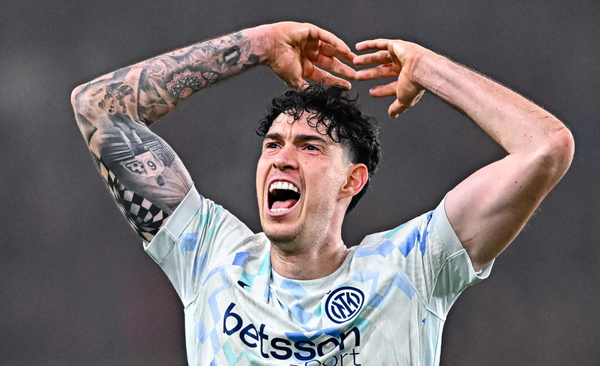
Italy lost to Bosnia and Herzegovina on penalties on 31 March 2026, becoming the first four-time World Cup winner to miss three consecutive tournaments. The Gazzetta dello Sport called it "the third apocalypse." Former Prime Minister Matteo Renzi called it "a sign that Italian football has failed." Italy's Sport Minister Andrea Abodi called for federation president Gabriele Gravina to resign — and Gravina subsequently did. Alessandro Bastoni will be 30 at the 2030 World Cup. Sandro Tonali will be 29. Nicolo Barella will be 33. A generation of players may never experience a World Cup.
The standard narrative points to coaching failures, tactical conservatism and administrative dysfunction — all of which are real. But the underlying structural issue connects directly to the club-country tension at the heart of this article. Serie A currently has approximately 68.5% non-Italian players in its squads. For comparison, La Liga sits at around 43.7%. The argument — and it is an argument, not a settled fact — is that the Italian domestic pipeline has been so thoroughly colonised by foreign talent that young Italian players have struggled to accumulate the first-team minutes in their own league that would develop them into a cohesive, tactically aligned international generation. As one former Serie A coach told Business Day: "Before, Italian players never went abroad. Now they do and mediocre players arrive in Italy taking space away from Italians." Whether that is the primary cause or a contributing factor is genuinely contested — but the correlation between the hollowing of the domestic pipeline and the decline of the national team is hard to ignore when Italy's last Champions League winner was Inter Milan in 2010 and all four Italian clubs this season were eliminated before the last eight.
This is the inverse of the Raphinha problem, but they share a common root. In Raphinha's case, the club is damaged by the demands of the national federation. In Italy's case, the national team is damaged by the decisions of the clubs. The common thread is that the ecosystem has failed to create rules that make club success and national team success mutually reinforcing. In Italy they are in direct competition, and the clubs are winning.
The research has been done
This is not merely subjective. Academic research published in Football Perspectives demonstrates, using two-stage least squares regression, that a country's aggregate club success and its national team performance are statistically linked — the key mechanism being that strong club development environments raise the quality of domestic players who then filter through to the national squad. The Spain of the Xavi-Iniesta era was not an accident: it was La Masia producing a generation with identical tactical vocabulary, deployed at Barcelona, exported across La Liga, and reassembled for the national team with minimal transition cost. Germany's post-2006 investment in youth academies and the DFB Talent Development Programme produced the 2014 World Cup winning squad over a decade of systematic work.
Italy made no equivalent investment. Roberto Baggio resigned as FIGC technical director in 2013, telling state broadcaster RAI: "I haven't been allowed to work: my 900-page program has remained a dead letter." The warning was explicit. The warning was ignored. Thirteen years later, Italy is not at the World Cup.
FIFA's reform — a step, not a solution
It is fair to acknowledge that FIFA has moved. From 2026, the separate September and October international windows will be merged into a single 16-day block, reducing the number of annual breaks from five to four and cutting total travel cycles for players. Arsène Wenger had proposed something similar in 2021: one major October window with all qualifiers condensed. The 2026 reform is a partial implementation of that logic and deserves credit.
But the March window remains. The friendlies remain. The compensation gap remains. The 28-day threshold before payouts begin remains. And the structural incentive for federations to maximise player availability in preparation windows — particularly in years when they are building squads, testing combinations, and managing public expectations — has not changed at all.
What a real solution might look like
The honest answer is that this problem does not have a single solution. It has a set of overlapping ones that require all parties to surrender something.
For FIFA: the compensation model has to be rebuilt. Payouts should apply from the first day of absence, tied to actual player wage costs, not from day 29 at a capped daily rate. The 48-team World Cup has generated record revenues. Distributing that money only through long-lag schemes, while clubs carry the first month of injury costs entirely, is not partnership. It is extraction with apology.
For federations: the March friendly window in the final months of the club season should either be eliminated or capped at one match per player — with explicit opt-out rights for clubs whose players have exceeded a defined injury risk threshold. If a player has already suffered the same injury twice in a single season, no friendly obligation should apply. That is not a radical position. It is a minimum standard of care.
For leagues: Italy's example is a reductio ad absurdum of what happens when domestic club football treats its youth pipeline as an afterthought. Leagues that allow their domestic talent pipelines to be hollowed out by imported players signed for short-term competitive gain are making a bet that will eventually be called in. Italy just paid.
For players: they are correct that they play too much football. The combination of expanded leagues, expanded European competitions, international calendars and expanded tournaments is physically unsustainable at the intensity modern football demands. FIFPRO has documented this for years. The players are not wrong. But they are also not unified enough in their advocacy to force structural change without institutional allies — and those allies must be the clubs, speaking collectively through the ECA, not individually through post-match press conferences.
The system is not broken because anyone is malicious. It is broken because it was designed when football was smaller, slower and less financially complex — and it has not kept pace with the game it is supposed to serve. Raphinha's hamstring is not an anomaly to be managed around. It is a message from the system about what the system values. And the message, at the moment, is clear: the tournament matters more than the tournament's best players