Álvarez or nothing is not such a disaster
Spending €100 million on Julián Álvarez would be defensible. Spending €100 million on anyone else on the market right now wouldn't be. Barcelona will have to wait for their hitman, and waiting is the lesson Coutinho and Griezmann should have already taught this club


Álvarez or nothing is not the disaster it looks like
The number that we fans should consider is €48.6 million.
That is what Liverpool paid for Alexander Isak. €48.6M for each of the three goals he scored for them in the Premier League after leaving Newcastle.
Nick Woltemade cost around €76 million and scored seven, which is roughly €10.8 million a goal, and he is one of the better value buys on the list. Even Viktor Gyökeres, one of last summer's genuine successes, cost around €64 million for fourteen.
This is the market of the 9s.
This summer money flowed into midfields across continents while forward lines stayed still, and Golden Boot predictions in late August still had no new signing anywhere in the top twenty. João Pedro re-signed at Chelsea. Eli Junior Kroupi got valued at €130 million and then broke a metatarsal. Benjamin Šeško, Hugo Ekitike and Viktor Gyökeres all moved early and for club-record fees, closing doors before transfer windows opened. Mikel Oyarzabal said "You can say no to Barcelona." Lautaro Martínez said he will never leave Inter. When the ten best strikers available were ranked in the middle of August, Julián Álvarez was first, Serhou Guirassy at thirty was third, Folarin Balogun was ninth.
That was the entire list and Guirassy at number three, was thirty years old.
A market where a thirty-year-old is one of the best three names is not a market with a genuine elite nine. Gyökeres, Ekitike, Šeško, João Pedro: good, occasionally very good players, but all priced at Isak money for Woltemade output.
None of them is a Luis Suárez. None of them is a Lewandowski.
That distinction is not nostalgia, it is a real category difference between a very good centre-forward and one of the two or three best in the world at that position. And Barcelona have had both of the latter in the last fifteen years and know exactly what one costs to acquire and what it is worth once it arrives.
Spending €100 million or more to sign a player who is not in that category, purely because the position needs filling, is how a club ends up worse off than if it had done nothing. Spending the same money on Álvarez, who at least changes how the team plays even if he never becomes a thirty-goal-a-season totem, is a different kind of gamble entirely.
Lewandowski cannot be replaced. He leaves with 193 appearances and 120 goals in Barcelona colours. The spine of two title-winning sides, and there was no version of this summer where a like-for-like arrived to take his place. He also had to go. He is 38, his contract would have cost the club €104 million gross across its life had it run on, and you cannot run a squad under a hard spending cap while also carrying that number for one more year. Both things are true at once, and neither one is a planning failure. It is what the end of a great career looks like when the club carrying it has to answer to a salary limit.
Now let's look at what came in instead of a nine. Anthony Gordon came in from Newcastle at €80 million, Rodri in from Manchester City at €60 million, Karim Adeyemi in from Dortmund at €22 million, Jesse Bisiwu in from Club Brugge's NXT side at €8.5 million, Dominik Livaković in from Fenerbahçe at €2 million, and the eighteen-year-old Hamza Abdelkarim in from Al Ahly at €1.5 million.
That is €174 million in transfer fees, and not one euro of it on a recognised centre-forward.
Set against that, the sales column looked encouraging. Ferran Torres to PSG topped it at €48.5 million. Ansu Fati's move to Monaco was at €11 million. Tommy Marqués left for Braga at €11 million, real money for a nineteen-year-old defensive midfielder most casual followers of the club have never heard of. Héctor Fort went to Real Sociedad for €8.5 million, and Iñaki Peña went to Cela Vigo for €3 million. Toni Fernández went to Venezia at around €4 million with a 50 per cent sell-on clause, and Álvaro Cortés went to Royal Antwerp at just over €3 million on similar terms. Cuenca left for Stuttgart at €700k and Dani Rodríguez left for Levante for around €600k. Add all nine together and Barcelona recovered roughly 90 million in sales this summer.
Lewandowski, Jofre Torrents and Ander Astralaga all left for nothing, and Ronald Araújo, Marc-André ter Stegen, Áron Yaakobishvili and Diego Kochen went out on loan. Net spend came to €84 million.
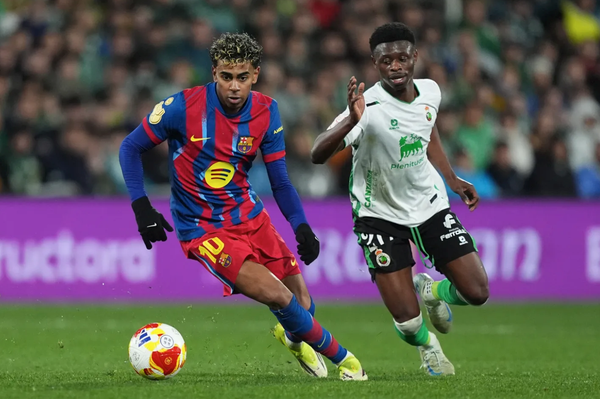
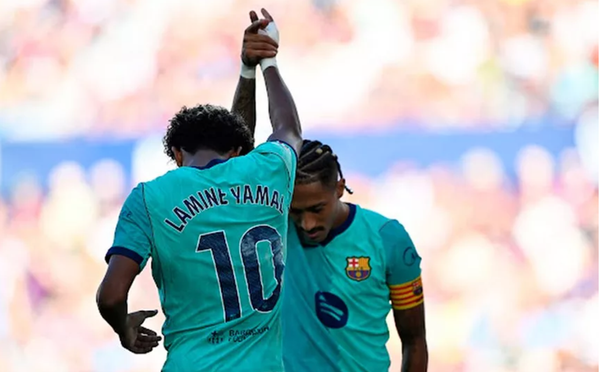
The house cleaning leaves Barca with Yamal, Fermín and Raphinha as hunters leading the line. Two wingers, a holding midfielder, a fringe full-back and a goalkeeper. Not a recognised nine.
The Ferran sale deserves more nuance. He finished the season with 16 La Liga goals in 23 appearances and also scored Spain's World Cup winner, numbers that read well from a distance. Closer up the reality was always different. He also missed 19 chances in La Liga last season, more than any other player in the entire competition. The finishing on the highlights reel sat next to a volume of missed sitters higher than the goal count. Fans who watched the games knew that gap. He was never a natural fit for what Flick wanted from the position. A mix of a false nine's link play and a winger's directness.
Barcelona rightfully hesitated over extending his contract. Ferran wanted a substantially improved salary with guarantees over his playing time, money the club was not going to commit for a return of that shape. Selling him this summer for somewhere near €50 million, with a year still left on his contract was a better outcome than losing him for nothing twelve months later once his contract had run down. Being back under the 1:1 rule does not mean spending indiscriminately just because the room exists, and a net outlay of €84 million that leaves the squad stronger and better covered in central midfield, at full-back depth and on the wings is not a bad summer of business by any reasonable measure.
That said, the gap at the centre-forward position is real and it will cost Barcelona points at some stage this season, most likely in the low-block, backs-to-the-wall games that define La Liga.
That is true.
It is also true that Flick will have to adjust to it rather than wish it away. But that adjusting is a better path than the alternative on offer, which was spending close to €150 million, on a forward who could just as easily return three league goals as thirty. Nothing genuinely available at that price this summer was a reliable insurance policy. It would just have meant spending the same discipline that built a deeper, better squad everywhere else on a gamble the market itself was not equipped to reward.
Now comes the fit question, because it matters more than the price tag.
Álvarez is not a Lewandowski replacement and there was never a version of this deal where he would be. He sits in the 96th percentile among forwards for chances created but only the 58th for shot attempts, the 53rd for goals and the sixth for aerial duels won. At 5ft 8in he plays best as a second striker or a ten, dropping deep to link rather than holding the ball up, and at Manchester City he did exactly that off the wings and through the middle while Erling Haaland did the hit-man job. He completes 3.82 progressive passes and 1.97 carries into the final third per ninety and presses relentlessly, closer to a connector in possession than a poacher.
That profile maps directly onto what Flick is already trying to do without him. Adeyemi started as a false nine at Elche with Raphinha and Yamal either side, and there was no recognised nine against Athletic Club either, the front line rotating through Raphinha, Gordon and the two wingers with full-backs pushed high to supply the runs. Nine big chances and five goals from seven shots on target in the opener is a real return, but there is a ceiling to it. Without a genuine reference point inside the box, this approach is vulnerable the moment a team sits deep and stops chasing the game.
Álvarez would not eliminate that risk. He would make the false nine a real forward's job instead of a winger's improvisation, adding a pressing trigger and a link player who scored 29 goals and seven assists in his debut Atlético season. 36 goal contributions in a team that creates chances at a fraction of the rate Barcelona's front line does. Nine big chances in a single opening match is the kind of volume Álvarez has never had regular access to. A realistic season inside Flick's system, and one could always dream of a 40 goal season. But he still would not give Flick someone to attack a cross in a wet November away game.
So yes, would he be an asset inside Flick's system? For sure. He is worth trying, but there are two problems. It doesn't seem like he can leave Atleti and there aren't that many in the market like him. A wrong signing doesn't just waste money, it removes the room to fix the mistake quickly. Which is the actual argument for Álvarez or nobody. Not stubbornness, not a lack of ambition, but the plain lesson of the last decade, learned at a very steep price.
If the door stays shut past deadline day, Flick already has more than one route to compensate. He can keep rotating Adeyemi, Raphinha and Gordon through the false-nine role and lean on Fermín and Dani Olmo to overload the middle. He can trust Gordon in the position directly, since the player has said himself that he is happy to play there. He can widen the attack further and ask Yamal and Raphinha to interchange the way PSG's front three does without a fixed point, trading a target man for pure movement and combination. There is also a smaller, more specific option sitting on the bench: Bisiwu is eighteen and was not bought to start big games, but there is no reason Flick cannot throw him on for twenty or thirty minutes in the matches that open up, against a tiring low block or a side already chasing the game, purely for the directness a fresh, uncomplicated runner offers when the first eleven has started to overthink it. Hamza Abdelkarim also has a knack of scoring goals that can come good in this system. He at least behaves like a 9.
None of those routes is as clean as adding a proven, battle-tested centre forward, and the coaching staff has already said in public that they expect to make one more move before the window shuts. But none of them is a crisis either, and a team that has opened the season with two wins, seven goals and two clean sheets does not need to be rescued from itself in the next few days.
Under Flick, Álvarez can become a consistent twenty-thirty goal contribution season player, a genuine upgrade on what the false nine currently produces. He will never be a nine. He was never going to be, and nobody serious about his profile would pretend otherwise. What Barcelona lose by not landing him is the chance to change how the team actually plays, to turn the false nine from an improvisation into a real, repeatable shape with a proper link man inside it.
That is a real loss, not a manufactured one. But it argues for holding to a principle rather than abandoning it under deadline pressure. If Julián arrives before the window for around €100 million, that is a good outcome and worth the fee. If he doesn't, that is simply what it is. Yes, the lack of a genuine No.9 will hurt Barcelona at some point this season. It would have hurt anyway, whoever wore the shirt, because nothing on the actual market this summer was ever going to remove that risk entirely.
Barcelona will get their hitman eventually. It will not be whoever is cheapest and available this week, and it should not be that way.