Flank Dynamics in Flick’s 7–2 Thrashing of Racing
How Flick’s 6.74 xG machine turned flank overloads and box entries into a seven-goal storm.

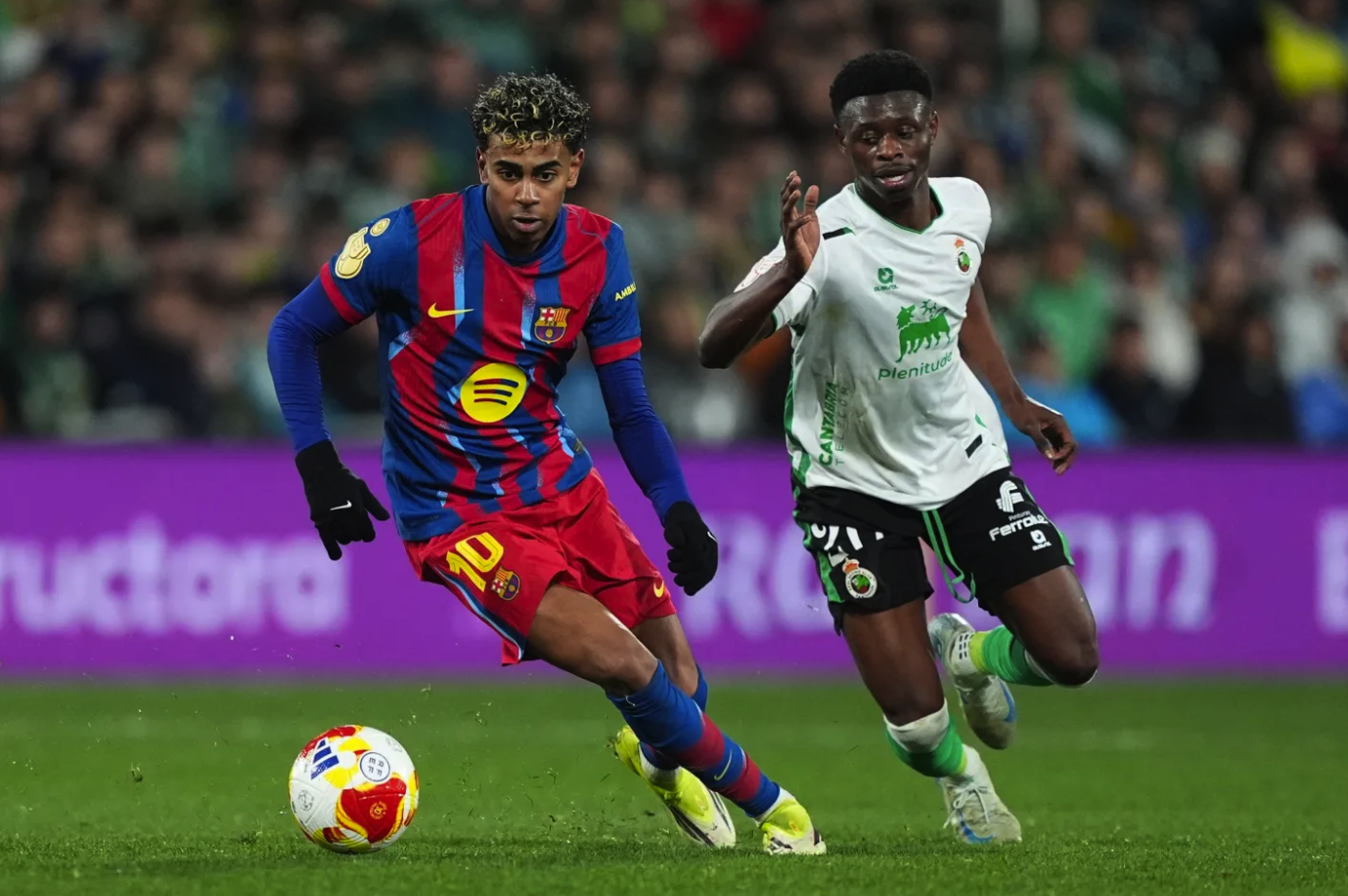
Lightning flickered across the night sky above Camp Nou, accompanied by a relentless late-summer rain that slickened the grass and accelerated the ball across every inch of the pitch. Hansi Flick’s Barcelona arrived at Matchday 6 carrying a pristine league record, but this clash carried an added layer of history: a victory would make Flick the first manager in Barcelona’s history to win his opening seven competitive matches of a campaign.
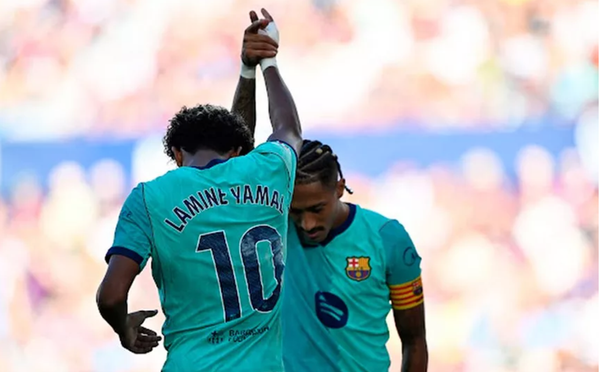
Barcelona did not just win; they submerged Racing beneath a wave of chance creation, finishing with seven goals from an extraordinary 6.74 Expected Goals (xG). João Cancelo opened the scoring with a thunderous long-range strike, followed by a Raphinha penalty, an Asier Villalibre own goal forced by Cancelo, and another clinical finish from Raphinha before the interval. Racing fought back through Maguette Gueye in the first half and capitalized on an error from second-half substitute goalkeeper Wojciech Szczęsny to make it 4–2 through Yassir Zabiri. Yet every time the visitors showed a pulse, Barcelona raised their tempo. Raphinha completed his hat-trick from the spot, Gabriel Jesus stepped off the bench to score his first league goal, and Lamine Yamal capped the demolition at 7–2.
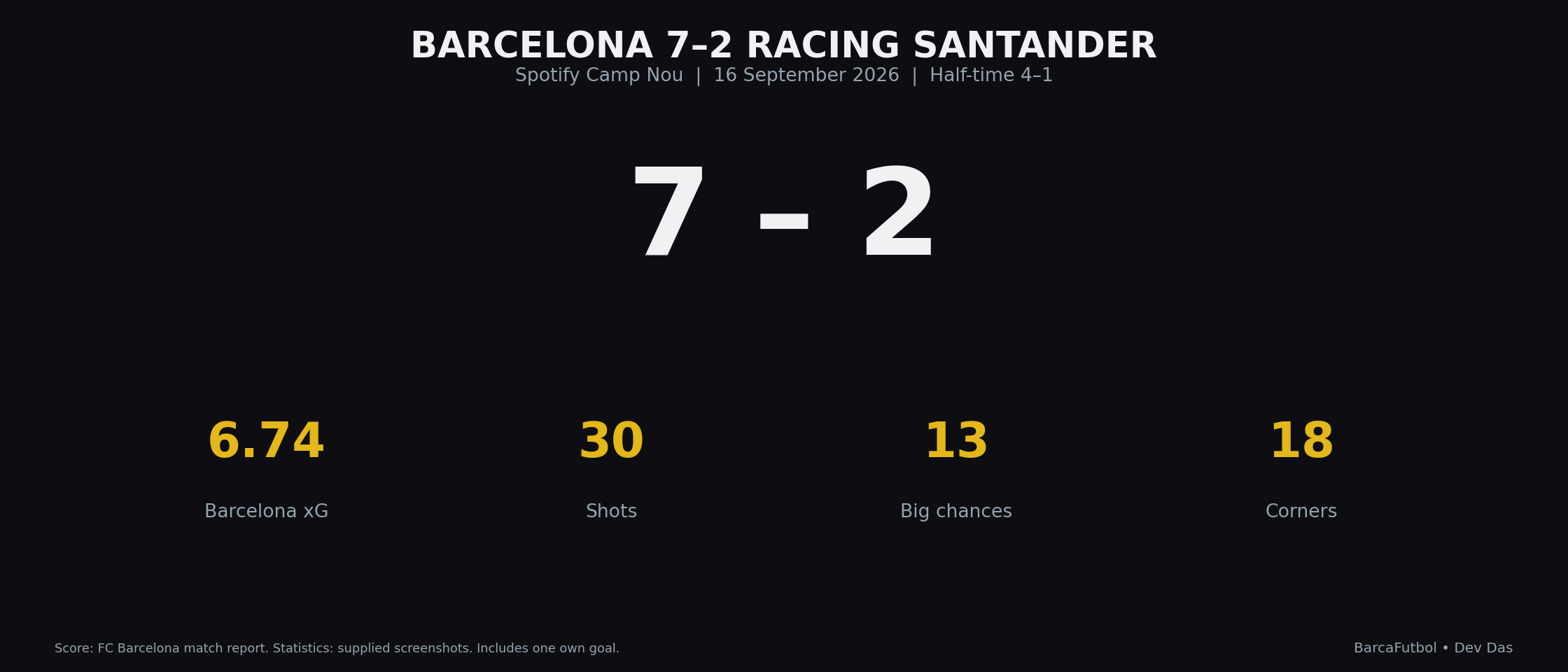
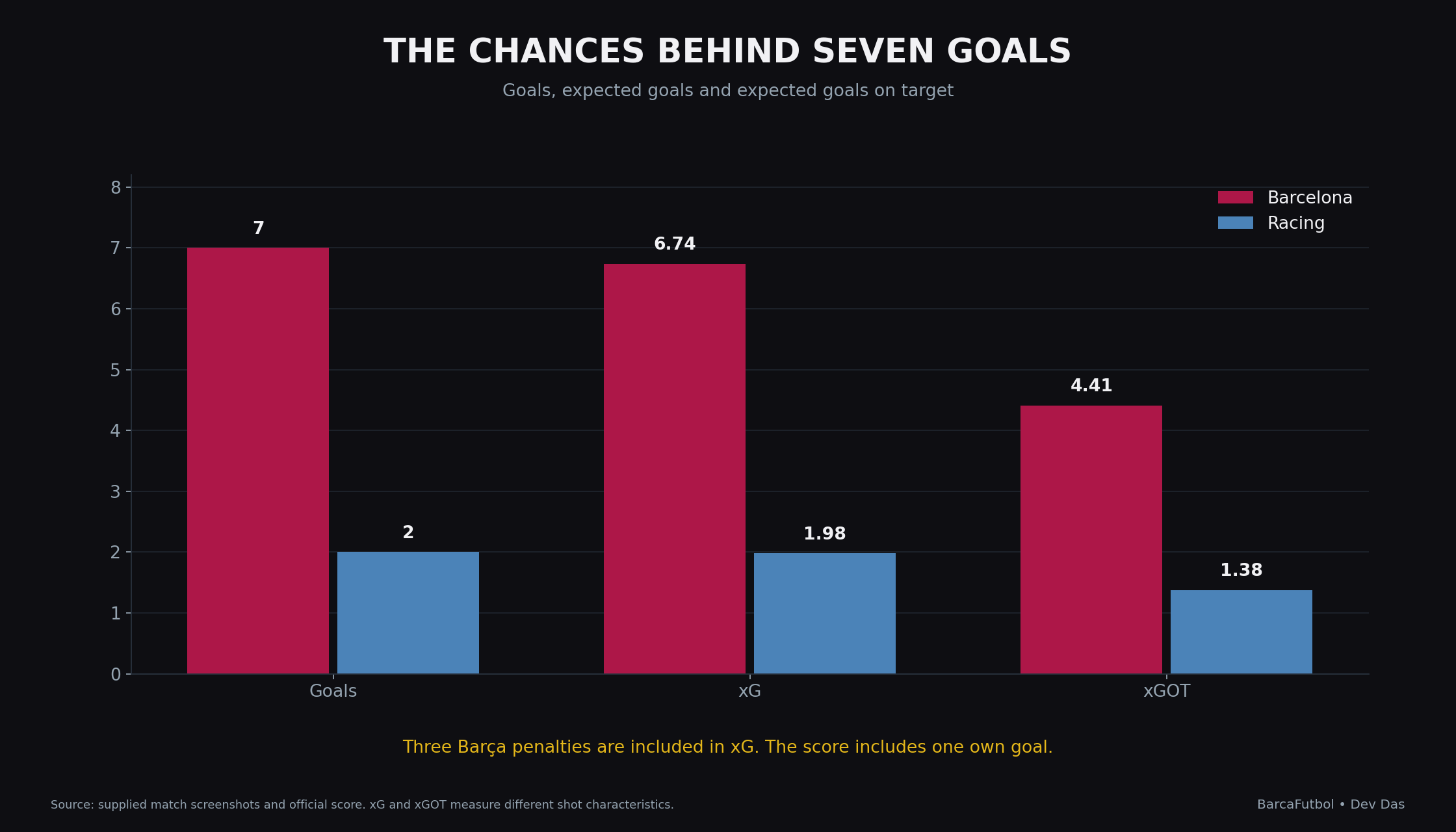
7 goals scored from 6.74 Expected Goals (xG) and 13 big chances created. In modern football analysis, xG measures the quality of a shooting chance based on proximity to goal, angle, and defensive pressure. Piling up nearly seven expected goals is extraordinarily rare. So rare that is has never been recorded in LaLiga from the time statsitics started getting used. It shows how Barcelona's seven goals were not the byproduct of lucky deflections or speculative long-range punts.
They carved Racing open repeatedly and at will.
Barcs's approach this season under Flick is built around dynamic rotations. On the left flank, João Cancelo stepped forward from fullback into central midfield, linking directly with Karim Adeyemi out wide. In the middle, Rodri and Pedri dictated tempo, constantly threading passes through Racing's defensive lines into Dani Olmo. Meanwhile, on the opposite wing, Lamine Yamal held his width, ensuring Racing's defense could never tilt entirely toward one side. When Cancelo's strike cannoned in off the crossbar in the 8th minute, Racing were forced to stretch their defensive block, exposing gaps that Raphinha and his supporting runners exploited all evening.
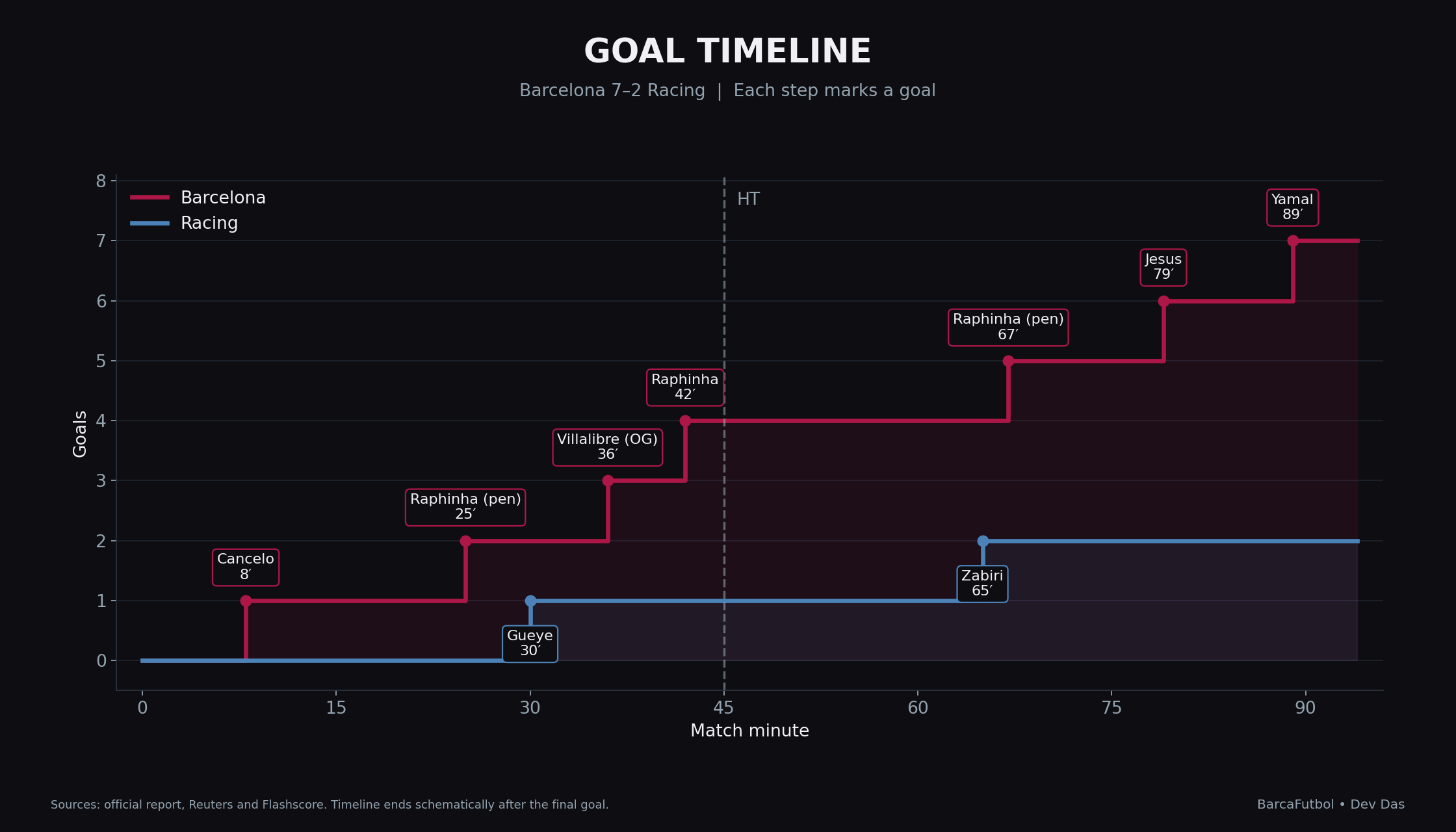
The match timeline graph traces the sequence of goals, illustrating how the game state swung between Barcelona's relentless pressure and Racing's fleeting moments of hope.
- The Early Surge (0'–25'): Cancelo’s 8th-minute opener and Raphinha’s 25th-minute penalty established an early 2–0 cushion.
- Racing's First Response (30'): Maguette Gueye muscled through a rare gap in Barcelona’s high line to slide home a finish for 2–1.
- Barça’s Rebuttal (36'–42'): Within six minutes, Cancelo fired another deflected effort off Villalibre into the net, followed closely by Raphinha’s second goal to restore a commanding 4–1 lead before halftime.
- The Goalkeeping Mishap (65'): After Joan García was substituted at halftime due to a minor slip, veteran Wojciech Szczęsny was caught in possession by Yassir Zabiri, who rolled the ball into an empty net to make it 4–2.
- The Final Stride (67'–89'): The timeline reveals how quickly Barcelona snuffed out any comeback idea. Within two minutes, Adeyemi won a penalty that Raphinha converted for his hat-trick. Gabriel Jesus (79') and Lamine Yamal (89') then added goals to finalize the 7–2 scoreline.
Making Possession Count
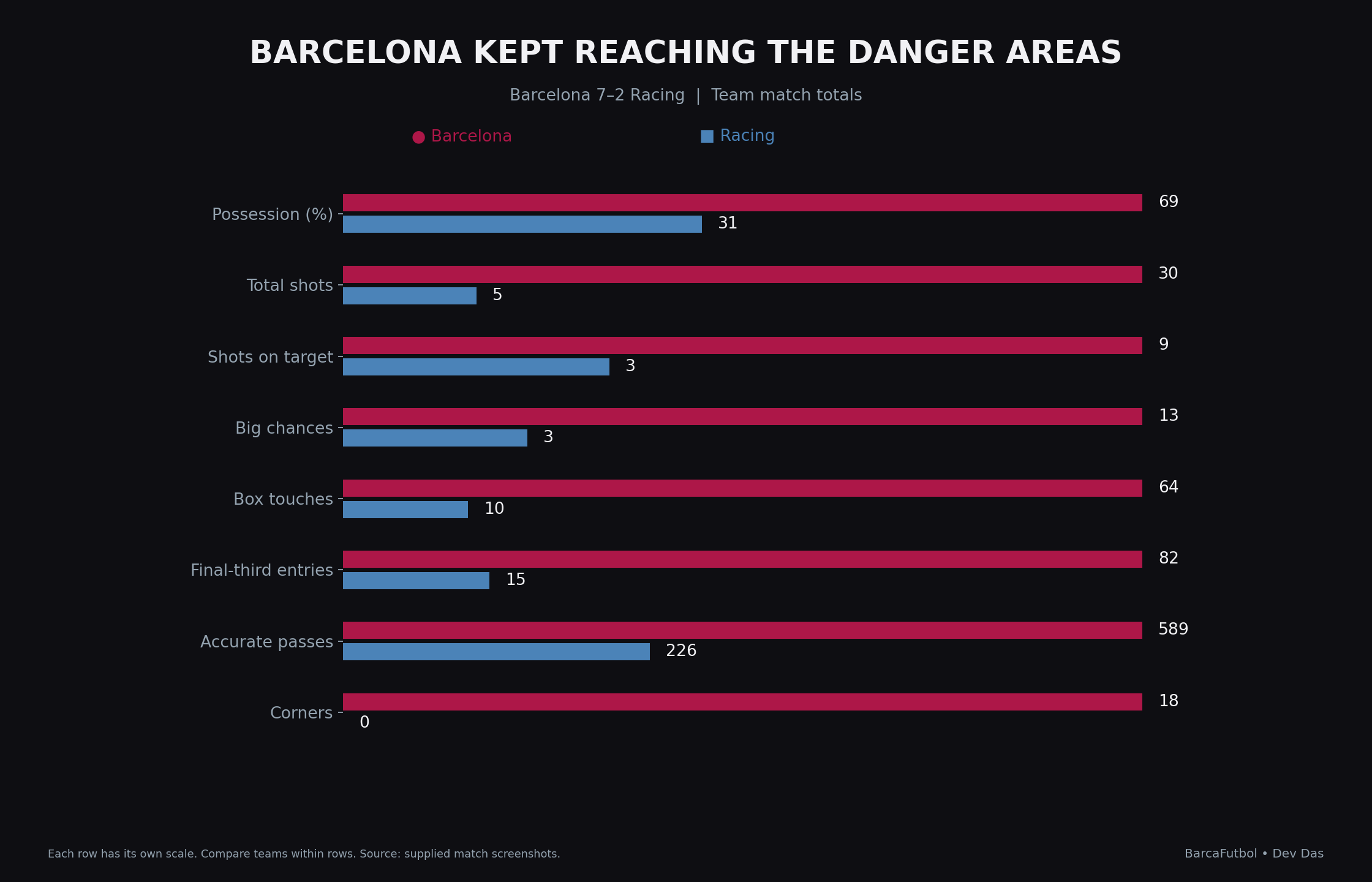
Barcelona held 69% of the ball, but unlike older versions of Spanish possession football that circulated harmlessly along the perimeter, Flick's team transformed possession into annihilation.
Racing were pinned inside their own defensive third for long stretches, forced to clear loose balls directly back into Barcelona's midfield. By winning secondary balls immediately through high counter-pressing, Barcelona restarted attacks within 30 yards of Racing’s goal. The volume of box entries—crosses, cutbacks, and diagonal through-balls—forced Racing’s central defenders to repeatedly turn toward their own net, a physically and mentally exhausting defensive posture that led to late to a consistent onslaught that Racing simply could not cope with.
Cumulative xG and Momentum
The progressive threat chart reveals a steep, continuous upward trajectory for Barcelona across the entire 90 minutes. Rather than flattening out or settling into game-management mode after taking the lead, Barcelona’s rate of chance generation remained relentlessly vertical from the opening whistle to the final whistle.
The data highlights a core tenet of Flick’s football: leads are protected by seeking the next goal, not by retreating into a block. Each goal scored stretched the pitch further; as Racing attempted to step out and chase the score, Barcelona sliced into the vacant space left behind. Racing’s xG line, by contrast, sits virtually flat aside from the two distinct steps that represent Gueye’s breakaway and Zabiri’s opportunistic goal.
Structural Balance and Phase-by-Phase Dominance
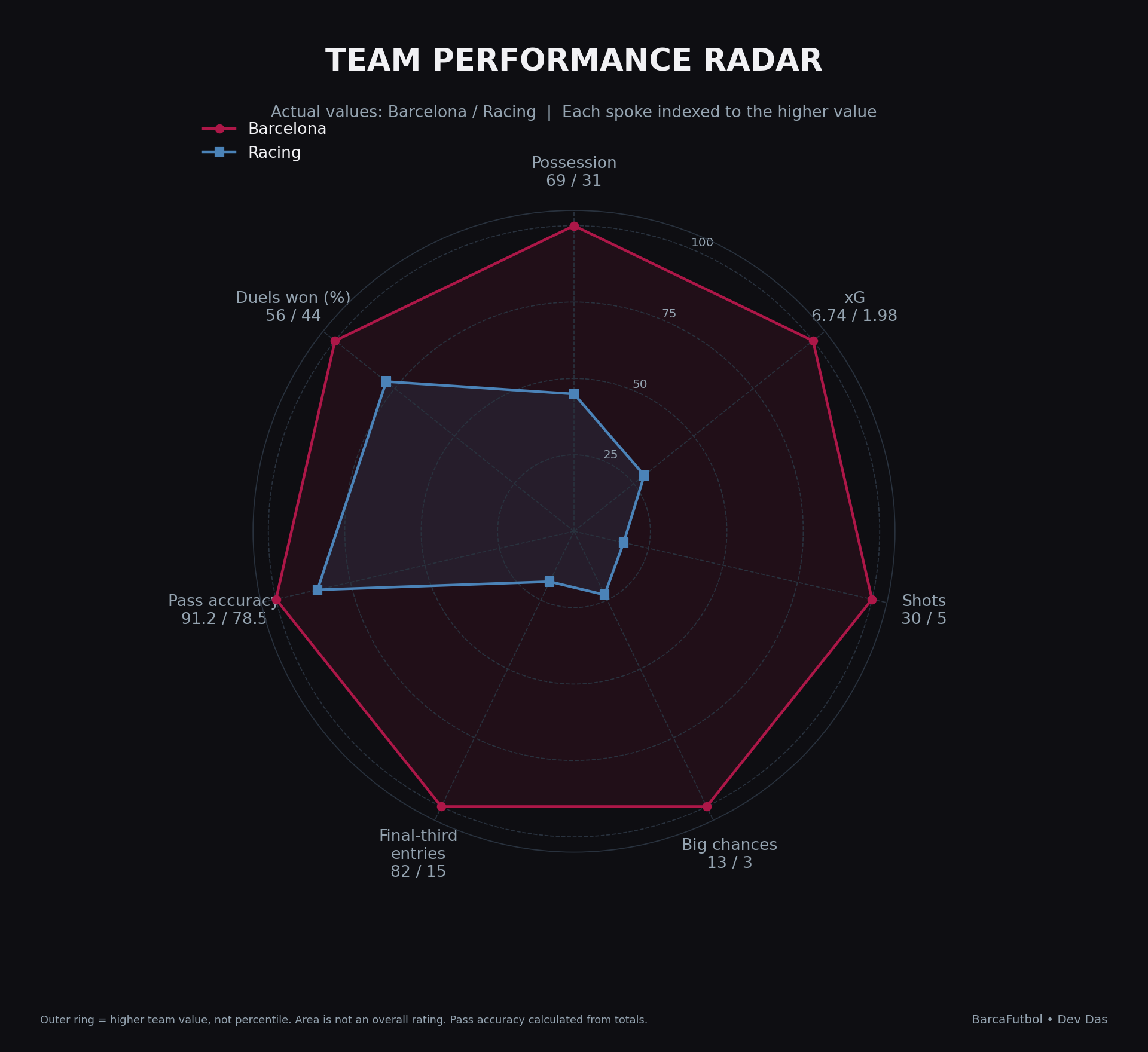
Barcelona’s radar expands to near-maximum capacity across every progressive metric. Their overwhelming 69% possession share was coupled with an exceptional volume of penalty-box touches and final-third entries, demonstrating that their circulation was consistently vertical and invasive rather than passive. The pressing and defensive action spikes highlight their counter-pressing efficiency: Barcelona choked off Racing’s outlets inside their own half, recovering possession in high areas before Racing could settle into a progressive passing pattern. The team’s chance quality axis—anchored by 6.74 xG and 13 big chances created—proves that Barcelona's defensive high line was directly subsidized by their attacking suffocating power.
Racing’s profile, in sharp contrast, is compressed almost entirely along their defensive and direct-transition axes. Their metrics reflect a side pushed to the perimeter: low overall passing volume, virtually non-existent sustained sequences in the opposition half, and a heavy concentration of defensive actions inside their own 18-yard box. However, their radar does display narrow, sharp spikes in direct vertical progression and transition efficiency, capturing the few moments where Maguette Gueye and Yassir Zabiri attacked the space behind Barça's high line to produce goals from minimal opportunities. The contrast between both profiles illustrates the match’s overarching dynamic: an all-encompassing attacking siege that conceded rare, high-leverage transition chances while completely overpowering the opponent across every other phase of play.
The Passing Web, Rest-Defense, and Spatial Dominance
When Barcelona advanced, the backline shifted laterally. Erc Garcia tucked inside from right-back to form a provisional three-man defensive foundation alongside the two central defenders. This provided direct insurance against Racing’s central strikers and gave Barcelona numerical security whenever possession turned over.
João Cancelo’s average touch position sat high up the left-inside channel, practically in line with the double pivot. Rather than overlapping on the outside and crowding Karim Adeyemi’s running lane, Cancelo stepped inside to act as a second deep-lying playmaker. This structural tweak gave Barcelona an extra passing angle into the box and made it almost impossible for Racing’s central midfield to step out and press without leaving pockets open behind them.
The central nodes of the network demonstrate why Barcelona controlled tempo so easily. Rodri occupied the base of the midfield, taking the fewest touches necessary to switch play, intercept clearances, and snuff out counter-attacks before they crossed the halfway line. Pedri operated with complete positional freedom just ahead, serving as the primary bridge between the first phase of build-up and the attackers pinned against Racing’s backline
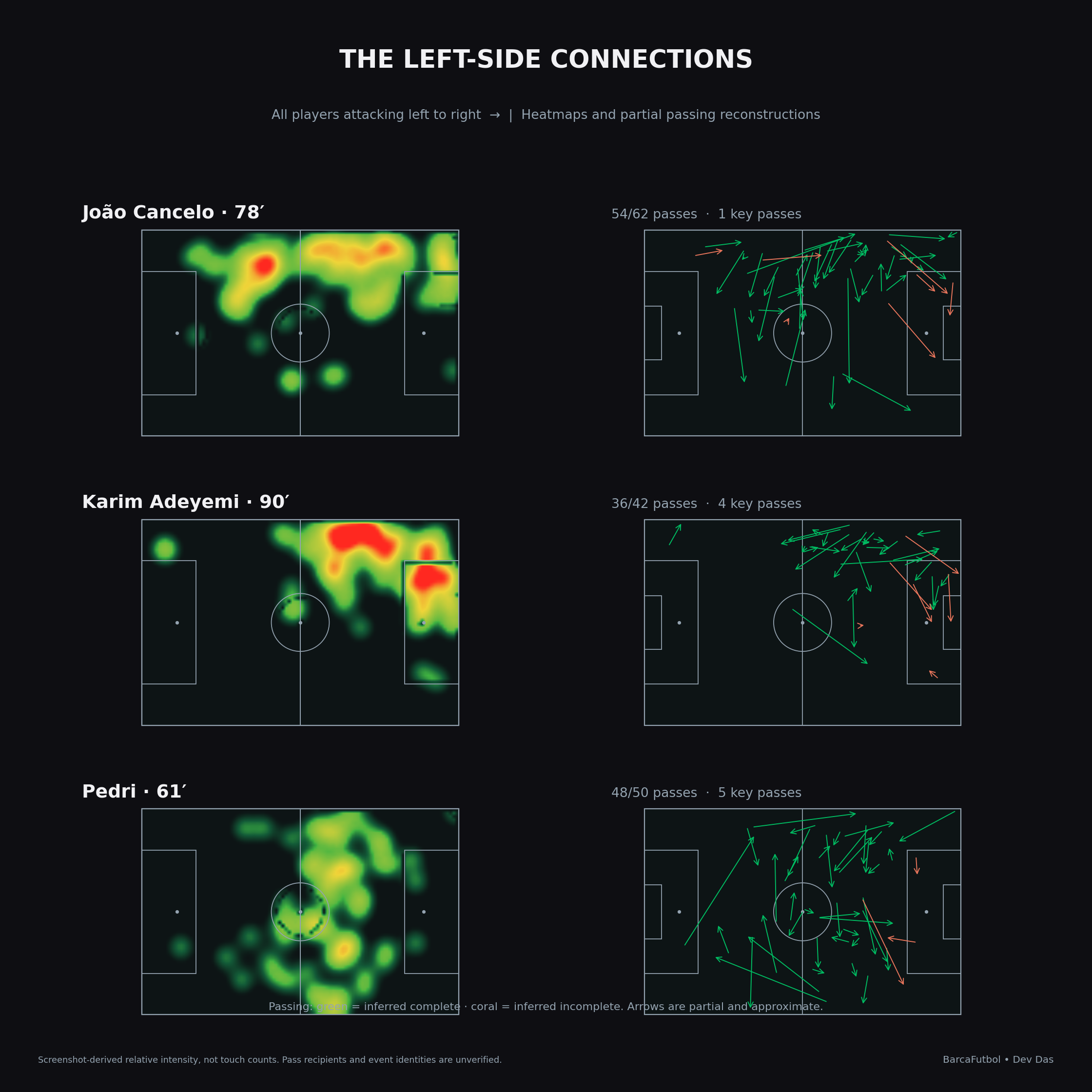
Barcelona systematically targeted Racing's right flank. Racing lined up in a compact 5-3-2 low block designed to guard the central box, but they had no collective answer for the movement mechanics of Cancelo and Adeyemi.
- Touchline Width vs. Half-Space Infiltration: Adeyemi was instructed to stay wide, hugging the chalk of the left sideline until the moment a pass was played. This forced Racing’s right wing-back to step out to close him down, which created a massive channel between Racing’s right-sided center-back and wing-back. Cancelo timed his forward runs to slip directly into that gap—an underlapping movement that caught Racing flat-footed repeatedly.
- The 1v1 Threat: When Adeyemi received the ball facing forward, his acceleration caused challenges. Knowing they couldn't match his pace in a straight footrace, Racing began fielding an extra central midfielder over to double-team him. That secondary movement opened up shooting lanes on the edge of the area—directly setting up Cancelo's opener and the long-range strike that turned into Asier Villalibre's own goal.
- Penalty-Box Penetration: Adeyemi’s relentless directness created pure chaos inside the 18-yard box. By driving aggressively toward the byline rather than looping crosses into a crowded area, his low, driven cutbacks contirbuted to winning penalties and ultimately setting up Lamine Yamal's finish for the seventh goal.
Central CreativityCombinations Between Pedri, Rodri, and Olmo
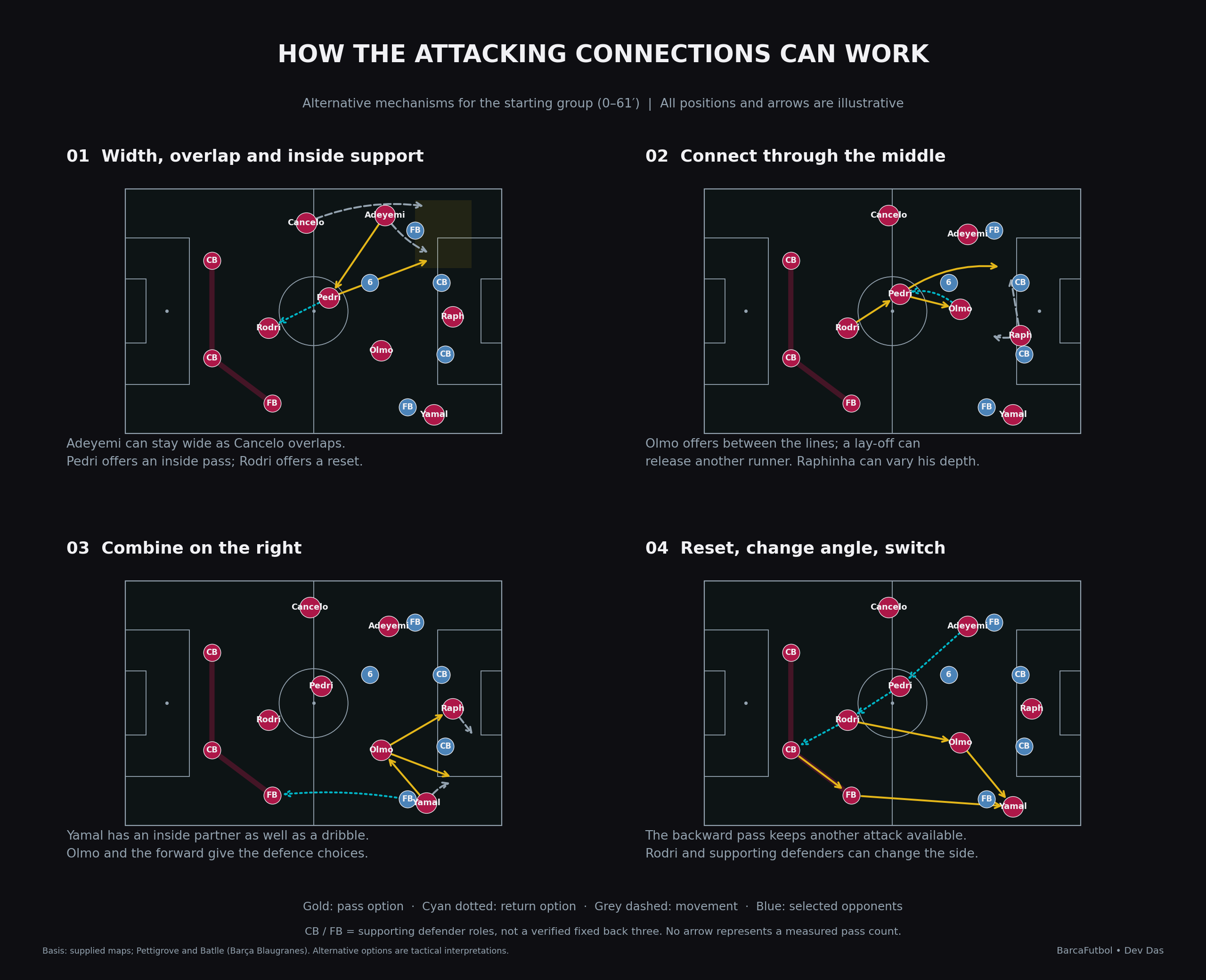
The interior passing map breaks down how Barcelona’s central midfield trio unpicked Racing’s defensive block through rapid, one-touch combinations rather than slow, static possession.
- Rodri’s Rest-Defense Anchor: Rodri’s value was defined by his positioning before Racing could launch a break. He positioned himself in the transition corridor 10 yards behind the attacking play, allowing him to win defensive duels and recover loose clearances the moment a turnover happened. This gave Barcelona sustained territorial pressure, keeping Racing trapped in a continuous defensive cycle.
- Playing on the Half-Turn (Pedri & Olmo): Pedri and Dani Olmo constantly drifted between Racing's flat midfield three and their back five. When Rodri fed them through-balls, neither player needed an extra touch to set themselves; they turned in the same motion, immediately attacking the penalty area.
- Olmo’s Vertical Delivery: Olmo’s vision consistently sliced Racing's center-backs open. Instead of playing predictable sideways passes, Olmo slipped angled diagonal balls between defenders, most notably finding Raphinha on a driving channel run for Barcelona’s fourth goal. This trio controlled the game’s pulse, determining exactly when to reset circulation and when to inject vertical pace
Lamine Yamal’s 1v1 Threat and Spatial Leverage
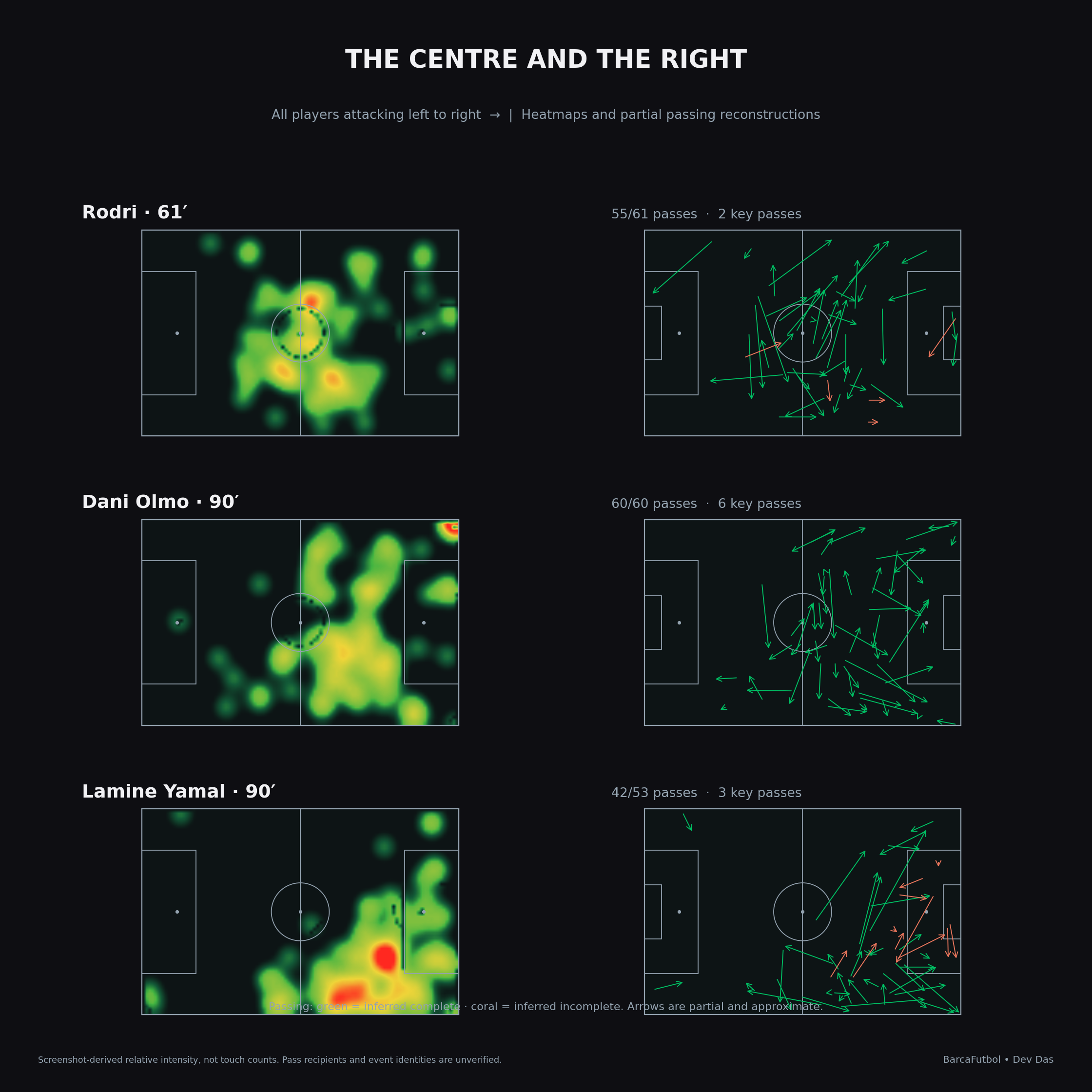
Lamine Yamal’s performance was a menace for Racing all night long. Even though he had to wait till the end to get his goal, he was incessant and kept coming from that right channel, opening spaces, creating chances, setting up assists and destabilising their defense consistently.
- Every time Barcelona circulated possession toward the right side, Racing’s entire defensive block visibly shifted. Yamal is difficult in isolated 1v1 duels. Racing had to assign two players—their left wing-back and an interior midfielder—to shadow him. This double-coverage tilted Racing's block away from the center, freeing up space for Raphinha to exploit through the middle and ensuring the left flank remained open for Cancelo and Adeyemi.
- Yamal was a bit unlucky. His first-half penalty was saved, another curled effort struck the woodwork, and a tidy finish was ruled out for offside. Yet there was no drop in aggression. He continuously attacked until Racing’s left flank collapsed from fatigue in the final 20 minutes.
- In the final phase, he drew two defenders before sliding a through-ball into Gabriel Jesus for the striker's goal. Ten minutes later, he capped the rout by ghosting in behind the back post to hammer home Adeyemi’s cutback for 7–2.
The Counterpress
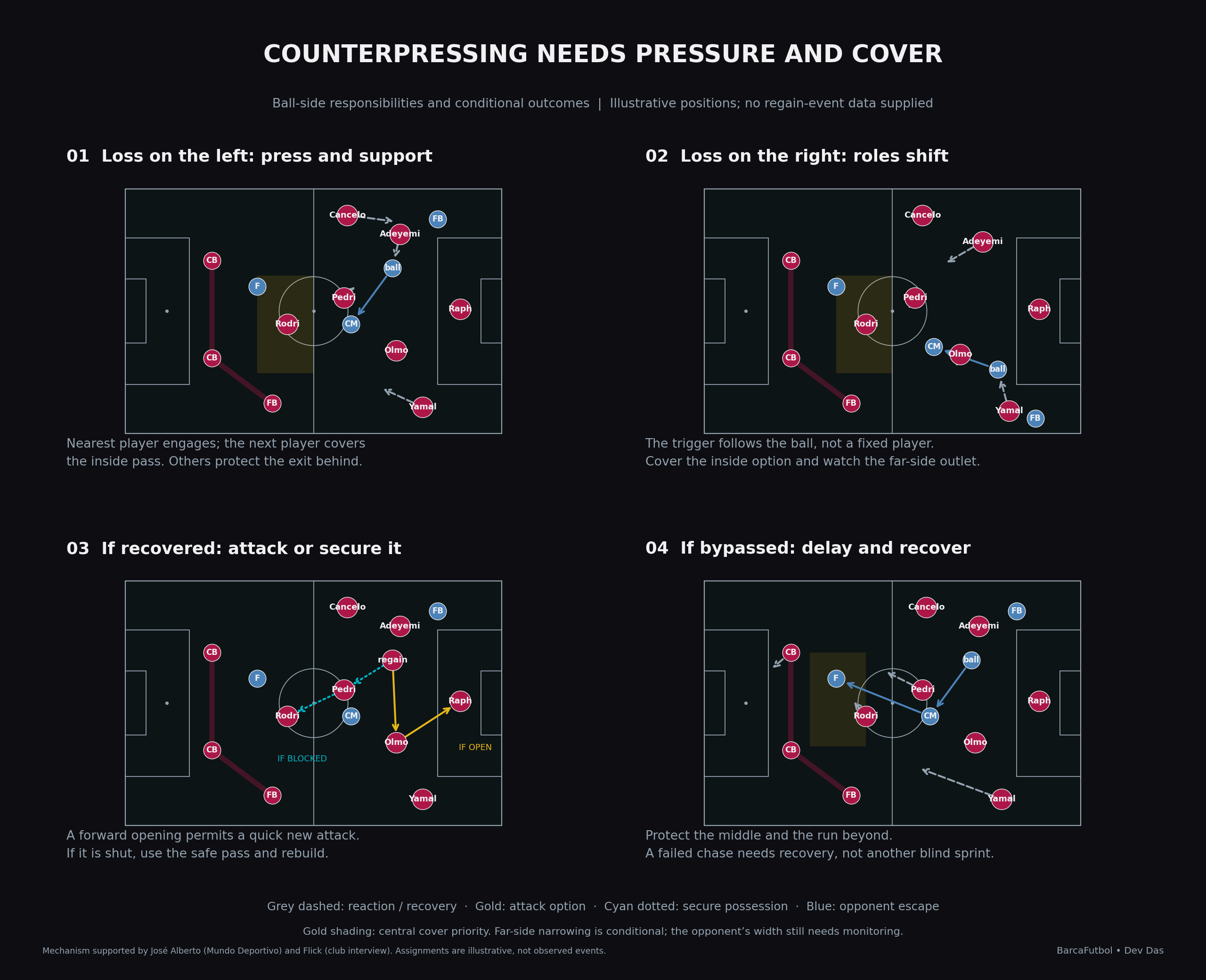
To aid this consistent chance creating machine, Barca held an average defensive line nearly 50 meters up the pitch, compressing the usable playing surface into a narrow band.
- This high line only functions when pressure on the ball-carrier is absolute. The team operated with clear pressing triggers: backward passes from Racing’s midfielders, bouncing balls on the wet surface, or touches toward the sideline. The moment a trigger occurred, Raphinha, Olmo, and Pedri converged in a pack, forcing Racing into rushed, blind clearances that the center-backs easily collected near the halfway line.
- When playing this aggressively, the goalkeeper must serve as an active libero. In the first half, Joan García executed this role cleanly, sweeping off his line to smother early through-balls outside his 18-yard box.
- It also highlights the vulnerabilities Racing managed to expose. If an opponent manages to bypass the first wave of pressure, Barcelona's high line leaves behind a 40-meter runway toward goal. Maguette Gueye exploited this exact gap in the first half, timing his run between the center-backs to make it 2–1.
WHO CREATED THE CHANCES?
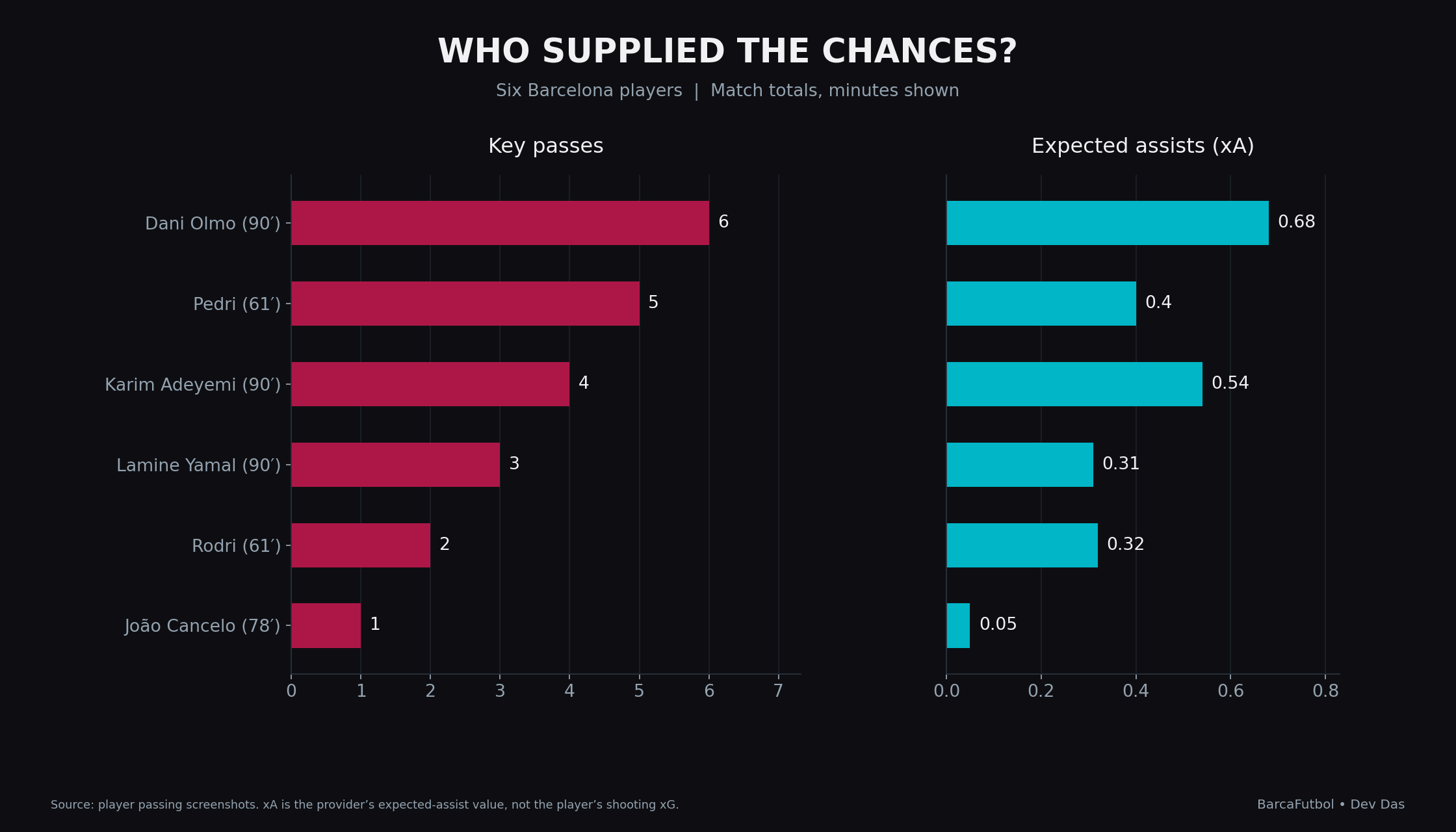
The creative production chart ranks Barcelona’s six primary chance architects by key passes and expected assists (xA). It highlights the multi-pronged nature of Flick's attacking machinery, showing that threat was distributed across every lane of the pitch.
Dani Olmo led the squad across his 90 minutes with 6 key passes and an outstanding 0.68 xA, proving to be the primary engine of central penetration. Directly behind him was Pedri, who generated 5 key passes and 0.40 xA in just 61 minutes of action, demonstrating immense creative efficiency between the lines.
The wide players contributed heavy chance-creation volume as well. Karim Adeyemi recorded 4 key passes and 0.54 xA across 90 minutes, using his touchline isolation to carve out high-value cutbacks. Lamine Yamal supplied 3 key passes and 0.31 xA from the right flank, while Rodri chipped in with 2 key passes and 0.32 xA from his deep-lying anchor role. João Cancelo rounded out the group with 1 key pass and 0.05 xA in 78 minutes, reflecting his hybrid duty of balancing interior circulation with direct goal threat.
Player Highlight: Karim Adeyemi
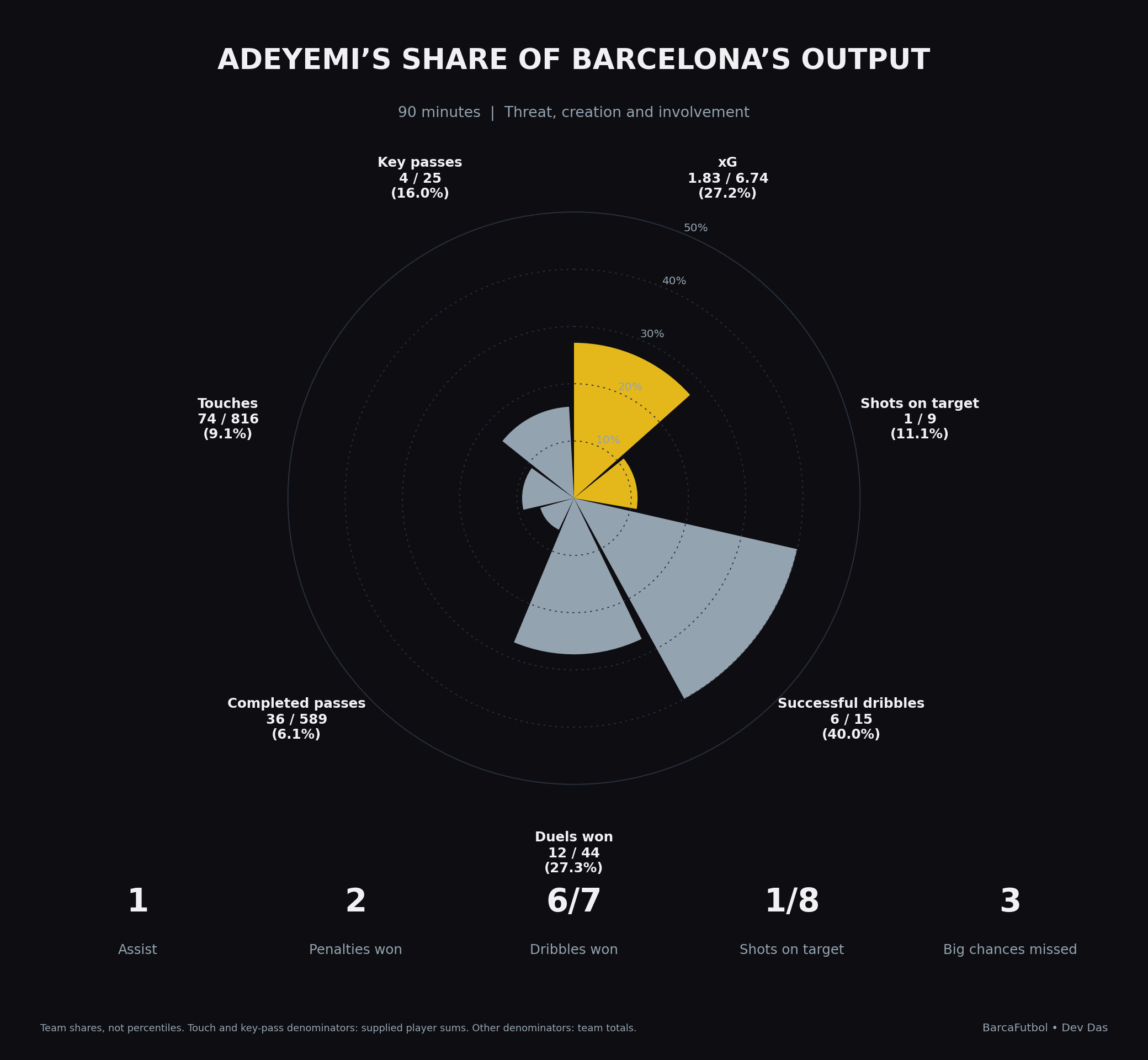
The individual performance radar highlights Karim Adeyemi’s performance on the left wing, tracking his decisive impact across shot creation, progressive carries, box entries, and take-on success.
Adeyemi’s profile demonstrates an exceptional blend of vertical speed and spatial intelligence. He didn't just stay wide to provide a passing option; he actively attacked Racing’s full-back from isolated positions, registering elite numbers in completed take-ons and penalty-box carries.
His ability to beat his direct marker off the dribble destabilized Racing's entire defensive structure, pulling center-backs out of position and creating the cutbacks that supplied Barcelona’s attackers. Adeyemi provided the direct running threat that balanced Barcelona’s central possession, establishing himself as the primary catalyst on the left flank.
Chance Creation and Shooting Threat
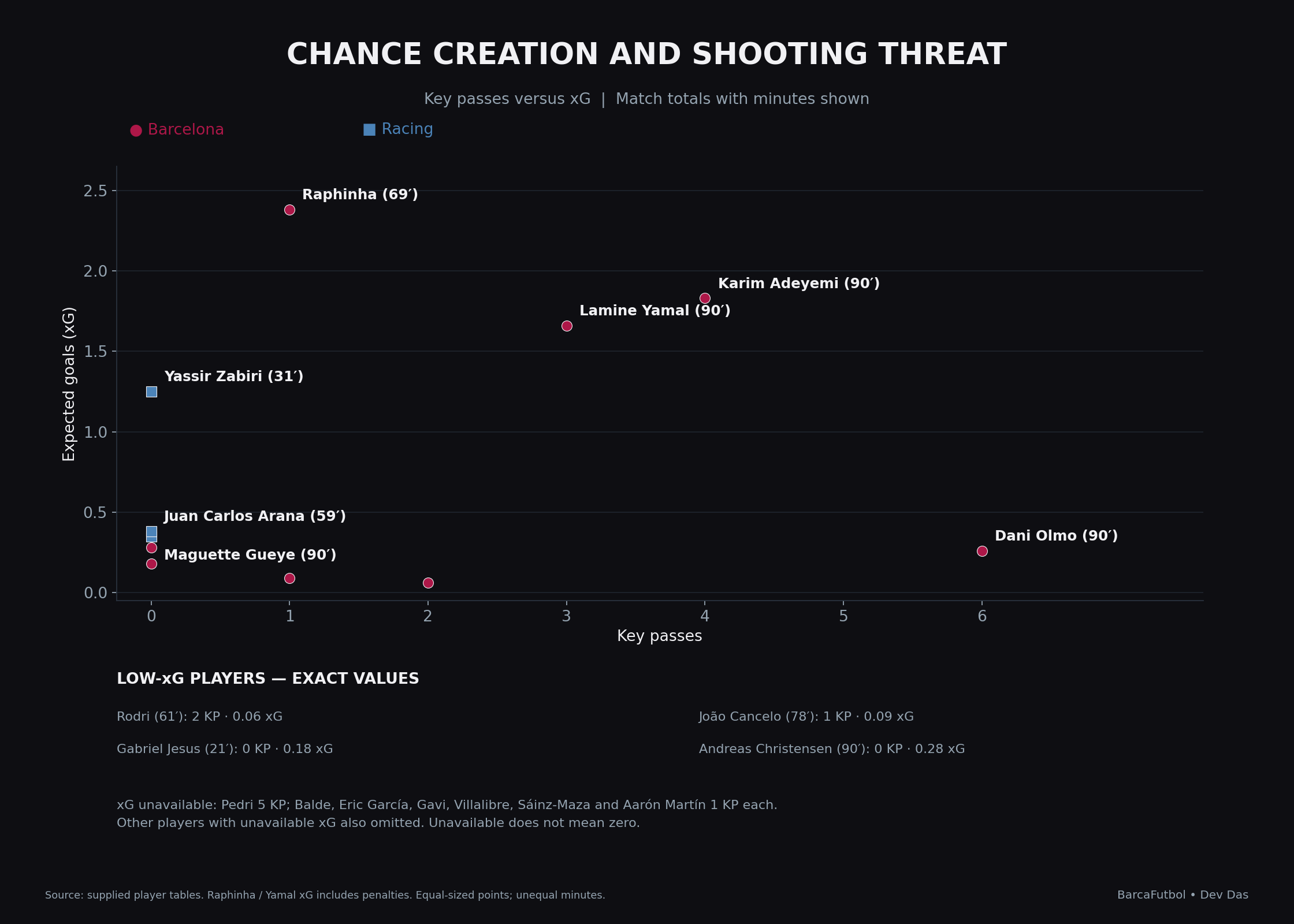
Rather than relying on a single attacker Barcelona's distribution displayed a distinct, complementary profile among their finishers and creators.
Raphinha (69') sat near the top, accumulating roughly 2.38 xG primarily as a finishing hub. While his creative distribution was limited to a single key pass, his movements in the box and penalty conversions made him Barcelona’s primary execution point. At the opposite end of the spectrum was Dani Olmo (90'), who led the entire match with 6 key passes despite recording only around 0.25 xG.
In between, Karim Adeyemi (90') and Lamine Yamal (90') provided dual-threat balance from the flanks. Adeyemi generated over 1.8 xG alongside 4 key passes, while Yamal posted over 1.6 xG with 3 key passes, underscoring how both wide forwards consistently blended isolated 1v1 penetration with incisive deliveries into the box.
Looking ahead
While seven goals and nearly seven expected goals provide immense cause for celebration, the match also highlighted the area which is the achilles heel for this Barca. Hansi Flick’s high defensive line requires total synchronization and aggressive sweeping from the goalkeeper. Joan García swept cleanly off his line in the first half, but after his injury withdrawal at the interval, Wojciech Szczęsny’s distribution error demonstrated that momentary lapses can be punished even during dominant performances.
Racing’s two goals came from direct, vertical balls that attacked the space behind Barcelona’s center-backs. Against elite European opposition in the Champions League, transitions of that nature will be far more lethal.
If Barcelona can maintain this extraordinary level of offensive fluidity while tightening their sweeping execution and rest-defense , they will be a force to beat this season.