Barça Raise €510m More in Debt, Raphinha Extends to 2030 and Daniel Freire joins the youth setup
Barca add new commercial partners to fund its debt repayment. The challenge is at 10x debt-to-EBITDA there is minimal room for further slippages.

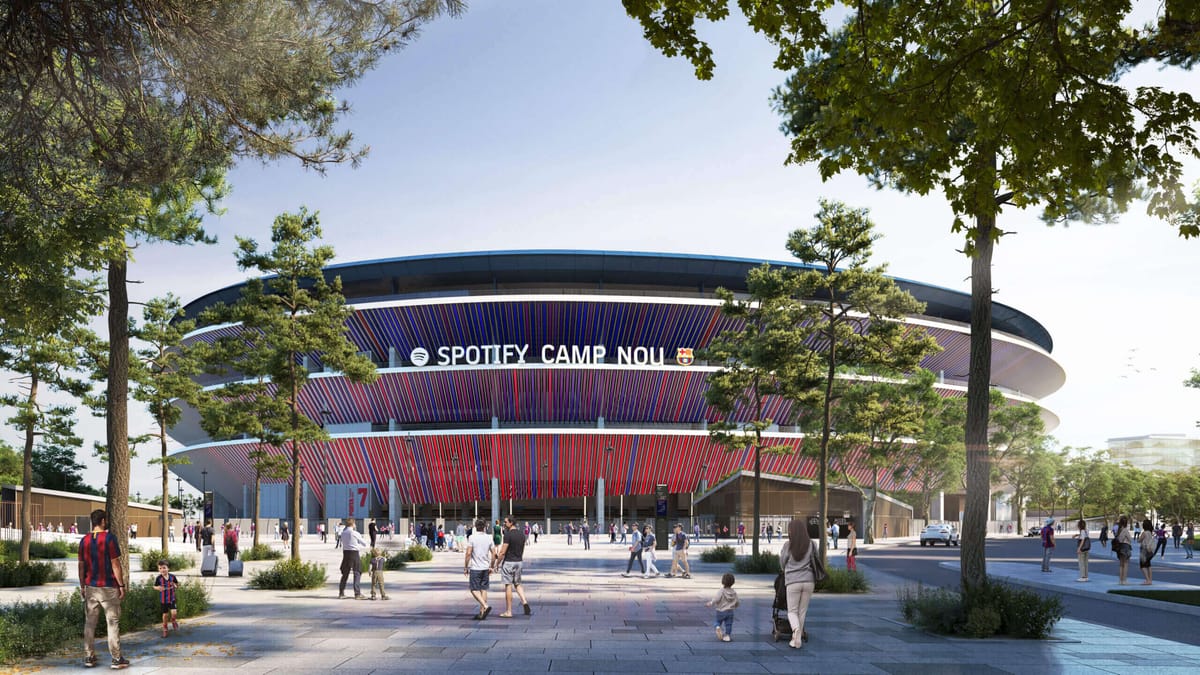
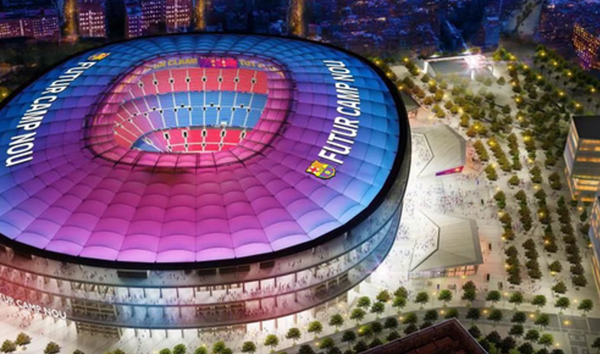
Barça raise another €510M to complete Camp Nou construction!
At the Ordinary General Assembly (Assemblea General Ordinària), FC Barcelona’s board of directors presented a comprehensive financial, infrastructural, and sporting blueprint designed to navigate the final leg of the club’s post-pandemic fiscal crisis. For the past three seasons, the club has operated under severe financial fair play restrictions, deployed emergency asset divestments (palancas), and endured the revenue vacuum of playing at the Montjuïc Olympic Stadium.
The headline resolution approved by the assembly of delegate members (socis compromissaris) was an incremental €510 million total financing package.
The approval raised immediate questions among members and analysts: Why did a project budgeted at €1.45 billion—which already included a dedicated contingency reserve—require over half a billion euros in fresh capital? How are these tranches secured? Who is funding them, what does it do to the club’s balance sheet, and what are the actual debt coverage dynamics?
Why did Barça need over €500M more?
When delegates authorized the initial financing structure in April 2023, the stadium redevelopment was capped at €1.450 billion, supported by an internal contingency buffer. That cushion, however, was depleted by a series of compounding technical, macroeconomic, and scheduling realities.
Addressing the assembly, Economic Vice President Ferran Olivé and President Joan Laporta outlined four primary cost drivers that forced the club back to the credit markets
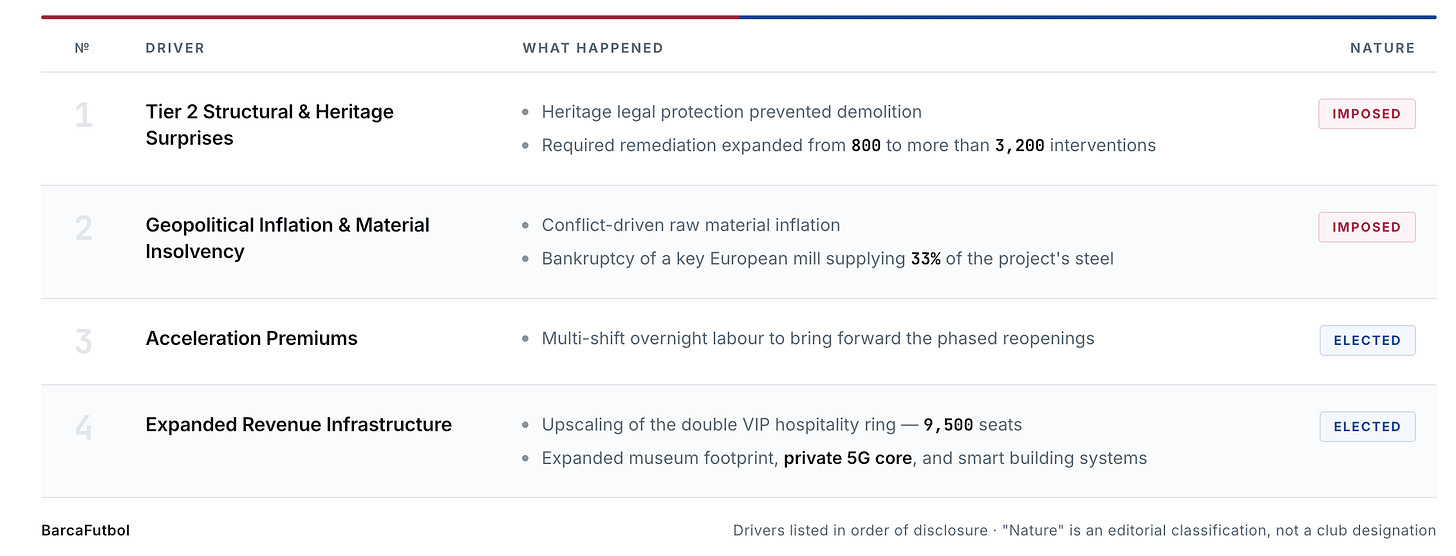
- Tier 2 Structural Remediation: The original 1957 second tier is legally protected architectural heritage and could not be demolished. When demolition crews stripped away the legacy facade and internal finishes, structural engineers discovered widespread degradation in the internal concrete framework. Planned remedial interventions ballooned from an estimated 800 structural points to more than 3,200, requiring complex restorative engineering.
- Supply Chain Shocks and Steel Mill Insolvency: Geopolitical instability in Eastern Europe and the Middle East triggered sharp price spikes in concrete, energy, and structural steel. This was compounded by the insolvency of a primary European mill contracted to supply roughly one-third of the stadium’s specialty structural steel, requiring emergency procurement at higher market spreads.
- Acceleration and Double-Shift Premiums: Staying at the Estadi Olímpic Lluís Companys drained the club’s matchday receipts. Every month away from Les Corts cost the club millions in lost ticketing, concessions, and retail turnover. To compress the construction schedule and enable phased reopenings, the board authorized 24-hour labor shifts, weekend operations, and expedited delivery contracts, creating substantial unbudgeted premiums.
- Upgraded Commercial Architecture: The board expanded the stadium’s original technological and hospitality scope. To secure future high-margin income, the club enlarged the footprint of the double VIP hospitality ring to accommodate 9,500 premium corporate seats, expanded the museum and tour spaces, and integrated advanced building automation.
The €150 million reserve had been exhausted absorbed by early inflation, structural fixes, and site logistics. Completing the stadium to its full 105,000-seat capacity and navigating the temporary cash drain required a dual-structured capital injection.
Unpacking the two tranches: €300M vs. €210M
The €510 million package is divided into two legally and structurally distinct operations designed for different purposes and backed by different collateral.
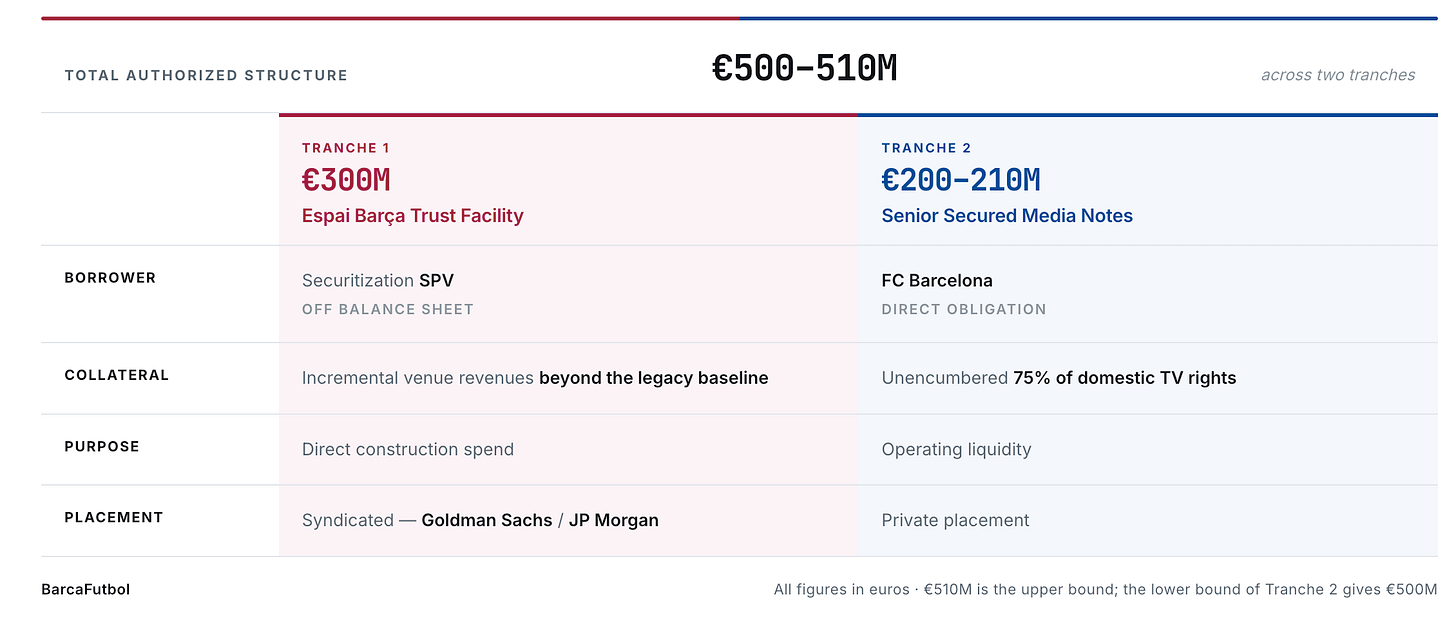
€300M Espai Barça credit expansion
- The Mechanism: An expansion of the existing securitization facility (Fondo de Titulización Espai Barça - FTA), established in April 2023. This vehicle lifts the dedicated stadium debt envelope from €1.450 billion to €1.750 billion.
- Who Funds It: Arranged through the existing syndicate led by Goldman Sachs and J.P. Morgan, funded by institutional private credit managers, US life insurance companies, and sovereign debt investors.
- Security and Collateral: The €300 million facility is non-recourse to ordinary club assets. It carries no physical mortgage over the stadium, the Ciutat Esportiva Joan Gamper training ground, or the surrounding land. Furthermore, bondholders have zero claim on membership dues, domestic TV income, or player transfers.
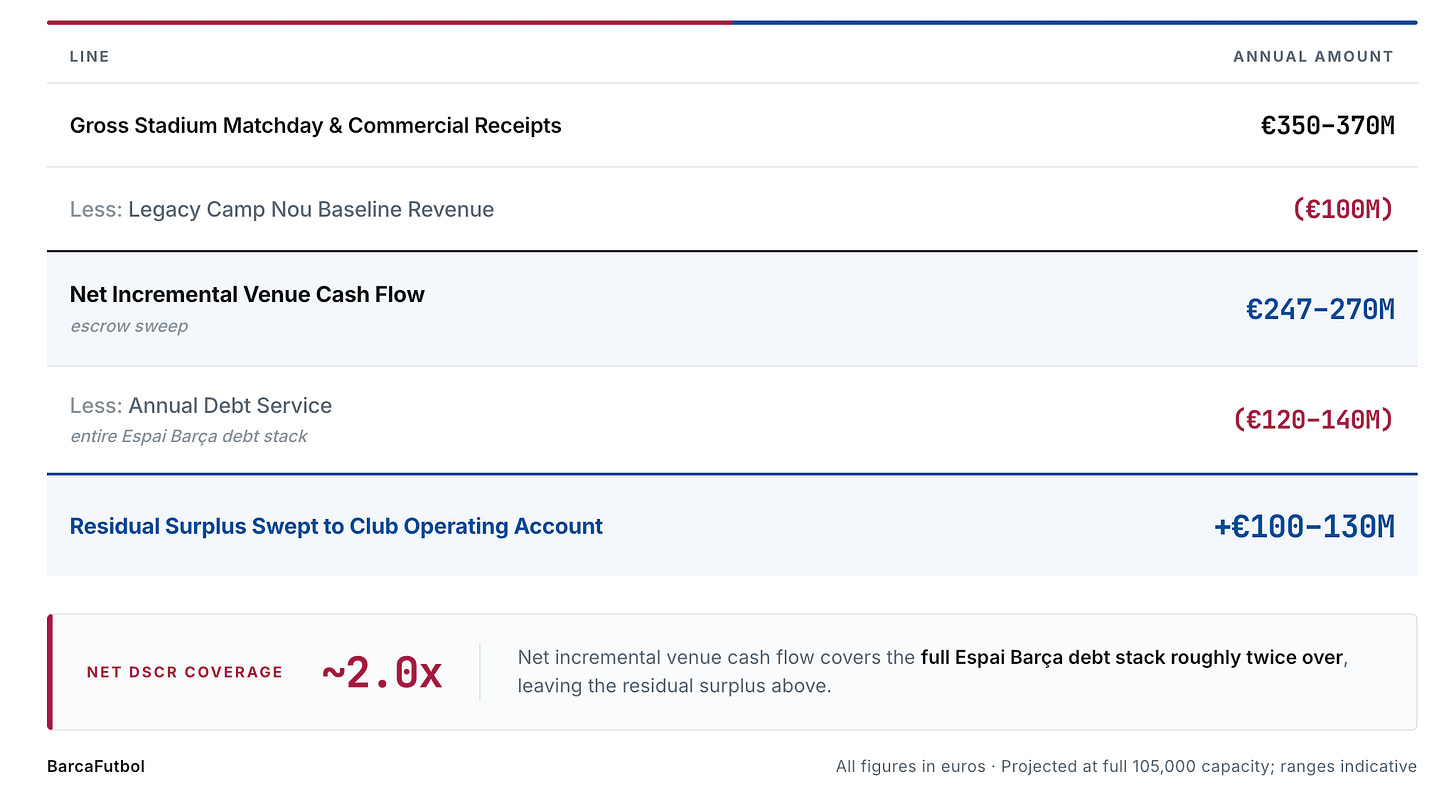
- Repayment Waterfall: The debt is repaid through a self-liquidating cash sweep. All gross revenues generated by Spotify Camp Nou flow into an escrow collection account. The first ~€100 million is remitted directly to the club to replace the legacy stadium’s baseline earnings. Only the incremental surplus above that baseline is captured by the trust to service interest and amortize principal.
- Assembly Vote: Approved with 562 votes in favor (89%), 45 against (7%), 14 blank (2%), and 14 abstentions.
€200M–€210M senior secured media notes
- The Mechanism: The issuance of two tranches of senior secured notes (~€105 million each) under an institutional private placement program. The first tranche was placed in July 2026, with the second scheduled for late 2026. Both carry maturities of up to 10 years (maturing October 2036) at fixed market coupons (~5.14%).
- The Television Rights Question: In the summer of 2022, Barça sold a 25% stake in its domestic La Liga television rights to US private equity firm Sixth Street for 25 years (generating €522.5 million across two tranches). Barça did not sell its remaining television rights. Instead, the club issued standard senior debt backed by the unencumbered 75% of domestic media revenue it still owns, alongside 100% of its UEFA broadcasting money (which was completely excluded from the Sixth Street deal).
- Cash Flow Mechanics: Broadcast payments distributed by La Liga flow into a secured collection account. Sixth Street receives its 25% cut first. From the remaining 75%, scheduled debt service (~€10M–€12M per year) is paid to institutional noteholders. The residual cash is then swept into Barça’s unrestricted operating treasury.
- Why Use TV Rights? Broadcast distributions from La Liga and UEFA are among the most predictable, legally insulated cash flows in sports. Because the notes carry a senior claim on these inflows, credit agencies rate the issuance Investment Grade (BBB), enabling Barça to borrow at an interest rate (~5.14%) significantly lower than unsecured bank credit lines.
- Purpose: To provide immediate bridge liquidity, replenish general treasury reserves, and smooth operating working capital while the stadium runs at reduced capacity.
- Assembly Vote: Approved with 486 votes in favor (85%), 55 against (9%), 28 blank (5%), and 5 abstentions.
The full capital stack and balance sheet exposure
With these approvals, the architecture of FC Barcelona’s global debt facilities breaks down across specific structures, maturities, and collateral pool
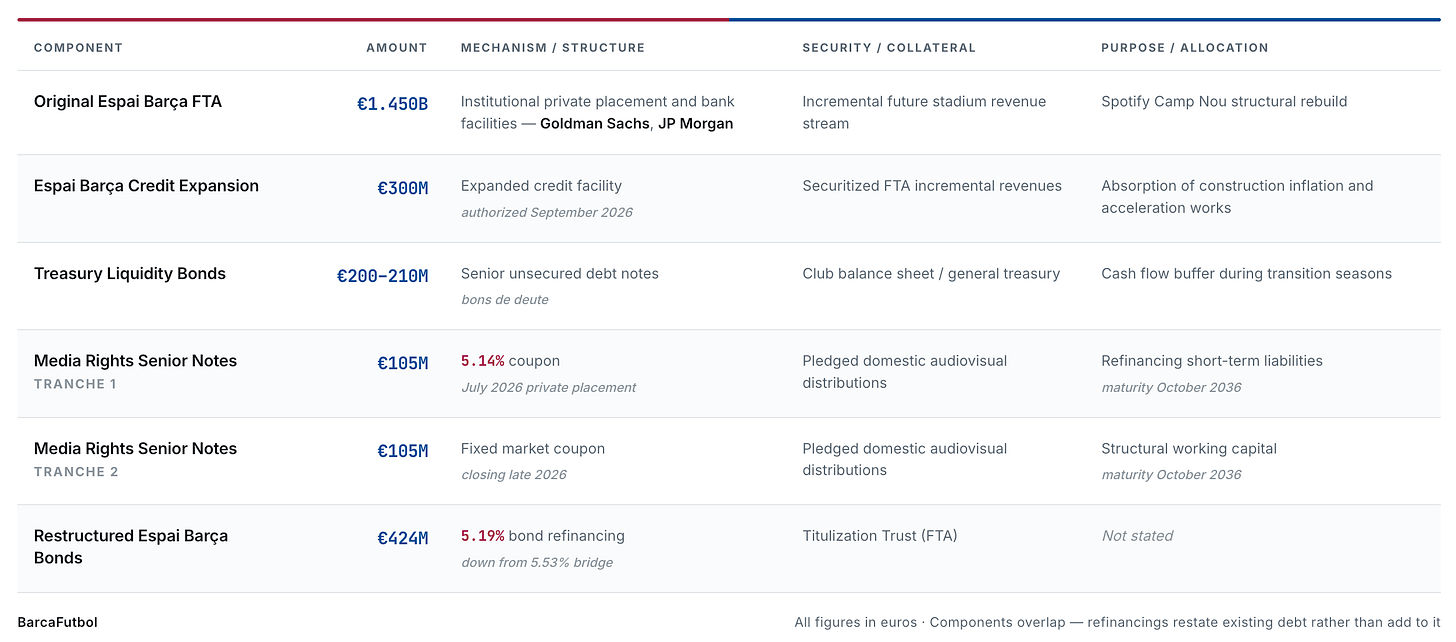
Balance sheet exposure and multiples
- Aggregate Club Liabilities: Global club debt—encompassing the Espai Barça securitization facilities, institutional senior notes, syndicated bank credit lines, supplier trade payables, and player transfer amortizations—stands at approximately €2.0 billion.
- Enterprise Valuation Backstop: This debt load is set against an independent club enterprise valuation estimated at €7.5B to €8.0 billion.
- Leverage Multiplier: With operating EBITDA compressed to ~€130M–€180M during the displacement and phased-reopening period, the club’s debt-to-EBITDA multiple stands at roughly 10x. Standard investment-grade European corporate borrowers typically operate within 3.5x to 4.0x, highlighting the operational tightrope the board must walk until full stadium monetization is realized.
- Statutory Solvency Guardrails: To protect the club’s traditional ownership model, four core parameters govern the entire stack:
- No Club Mortgage: The stadium, training grounds, and campus real estate cannot be mortgaged or seized by creditors.
- Operational Independence: Everyday commercial revenues, sponsorship money, and membership dues remain isolated from stadium bondholders.
- Zero Levy on Socis: The board is statutorily barred from issuing capital calls or financial assessments to members to cover debt service.
- Self-Liquidating Cash Sweep: Infrastructure debt is amortized exclusively out of the differential revenue generated over the legacy €100M baseline.
Commercial capitalization: Ohana and Babylon Park
To generate non-stadium revenue without incurring capital expenditures, Vice President Ferran Olivé presented two non-recourse operational partnerships. Both contracts monetize intellectual property and stadium footprint while transferring real estate and financial execution risk to external partners.
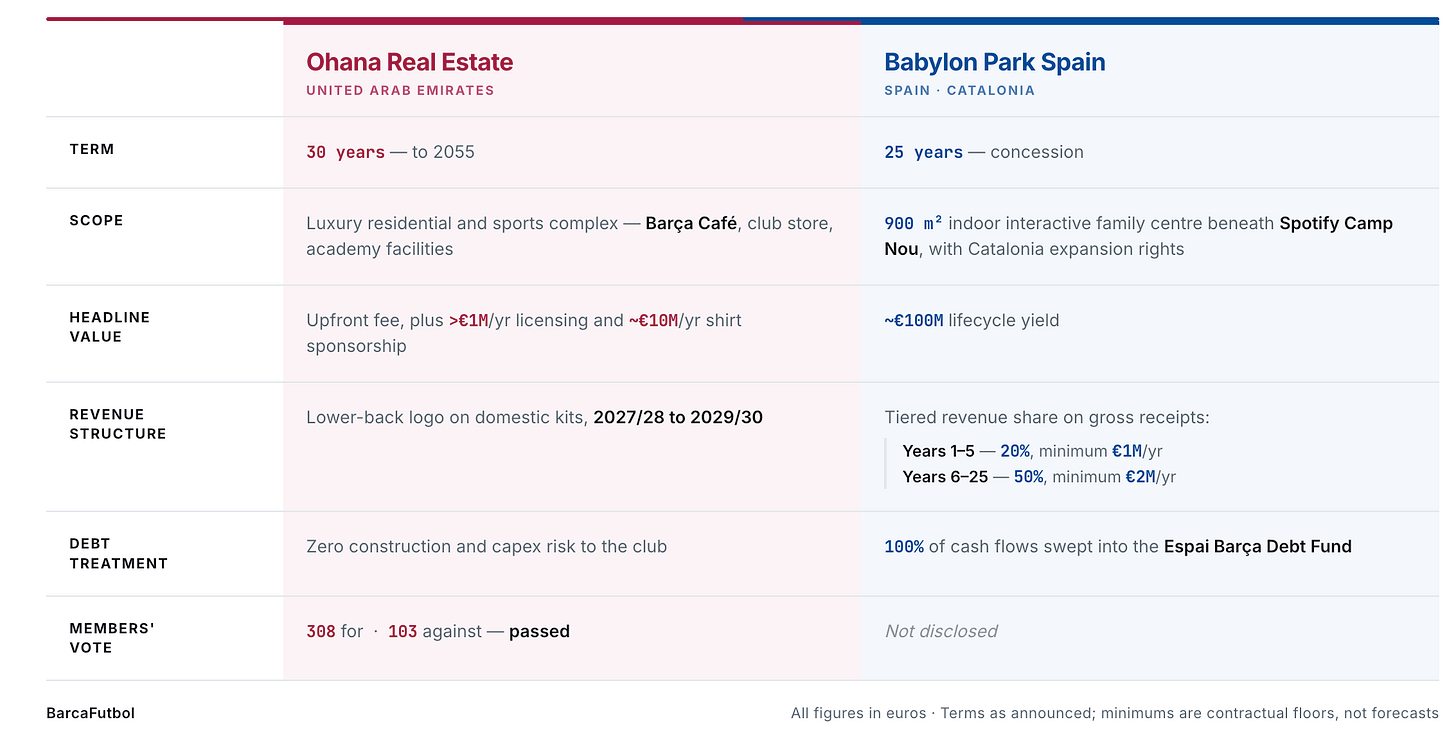
Ohana Real Estate Development & Construction LLC
- Duration: 30-year brand licensing agreement running through 2055.
- Scope: Development of an exclusive luxury residential, sports, and lifestyle complex under the FC Barcelona brand in the United Arab Emirates. The development integrates experiential club assets, including a Barça Café, an official retail megastore, and a Barça Academy.
- Domestic Shirt Sponsorship: Global partner branding on the lower back of both the men’s and women’s first-team shirts for domestic competitions (La Liga, Copa del Rey, and Supercopa de España) for three seasons: 2027/28, 2028/29, and 2029/30.
- Financial Model: The club collected an upfront deposit, followed by ongoing annual licensing royalties (>€1 million per year base) and sponsorship fees estimated at ~€10 million annually across the active jersey cycle.
- Risk Profile: Zero real estate or capital expenditure liability. 100% of the construction capital, material costs, labor liabilities, and market risks are borne entirely by Ohana.
- Vote: Approved with 308 votes in favor, 103 against, and 32 blank votes.
Babylon Park Spain, S.L.
- Duration: 25-year operational license.
- Scope: Construction and commercial management of a 900 m² indoor interactive and family entertainment center situated directly below the Barça Café within Spotify Camp Nou, with development rights across Catalonia.
- Financial Model & Securitization: Projected to yield approximately €100 million over the 25-year lifecycle.
- Years 1–5: 20% gross revenue share with an annual guaranteed minimum floor of €1 million.
- Years 6–25: 50% gross revenue share with an annual guaranteed minimum floor of €2 million.
- Debt Service Integration: Crucially, 100% of the cash flows generated from Babylon Park are pledged directly into the Espai Barça Fund (Fondo de Titulización Espai Barça), reinforcing debt service coverage for the Goldman Sachs credit facility.
- Corporate Scrutiny & Vote Context: The proposal generated the most contentious debate of the assembly. Several delegate members questioned the corporate origins of the company and its institutional footprint amid ongoing geopolitical conflicts. Ferran Olivé addressed the floor, stating that Babylon Park is an established UK-headquartered operator across Europe (>15 years) and that independent legal due diligence confirmed the ownership structure complied with all European compliance frameworks and international sanctions regulations.
- Vote Outcome: The contract was ratified, though with the highest dissenting margin of the session: 252 in favor, 158 against, and 31 blank votes.
Incremental earnings, debt servicing, and coverage dynamics
To evaluate whether adding €510 million in debt is sustainable, the incoming cash flows from the redeveloped stadium must be compared against the combined debt-service burden.
The inflow engine
In the original 2023 prospectus, Spotify Camp Nou was modeled to produce roughly €247 million in incremental revenue per season beyond the legacy €100 million baseline. The board’s updated models show that expanded VIP boxes, the 48,000 m² cable-net roof with its panoramic tourist skywalk, and non-matchday campus exploitation will drive recurring gross stadium receipts to €350M–€370M annually. This generates an incremental yield of €247M to €270M per year dedicated to debt servicing.
Outgoing debt service on the incremental €510M
The debt service burden generated specifically by the newly approved €510 million financing breaks down as follows

Debt service coverage ratio (DSCR)
- Normalized Operation Coverage (Post-2028): Once Spotify Camp Nou operates at its completed 105,000 capacity, the incremental stadium cash flow alone (€247M–€270M+) will provide an estimated 2.0x coverage ratio over the annual debt service (~€120M–€140M) of the entire consolidated €1.750B infrastructure debt facility.
- The Revenue Dividend: Because debt servicing captures only what is needed to amortize the notes according to the agreed schedule, the remaining differential revenue (projected at €100M+ annually) is released from escrow into the club’s ordinary budget, lifting overall operating revenue.
Multi-Year Financial Outlook (2025–2031)
The financial presentation concluded with an operating model mapping the club’s transition through the construction cycle into full exploitation:
Comparative Financial Performance & Projections

While the math is sustainable once the 105,000-seat bowl is fully operational, the club faces a tight transition window. Economic Commission Chair Oriol Amat highlighted that the budgeted operating surplus for the 2026/27 season is razor-thin: just €1.0 million on €1.195 billion in turnover.
Any material execution delay or sporting shortfall during this two-year bridge period could strain operating liquidity. This explains why the board structured the €210 million media-secured notes: it provides dedicated balance-sheet insulation until the stadium’s primary cash-generation engines go live.
Sporting equity and governance safeguards
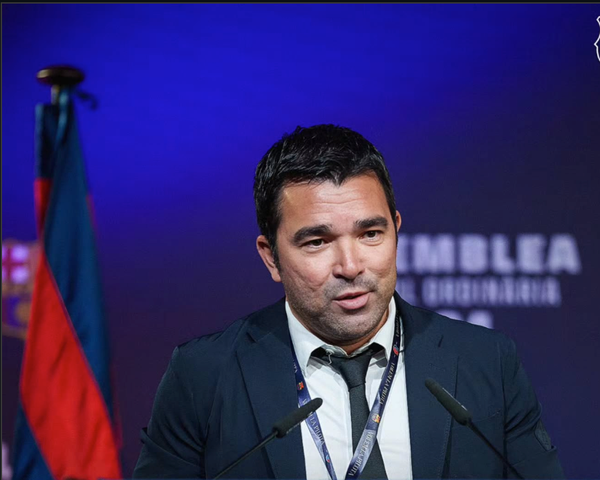
The financial strategy was linked to the sporting presentation delivered by Deco, who argued that squad construction has become the primary defense against market inflation.
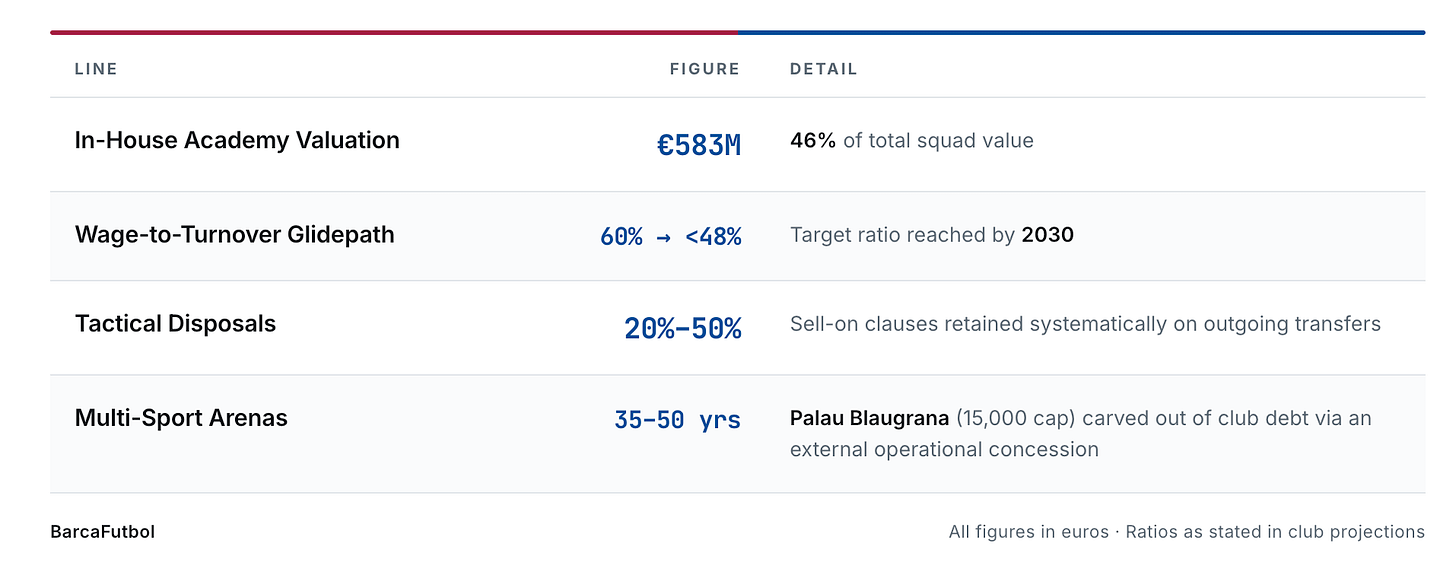
- The La Masia Anchor: Homegrown academy talent accounts for €583 million (46%) of the first-team squad’s aggregate market value. Integrating players like Lamine Yamal, Pau Cubarsí, Marc Bernal, Fermín López, and Gavi has reduced reliance on speculative high-fee acquisitions.
- Asset Control on Outflows: Senior departures were executed to manage wage compliance under La Liga Squad Cost Limits (LCPD). Recent outgoing transactions (such as Ansu Fati to AS Monaco, alongside academy departures) retained buy-back options or 20% to 50% future sell-on rights.
- De-Risking the New Palau Blaugrana: To ensure the multi-sport sections (basketball, handball, futsal, roller hockey) maintain modern facilities without diluting football capital, the planned 15,000-seat Palau Blaugrana arena was carved out of direct balance-sheet debt. The facility will be constructed and operated through an external 35-to-50-year third-party concession.
FC Barcelona’s assembly vote was neither an emergency fire sale nor a blank check. It reflects an aggressive, highly engineered refinancing designed to manage severe construction inflation, ring-fence core assets, and modernize the stadium footprint.

By separating infrastructure liabilities from domestic media and ordinary club revenues, the board has created a structure where the stadium expansion funds its own completion. However, carrying a 10x debt-to-EBITDA multiple during the transition means there is minimal room for further construction slippage or operational delays before full commercialization begins.
Raphinha extends till 2030!
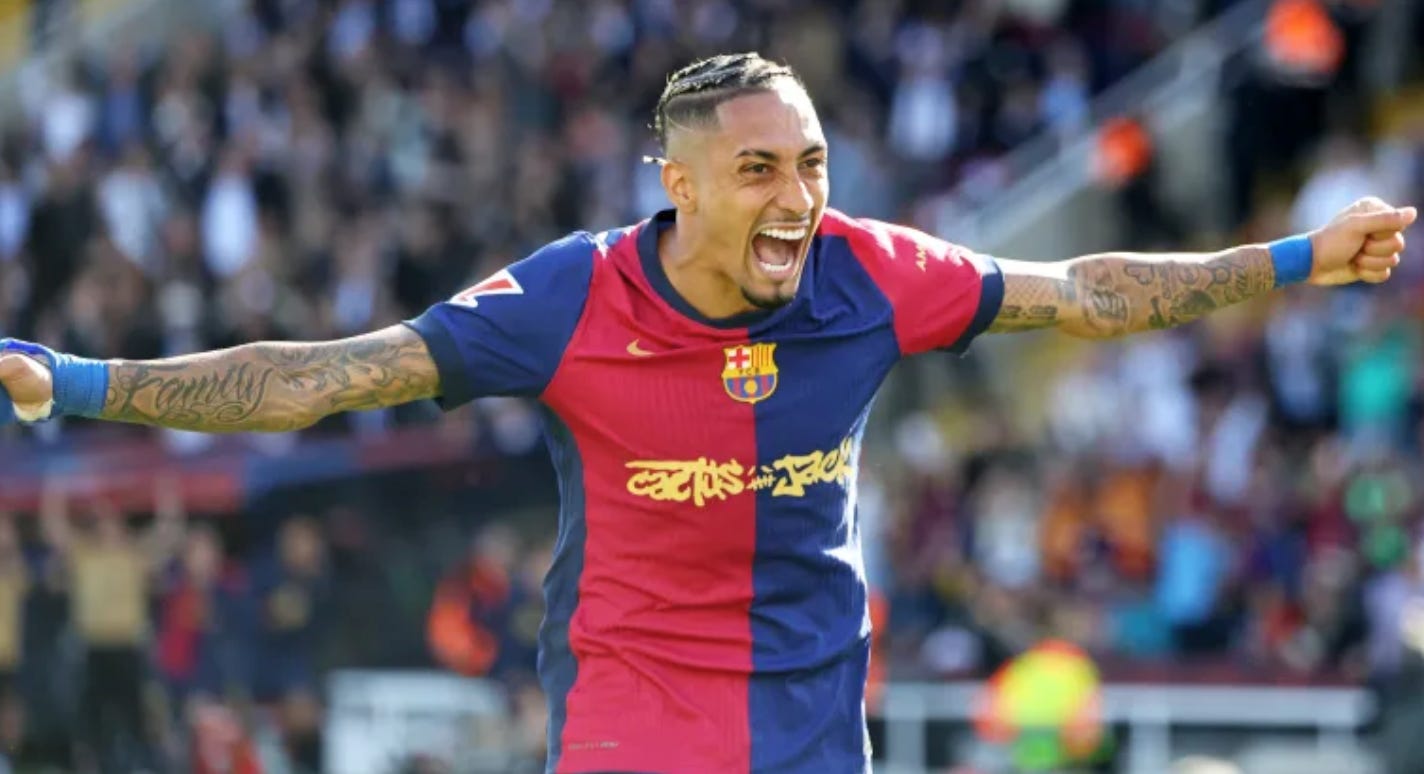
FC Barcelona sporting director Deco stepped up to the podium during Saturday’s Ordinary General Assembly and cut straight to the chase: the club had practically closed an agreement to extend club captain Raphinha. Deco confirmed from the dais that after intensive talks the previous afternoon, terms were in place to keep the Brazilian forward in Catalonia for the next four seasons.
The announcement untangled early confusion across Catalan media. Initial radio and wire reports suggested the deal ran until 2029, but official corrections clarified the arithmetic: four full seasons from September 2026 takes the agreement directly through June 30, 2030. The extension adds two years to his preceding contract, which was scheduled to expire in 2028.
The shock reinvention as Barcelona’s new No. 9
What makes this agreement so urgent is the sheer disbelief surrounding Raphinha’s tactical metamorphosis under Hansi Flick. Signed originally as an orthodox wide attacker, Raphinha has completely stunned observers by sliding seamlessly into the central striker role. Rather than struggling with his back to goal, he has led the line with the predatory instincts, diagonal blindside runs, and composure of a natural-born center-forward. He has outscored every forward in Spain, timing his box arrivals so cleanly that it looks as though he has spent his entire career operating inside the penalty area.
Securing this renewal was not just a defensive business move; it was an imperative recognition of an indispensable talisman. When a manager unlocks that kind of elite, match-winning output from an existing squad leader, locking him in for the long haul becomes the single most critical priority for sporting stability. Nobody in the squad worked harder to adapt, lead by example, and shoulder the scoring burden when the tactical framework shifted. He has earned every single euro and every single year on that new contract!.
It was also part of a coordinated triple announcement. Alongside Raphinha, Deco revealed that the club has simultaneously wrapped up extensions for emerging midfield pivot Marc Bernal (committed through 2031) and versatile full-back Xavi Espart (locked down through 2030). Locking in two homegrown teenage pillars while reinforcing the senior captaincy serves as a statement of squad continuity.
The numbers driving the decision
The sporting justification for extending a forward through his age-33 season is obvious to anyone watching the pitch. Operating in central offensive pockets, Raphinha has transitioned from a supporting creator into a lethal focal point.
He tops the domestic scoring charts with nine league goals across six La Liga fixtures, generating underlying expected-goals volume matching Europe’s most established center-forwards. Factoring in domestic league matches and European competition, the tally reaches 11 goals and 3 assists in just seven appearances.
Raphinha 2026–27 Output (Opening 7 Matches):
├── Total Appearances: 8
├── Goals (All Comps): 14
├── League Goals: 12 (La Liga Top Scorer)
├── Assists: 3
└── Tactical Role: Central Attacking Striker / Inside Left
In the modern transfer market, replacing that volume of direct goal contributions requires a nine-figure outlay. When clubs like Liverpool committed north of £100m on younger replacements in recent windows, spending that capital internally to extend an entrenched leader who is already delivering every forty minutes is straightforward asset preservation.
Rebuffing the market
The renewal also gives Raphinha what he fully deserves as the undisputed captain of this Barcelona side. Over recent months, lucrative approaches arrived from the Saudi Pro League, offering packages topping €90m in transfer value alongside substantial tax-free wage packages. Premier League suitors had also continued to monitor his contract status after his high-efficiency campaigns following his arrival from Leeds United in 2022.
The turning point was player intent. Speaking in an interview on Catalan radio RAC1 just before the assembly, Raphinha made it clear that initial talks were underway and that his explicit ambition was to finish his European career at Barcelona. Once both sides aligned on duration, the sporting department moved rapidly to shut down external suitors.
Payroll realities and squad construction
Where the renewal triggers debate is how it intersects with Barcelona’s wider wage framework. Under La Liga Economic Control regulations, Barcelona must keep its sporting payroll tightly balanced against approved spending caps.
Previous contract renegotiations for veteran figures were defined by financial concessions. Midfielder Frenkie de Jong took an aggressive salary restructuring to extend to 2029, while veteran striker Robert Lewandowski departed after refusing reduced wages on his expiring deal. Raphinha’s new terms reflect the opposite dynamic: a scheduled salary increase that rewards his armband status and irreplaceable goal return.
The question mark is how his long-term continuity fits next to recent recruitment. In May, Barcelona completed the high-profile capture of winger Anthony Gordon in an €80m total outlay from Newcastle United. Gordon has registered four assists across his opening 311 minutes without yet scoring, rotating with Karim Adeyemi out wide.
Extending Raphinha through 2030 solidifies the top of the wage bill and locks down the central channels. Deco has publicly declared the pact agreed. With the assembly presentation concluded, the club is set to finalize the administrative and legal filings this coming week to officially publish the formal paperwork.
Espai Barça expands its commercial portfolio with Telefónica
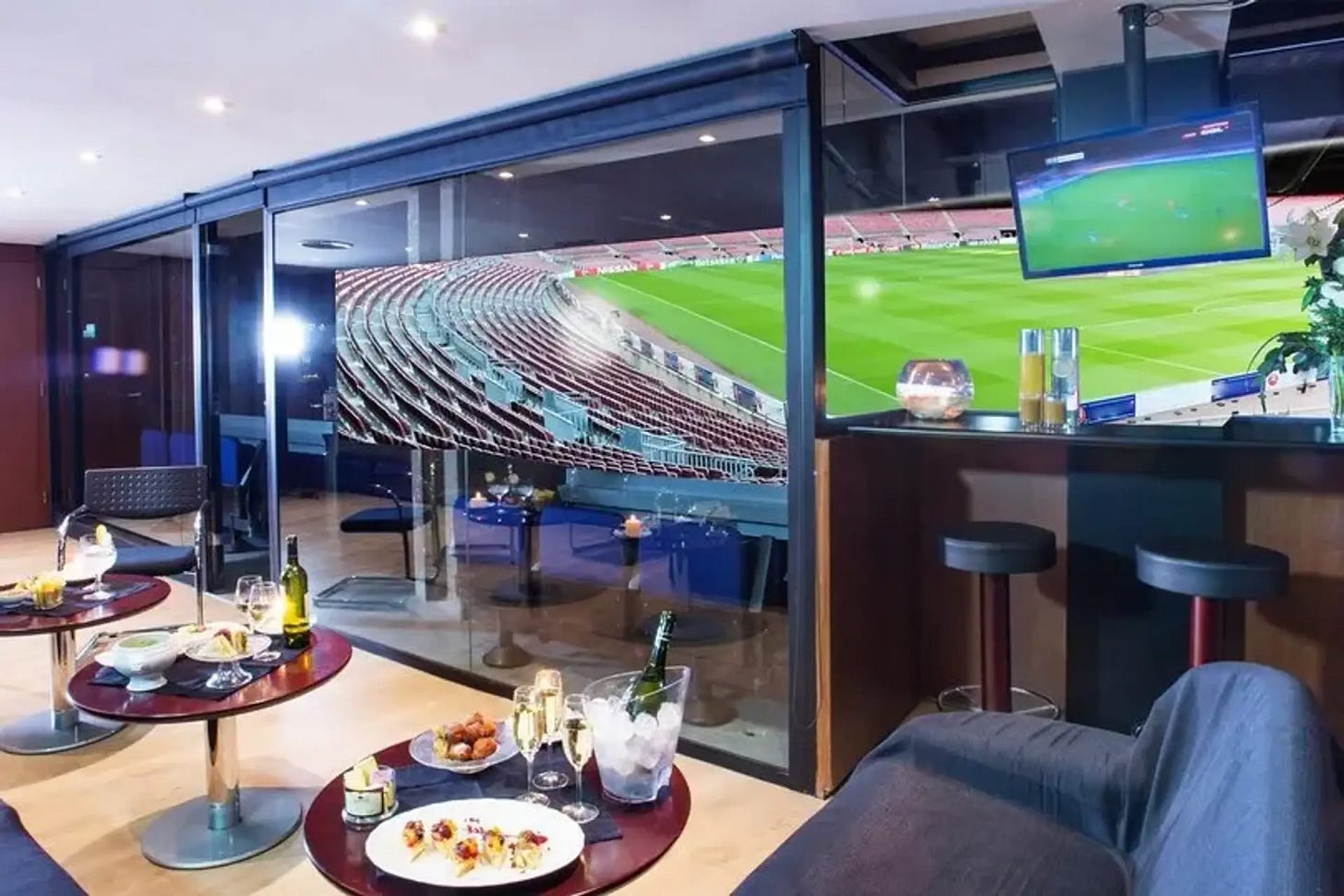
FC Barcelona took another step in monetizing the redevelopment of its sporting estate by securing a multi-year commercial alliance with Spanish telecommunications giant Telefónica. Signed at the worksite on September 18, 2026, the deal designates the operator as an Official Partner of Espai Barça across a five-year term running through 2031.
The signing comes at a pivotal operational junction for the club. As construction workers erect the stadium’s upper tiers ahead of roof installation and an eventual expansion toward nearly 105,000 seats, the board under Joan Laporta has focused on commercializing every square meter of newly generated hospitality space. To sustain the broader €1.45bn stadium financing structure, Barcelona needs its premium inventory generating recurring cash flow well before matchday turnstiles reopen at full capacity.
The scope of the inventory
The centerpiece of Telefónica’s package is the acquisition of naming rights for one of the primary social spaces located inside the stadium’s newly constructed double hospitality ring. Formally branded as the Telefónica Lounge, the area will connect directly with executive suites to serve as a meeting point for corporate guests during match intervals. The company also secured an exclusive private box within Spotify Camp Nou, granting its senior leadership dedicated physical real estate inside the venue bowl.
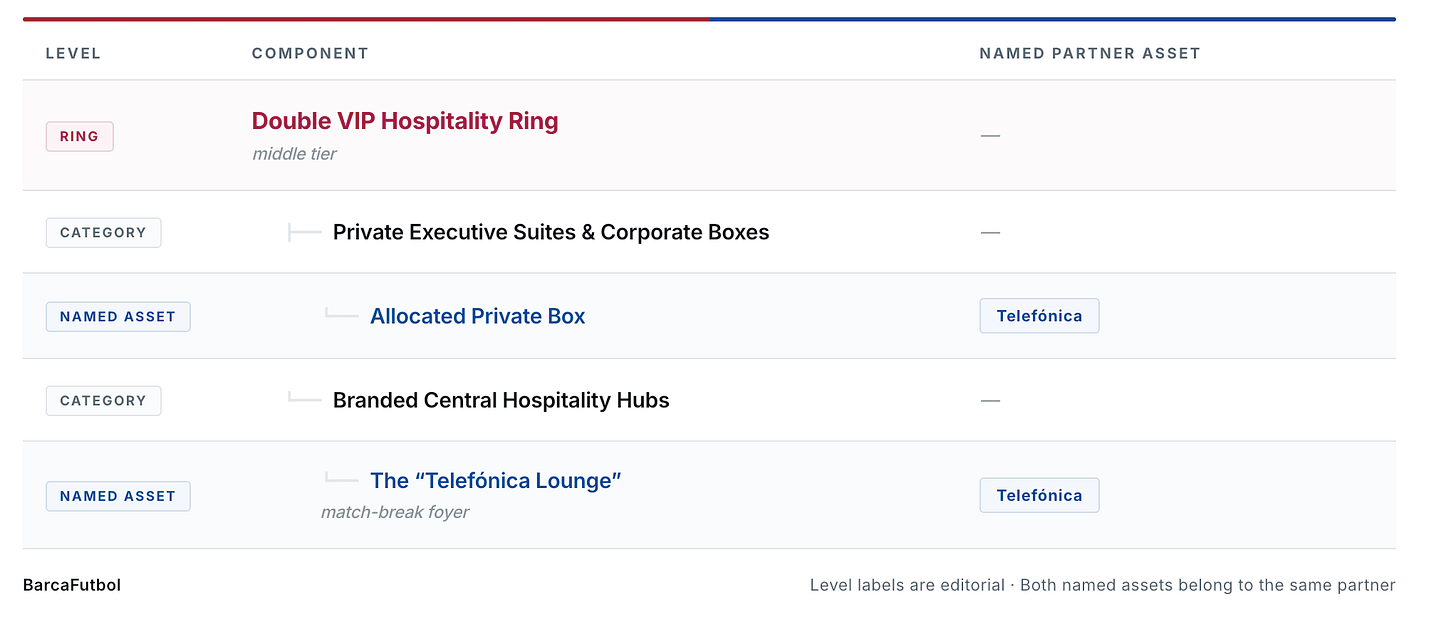
The alliance was formalized on-site by Joan Laporta alongside Telefónica España President Borja Ochoa. In public statements issued by both sides, Ochoa emphasized the telecommunications firm’s economic footprint in the region, noting that it invested €121m across Catalonia over the previous year while employing over a thousand staff locally.
Beyond physical hospitality, the agreement confers priority bidder status for upcoming technology projects across the complex. This provides Telefónica first-look positioning as tenders emerge for digital installations across the future Palau Blaugrana, secondary retail spaces, and the surrounding Campus Barça pedestrian zone.
Media Networks, Broadcast Signals, and the Connectivity Split
While initial promotional language described the agreement as a connectivity and technology partnership, its architectural scope differs significantly from previous club deployments. Spanish news dispatches verified that Telefónica’s technical delivery is focused on serving as a TV media network integrator, routing raw television broadcast signals and handling external media transmission pipelines.
The venue’s core networking infrastructure remains divided across distinct vendor relationships:
- Public Arena Wi-Fi: High-density attendee internet relies on HPE Aruba enterprise hardware, utilizing 3,200 wireless access points integrated by Axians.
- Private Mobile Telephony: High-bandwidth 5G connectivity is deployed under a separate agreement with MasOrange and New Era Visionary Group.
- Broadcast & Corporate Spaces: Handled by Telefónica via dedicated feeds serving corporate lounges and international production vans.
This demarcation contrasts with the 2019 Mobile World Congress announcement, when Barcelona and Telefónica unveiled an early pilot to test dedicated 5G millimeter-wave 360-degree cameras inside the old bowl. That experimental initiative concluded, allowing the club to compartmentalize public telecom concessions while monetizing VIP hospitality and broadcast integration through separate corporate packages.
Commercial valuation and revenue expansion
Neither entity published an explicit financial valuation for the five-year agreement. Unlike front-of-shirt sponsorships, agreements in the “Official Partner” tier bundle access rights, technical integration fees, and luxury lease values into unified accounts. Industry benchmarks for naming a dedicated corporate lounge inside an elite European stadium place such inventory between €3m and €6m annually, supplemented here by the technical servicing offset.
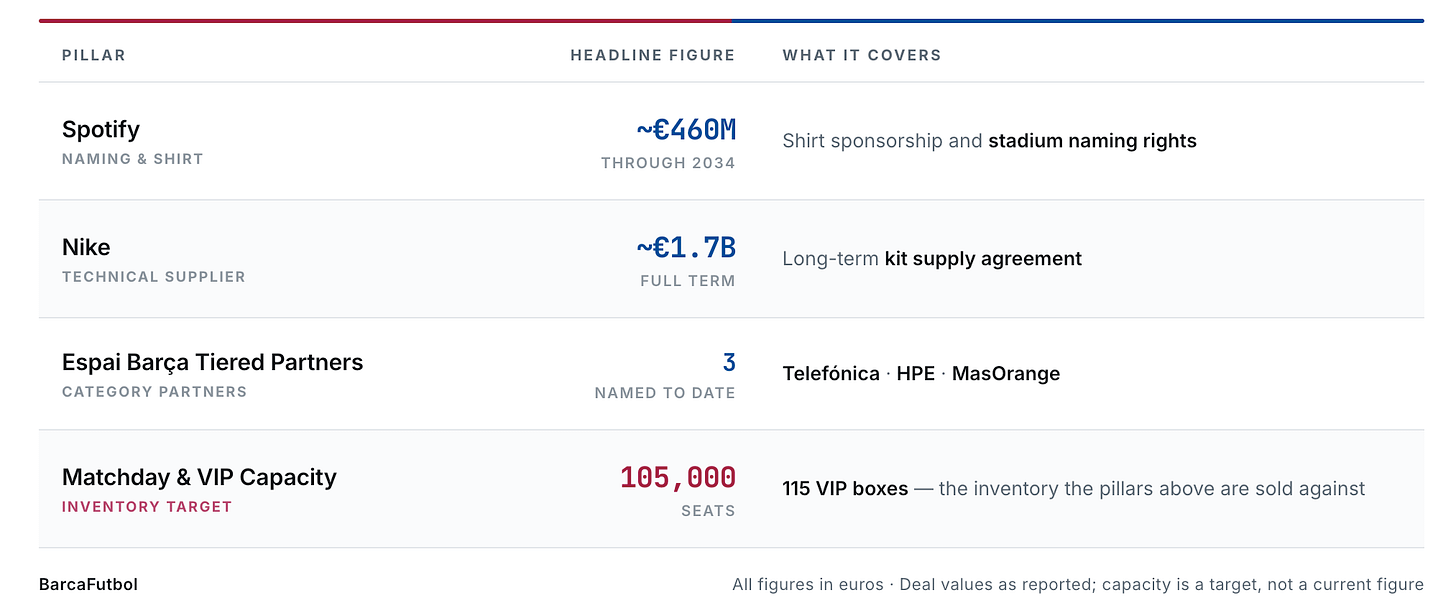
The timing of the announcement strategically preceded the club’s Ordinary General Assembly, where board members presented revised commercial budgets to member delegates. Barcelona’s leadership has consistently pitched Espai Barça as the club’s long-term financial engine, with modern VIP lounges and boxes projected to generate in excess of €120m in annual recurring matchday and corporate hospitality revenue.
- Duration: 2026–2031 (5 years) — Mid-term commercialization through construction and reopening
- Physical Inventory: 1 Private VIP Box, 1 Dedicated Lounge — Direct corporate entertaining inside double hospitality ring
- Priority Tender Rights: Full Espai Barça footprint — First-look bidding rights on Palau Blaugrana and campus IT
- Technical Integration: Broadcast transmission and connectivity — Video signal delivery, production connectivity, corporate LAN
For Telefónica, the investment complements heavy expenditures in Spanish sports broadcasting. Through its entertainment division Movistar Plus+, the operator co-holds domestic LaLiga broadcast rights alongside DAZN through the 2031–32 season. Maintaining a branded presence and hosting clients inside the largest stadium in Europe serves as an operational extension of that domestic rights footprint.
For Barcelona, the agreement confirms an ongoing commercial trend: subdividing stadium redevelopment assets into distinct corporate tiers. By leasing naming rights to individual lounges and granting technology options rather than exclusive telecom monopolies, the club is engineering multiple parallel income streams to ensure the expanded Spotify Camp Nou hits its revenue targets from day one.
The Ink Dries on Daniel Freire

Barcelona went ahead and closed another academy bet. The paperwork cleared over the weekend, formalizing a three-year contract that ties 16-year-old Daniel da Luz Lima Freire to the club through June 30, 2029.
The calendar was the hold-up. Freire spent a slice of the summer in Catalonia running trials, even managing an alert finish in an informal friendly against Badalona. But because the governing bodies take an unforgiving view of international youth movement, nobody could touch a pen to paper until his exact sixteenth birthday.
Under statutory FIFA transfer rules, international transfers of minors are barred until age eighteen unless they fall under the European Union exception, which unlocks at sixteen. Because Barcelona has lived through the sharp end of that policy before, they waited until September 19 before executing the contract. Once the date flipped, the formalities wrapped.
He steps into Cesc Bosch’s Juvenil B squad immediately. Notably, no transfer fee was published or agreed upon; standard training compensation regulations govern cross-border amateur development like this, meaning Racing FC Union Lëtzebuerg receives baseline statutory compensation rather than an open-market windfall.
It is low-risk bookkeeping. The interesting part is what kind of footballer they actually signed.
A creative ceiling
If you look at the registry, he is listed as an attacking midfielder who can drift into center-forward or flank duties. In reality, calling him a midfield metronome misunderstands how he operates on a pitch. Freire is an aggressive destabilizer.
His physical baseline sits at roughly 1.82 meters. For an adolescent wide attacker, that provides long strides that chew up grass quickly in transition. He plays with an upright posture and sudden hip shifts, using a burst over five yards to create separation rather than relying exclusively on showy stepovers.
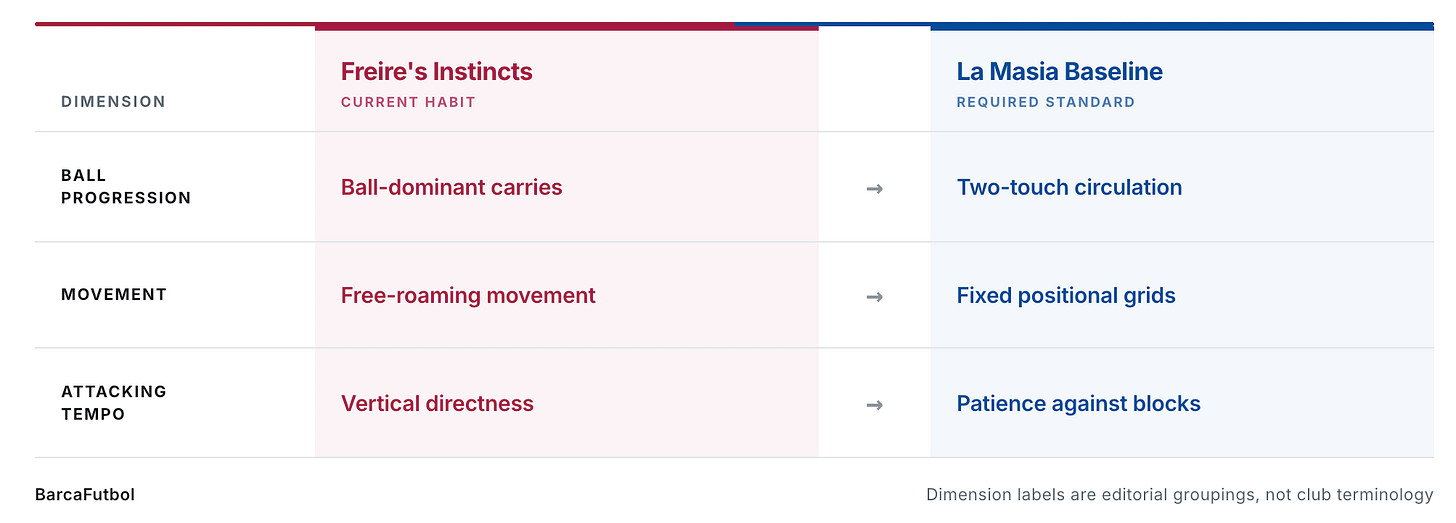
Where he stands apart is his appetite for direct elimination. His former youth coach in Luxembourg, Dany Vieira, captured the crux of his style while discussing his development: he is a player who requires tactical freedom to reach his ceiling. Put him in a rigid, repetitive box and you extinguish what makes him dangerous.
Operating primarily off the left inside channel, Freire does not hug the touchline. He prefers receiving along the half-turn, facing the defense head-on, and driving diagonally into the space between the opposing center-back and right-back. In isolated one-on-one situations, he leans on sharp inside-outside cuts with his dominant right foot, using his physical reach to shield off trailing challenges before snapping off a shot. When his side breaks from deep, he bypasses secondary passing phases entirely, carrying progressively and pulling markers toward the ball before slipping passes into overlapping lanes.
That tendency showed up regularly during his stretch in Luxembourg. In their domestic youth run, most notably a decisive display in the U-17 Cup final where he registered a goal and an assist, he served as the clear offensive outlet. Teammates looked to isolate him on the edge of the box whenever the build-up bogged down. Later in the summer, he earned tournament MVP honors at the Aqua Hotel Cup and featured in an exhibition win over Real Madrid.
Can he learn positional discipline?
That profile—fluid, vertical, individualistic—creates an immediate tactical puzzle the minute you walk through the doors at Sant Joan Despí.
La Masia is an institution built on strict geometry. The entire framework of Juego de Posición demands positional discipline, patience within designated corridors, and rapid circulatory ball movement designed to tilt defensive blocks. A teenager whose default instinct is to drop deep, turn, and run at three defenders will run directly into coaching staff that wants the ball distributed in two touches.
His dual-citizenship background hints at how that playstyle formed. Born in Lisbon before spending his formative development years in Luxembourg, he eventually committed to the Portuguese federation setup, accumulating competitive minutes in youth tournaments alongside teammates like Cristiano Ronaldo Jr.. That international exposure taught him how to handle physically imposing center-backs, but Spanish youth football introduces an entirely different test: processing speed without the ball.
There is also the physical adjustment. While his height gives him natural leverage, his core stability and aerial shielding need substantial conditioning to handle the cynical fouls common in Spanish youth football. Defensively, he will have to rewire his habits entirely. Playing with unrestricted attacking freedom in smaller leagues often comes with loose pressing mechanics; under Bosch, pressing triggers and recovery tracking are mandatory prerequisites for minutes.
Low risk, high upside
Every season brings another batch of viral clips and breathless declarations about the next generational prospect. Barcelona has signed plenty of teenagers under the EU exception, only to see them stall quietly in the lower ranks before being moved along.
What makes this sensible is the structure. Barcelona avoided committing a headline transfer fee or an unwieldy senior wage. They spotted an explosive dribbler with upside in European youth competitions, waited out the calendar to keep FIFA satisfied, and locked in three development years.
If he adapts his instincts to the system, they uncovered an agile, vertical attacker for nominal compensation. If the tactical friction proves too high, his developmental pedigree still commands a clean resale market. For a squad navigating tight financial boundaries, those are the exact calculated risks worth taking.