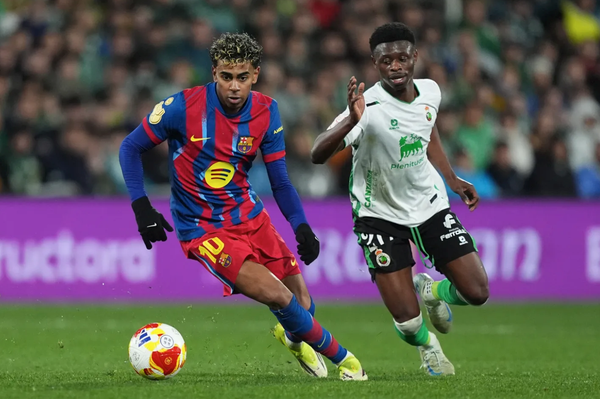
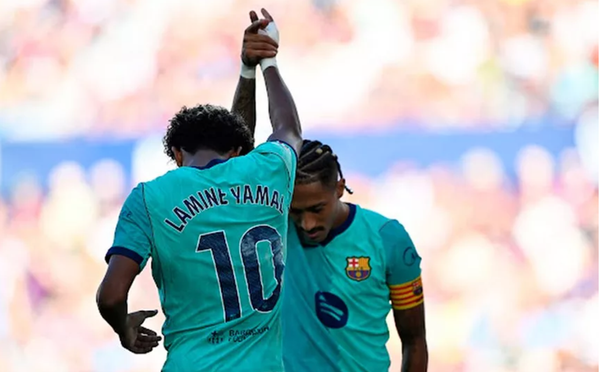
Barça Put Five Past Valencia: Rodri and Pedri Click, Raphinha Becomes La Liga’s Most In-Form Hitman
Rodri and Pedri controlled possession, while Fermín López, Lamine Yamal and Raphinha converted Barcelona's territorial dominance into a five-goal win.


Mestalla is a magical stadium, almost a reminder of a Roman colosseum. The steep tiers lean over the pitch. The noise has nowhere to escape. The history of the club weighs down every staircase. If Valencia’s planned move to the Nou Mestalla remains on schedule for the summer of 2027, this may have been Barcelona’s last competitive visit to the old ground.
The stadium has heard versions of its own obituary since before Lamine Yamal was born. Valencia would have wanted this match to carry that weight. Their ground, their crowd, perhaps the last visit from Barcelona in this form. A chance to make the evening mean something.
But that is not the version that happened.
Barcelona arrived knowing Real Madrid had already dropped points at Betis. Hansi Flick handed Rodri his first start in Barcelona colours and again selected a front line without a recognised centre-forward. Raphinha nominally occupied the middle, Lamine began from the right, Anthony Gordon stretched the left and Fermín López moved underneath them. The questions were obvious. Could Rodri give Barcelona the control he once gave Manchester City? Could Valencia’s 5-4-1 turn the occasion into a trap? Could Barça keep producing goals without a fixed nine?
The answers came quickly.
Lamine scored after six minutes. Fermín made it two after twenty-two. Raphinha added the third five minutes into the second half, Pedri scored the fourth and Lamine completed the five. The scoreboard made the evening look like a finishing exhibition. The match underneath it was more interesting. Barcelona built a structure in which the next attack was almost always theirs. Valencia covered slightly more distance and made more defensive actions. They were not passive. They ran, challenged and cleared. Yet Barcelona completed 728 passes, made 99 final-third entries and took 25 shots. Valencia completed 205 passes and took three.
The gap showed in the scoreline.
Rodri and Pedri did not merely keep possession. They shortened the distance between one Barcelona attack and the next. Raphinha could leave the centre, Fermín could attempt the difficult pass and Lamine could lose the ball trying to decide the move because the structure behind them was already close enough to recover it.
This was not control as decoration. It was control used as a platform for repeat attacks. The front four supplied the damage; the double pivot made the damage repeatable.
Valencia’s three shots produced two big chances and two efforts on target, almost all of the threat concentrated in Arnaut Danjuma. Joan García made two rushed saves against the run of play A goal conceded at this time, would have changed the course of the match, but it wasn't to be.
Football is a game of inches.
Comparative Match Statistics
Barcelona produced nearly nine out of every ten shots and more than 85 percent of the combined xG. They made 99 final-third entries to Valencia’s 41 and took 55 touches in the opposition box to Valencia’s ten.
Those numbers define territorial control.
Valencia’s numbers describe the cost. Stole Dimitrievski faced ten shots on target and made five saves. Valencia attempted 50 long balls and completed only 11. It is a proof of how often the first pass after recovery became a low-percentage clearance in another form.

Barcelona’s attacking advantage expressed across possession, xG, shots, saves, corners and fouls.
Perhaps the cleanest summary is the passing contrast. Barcelona completed 92 percent overall and 83 percent in the final third. Valencia completed 73 percent overall and 52 percent in the final third. The closer each team moved towards Barcelona’s goal, the more the technical gap narrowed for Valencia and widened for Barcelona. One side could keep its combinations intact under pressure. The other could not keep enough players connected to Danjuma.
Starting Structures and Goal Timeline
Valencia began in a deep 5-4-1. Barcelona answered with a 4-3-3 that became something far less fixed once Raphinha left the centre, Fermín entered the pockets and Pedri moved beyond Rodri.
On paper, the home side had the numerical protection a low block requires: five defenders, four midfielders and Danjuma as the outlet. In practice, the distances between those units were too great. Danjuma could threaten only when Valencia escaped cleanly, while the midfield line kept being pulled towards Barcelona’s wide receivers. That opened the inside lanes for Fermín and Pedri.

Starting line-ups and nominal formations. The positional movement made Barcelona’s attacking shape more fluid than the team sheet suggests.
Lamine began from the right, Gordon held the left, and Raphinha repeatedly vacated the central lane. Fermín then became the spare attacker arriving from midfield. Behind them, Rodri held the circulation point while Pedri moved according to the pressure: beside Rodri when Barcelona needed another exit, ahead of him when the next line could be attacked.
The timing mattered. Lamine scored after six minutes and Fermín after twenty-two, so Valencia never reached the part of the plan in which tthe deep block could begin to frustrate Barcelona. At half-time the contest was already structurally tilted. Raphinha’s goal five minutes after the restart ended it; Pedri and Lamine then added the late insurance.
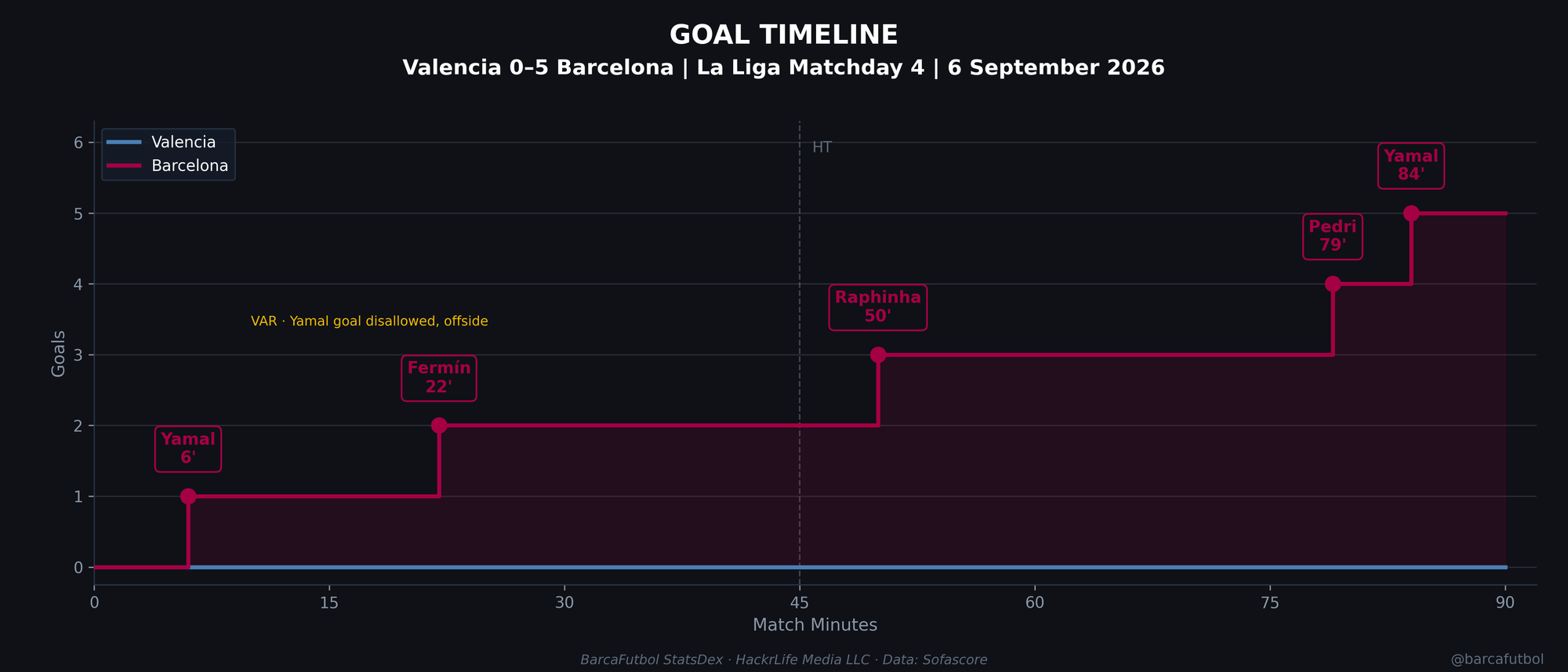
The scoring sequence: Lamine Yamal 6′, Fermín López 22′, Raphinha 50′, Pedri 79′ and Lamine Yamal 84′.
How Barcelona Scored the Five Goals
The first goal arrived at 6 minutes from a chance worth only 0.07 xG, with Fermín supplying Lamine. The winger finished left-footed into the high centre of the goal, improving the effort to 0.34 xGOT through placement. Fermín’s goal at 22 minutes, created by Anthony Gordon, carried the same pre-shot value, 0.07 xG, but an even stronger 0.74 xGOT after his left-footed finish found the low-left zone. Barcelona had turned two relatively difficult shooting positions into a two-goal advantage.

All five goals, with the shot position, pre-shot value, post-shot value and finishing zone. Shot positions are approximate reproductions of the supplied goal panels.
The third goal was completely different. Fermín released Raphinha on the fast break at 50 minutes, and the finish was easy. The first two goals rewarded execution from less generous positions. The third rewarded the structure for opening the pitch and delivering Raphinha into a near-unmissable one.
Dani Olmo created both late goals after coming on. Pedri made it four at 79 minutes; his right-footed finish carried 0.19 xG. Five minutes later Lamine completed the scoring. His second goal came from 0.53 xG.
The attacking-midfield function had transitioned cleanly from Fermín to Olmo.
Valencia could not simply close one corner or force one player onto an uncomfortable side. Barcelona attacked the goal with different players and different solutions.
That distribution matters for the false-nine question. Raphinha’s central role did not require him to monopolise the penalty area. It required him to make the centre unstable. When he moved away, Lamine could attack diagonally. When the wingers held width, Fermín could arrive between them. When Valencia’s midfield sank towards those threats, Pedri could advance from the second line.
A fixed striker gives a defence a reference. Barcelona’s five goals kept changing it.
Team Comparison: Territory, Duels and Defensive Work
A radar can disguise as much as it reveals, so the visual separates two questions. The left panel measures territory and attack: possession, expected goals, shots, box touches and final-third entries. The right measures contests and defensive actions. Barcelona’s attacking polygon expands almost to the edge. Valencia’s defensive polygon looks fuller because a side under pressure has more tackles, interceptions and clearances available to make.

The left radar shows who controlled the match. The right shows the work Valencia accumulated while trying to survive that control.
Barcelona were ahead on every attacking and territorial measure. 73 percent possession, 99 entries into the final third, 55 touches in the opposition box, 25 shots and 4.05 xG. Valencia had 27 percent, 41 entries, ten box touches, three shots and 0.67 xG.
Valencia’s defensive counts ran the other way. They obviously had to make more tackles, interceptions and clearances under a steady onslaught from Hansi Flick's team.
The chaos was constant for Valencia to ever settle into any form of rhythm.
Player Locations and Territorial Control
The easy thing to notice is the absence of activity in Barcelona’s defensive third. Valencia managed only three shots. The other one is Raphinha's actual position in this new set up. Cubarsí and Rodri occupied almost the same central band, with the centre-back stepping up behind the midfielder rather than retreating towards his own penalty area.

Fermín, Rodri, Cubarsí and Raphinha. The collective starting position explains how Barcelona kept one attack close to the next.
Fermín’s map is the highest and busiest of the four. He was not another midfielder circulating outside the block. He received between Valencia’s lines, then attacked the box. That is why an 85 percent pass-completion rate and fifteen possessions lost are compatible with being the match’s most productive player.
Raphinha’s map allows people to take a peek into Flick's mind. He spent much of the match moving towards the right half-space and dropping towards the middle third. That movement removed Valencia’s fixed reference. A centre-back could follow and open the line, or hold position and allow Raphinha to turn. The space he left was available to Lamine, Gordon and Fermín.
Rodri made the entire picture sustainable. Barcelona completed 792 passes, including 241 in the final third, because the return route remained open whenever the immediate attack closed. The ball could come back to Pedri, then Rodri, and change sides without returning to the goalkeeper. Possession did not merely last longer; it restarted closer to Valencia’s goal.
The double pivot did not make Barcelona conservative. It made risk affordable. Fermín could attack the gap because Rodri and Pedri had already shortened the distance to the next recovery.
Rodri's Role in Possession
Rodri’s 81 completed passes from 83 attempts are impressive. More important is what those passes allowed everybody else to do.
He played 62 minutes and took 91 touches, more than one touch every 41 seconds of his time on the pitch. That involvement indicates a player Barcelona deliberately used as a reset point. His five long balls were all completed. He added a key pass, a clearance, an interception and a tackle. He also hit the woodwork from a chance worth 0.08 xG. This was not a spectacular highlights performance. It was the essence of a controlled performance.
Rodri’s safe passing kept Barcelona in the part of the pitch where somebody else could take the risk. He lost the ball only five times. When Pedri dropped beside him, Barcelona had two exits; when Pedri advanced, Rodri could hold the base alone. The circulation protected the attack from having to restart at its own goal.
Rodri and Pedri as a Double Pivot
The radar shows why the partnership can absolutely transform Barca's midfield especially against elite opponents. Rodri owned circulation volume and range, while Pedri supplied ball-winning and the forward arrival.

Rodri’s first-start profile, with Pedri as the reference.
Rodri was removed after 62 minutes; Pedri played 81. Even with nineteen fewer minutes, Rodri leads the raw totals for touches, accurate passes and long balls completed. Pedri’s shape extends further on defensive actions and duels contested.
Pedri’s advantage appears without the ball. His three tackles in 81 minutes translate to 3.3 per 90. Rodri made 1.5. Pedri won 80 percent of his five duels; Rodri won 50 percent of two. Pedri could step into the contest because Rodri remained positioned to receive the next pass.
Then comes the goal. Pedri took two shots, one on target, and scored from 0.30 xG. Rodri took one off-target effort, hit the woodwork and registered 0.08 xG. The distinction is not simply creator and destroyer. It is controller and connector. Rodri made the circulation reliable. Pedri could participate in that circulation at 96 percent completion, win the ball, then cross the line into the attack.
Possession security was almost identical: five losses from 91 touches for Rodri, six from 86 for Pedri. This is why “double pivot” should not mean two holding midfielders standing side by side. At times it was a platform; at others Pedri left Rodri alone and became the extra player between lines. The success was not symmetry. It was how easily one player’s movement activated the other’s strength.
Fermín López's Match Contribution
This chart does not rank Fermín against other midfielders. It shows how much of Barcelona’s total match output belonged to him.
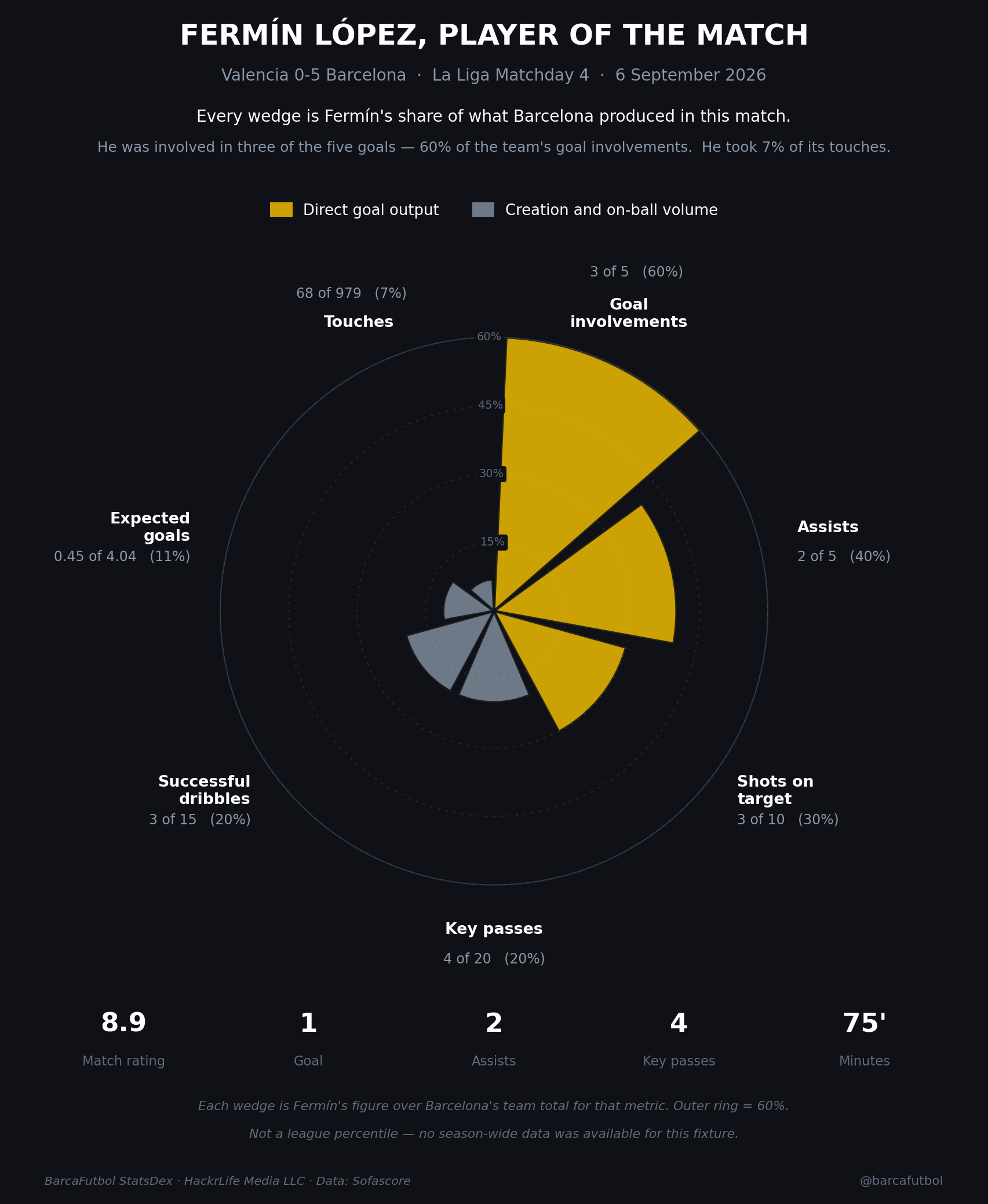
Every wedge is Fermín’s share of Barcelona’s team total in that metric. This is a match-contribution chart, not a scouting percentile.
Fermín was involved in three of Barcelona’s five goals: 60 percent of the team’s direct scoring output. Yet he took only seven percent of their touches. That is an unusually concentrated return. He was not dominating possession for its own sake. He was converting a relatively small share of the ball into the actions that altered the score.
The rest of the circle explains how. He supplied 40 percent of the assists, 30 percent of the shots on target, 20 percent of the key passes and 20 percent of the successful dribbles. His 0.45 xG was only 11 percent of Barcelona’s total. In other words, his influence was not built on repeatedly receiving the match’s best chances. It was built on joining creation, carrying and finishing inside the most crowded part of Valencia’s block.
The passing line needs context. Fermín completed 40 of 47 passes and lost possession 15 times, second only to Lamine among Barcelona’s outfielders. Those are not numbers to airbrush away. They are the cost of receiving between the lines and attempting the pass or dribble that changes the phase. Rodri and Pedri gave him permission to spend possession more aggressively because they were positioned to repair the action if it failed.
The performance was therefore more than one goal and two assists arriving from three isolated moments. Fermín took four shots, put three on target, created four chances and carried the ball through pressure. He occupied the game. When Olmo replaced him after 75 minutes and created the final two goals, the role continued to produce even after its first occupant had left
Chance Creation and Finishing

Caption: Key passes measure creation; xG measures the quality of shooting opportunities.
Raphinha sits high and left: 1.28 xG but only one key pass. That is the profile of the player performing the nine’s finishing work.
Lamine occupies the opposite attacking extreme, high and far to the right. Six key passes made him Barcelona’s leading creator; 1.18 xG and two goals made him one of the principal finishers too. He was not simply a winger feeding a central striker. He was the player stretching the defence, creating the next shot and then arriving to take his own.
Fermín sits between those roles with four key passes and 0.45 xG. Gordon is a smaller version of the same mixed profile with two and 0.49. Pedri appears low on creation and modestly on xG because his influence came from the late arrival rather than repeated final passes. Olmo’s point is more deceptive: two key passes and only 0.16 xG, but two assists in fifteen minutes.
Raphinha supplied the penalty-box threat. Lamine carried both creation and finishing. Fermín connected the two. Pedri arrived from behind them. Olmo inherited the creative space from the bench. No single player reproduced a complete number nine; the team divided the job into parts
In conclusion
Mestalla may have one final season in its present role. Barcelona’s possible last visit ended 5-0 and told us a great deal about how this side can attack a deep block. Against a 5-4-1 designed to narrow the pitch and keep the score down, Barça opened the match in six minutes, reached 2-0 in twenty-two and never allowed the contest to acquire the emotional weight the stadium was ready to give it.
But every part of the structure worked under favourable conditions. The back line could stand near halfway because there was little to retreat from. Rodri could concentrate on distribution because Valencia rarely pressed him into a difficult turn. Raphinha could vacate the centre because the back five did not know whether to follow him. Fermín could gamble between the lines because Rodri and Pedri were almost always close enough to repair the move.
The question is can Barca replicate this against an in-form PSG or a resolute Inter on a Champions League night?