Barcelona 5-2 Rayo Vallecano: Three From Three
Raphinha and Lamine Yamal delivered the goals, but Rayo exposed the defensive questions Hansi Flick still needs to answer.

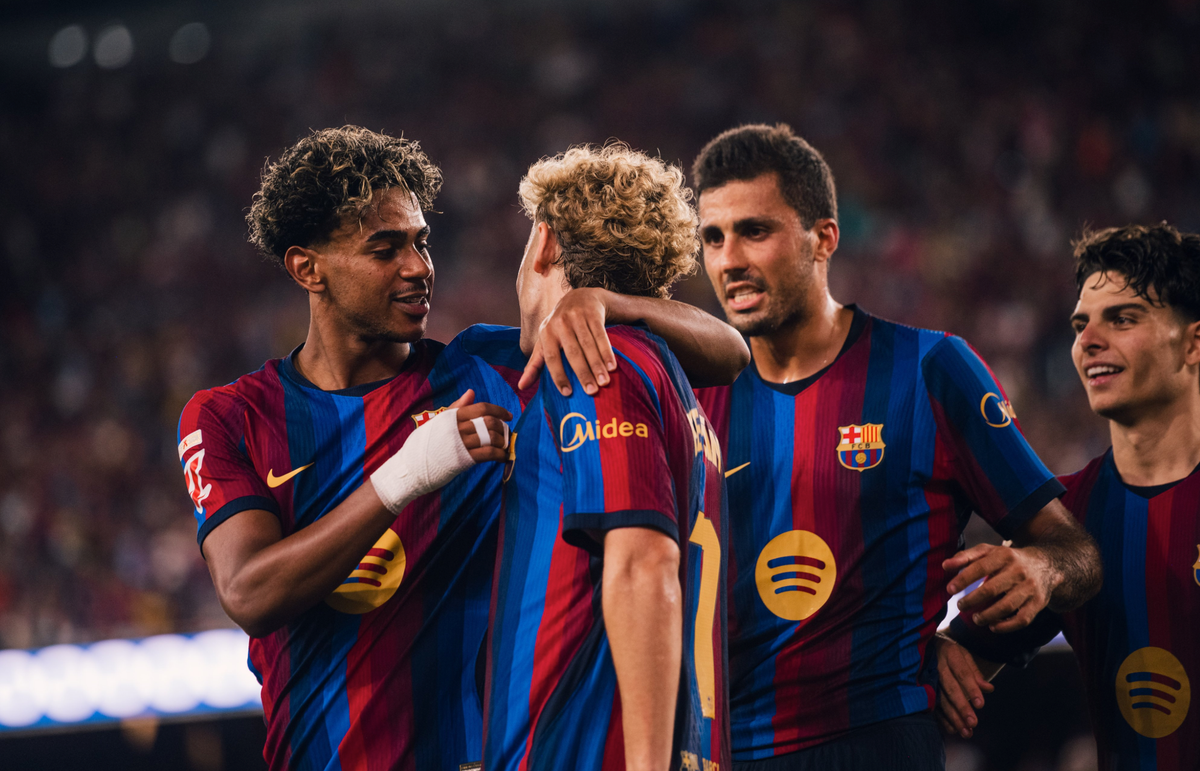
After twelve minutes at Camp Nou, Barcelona had a problem. Álvaro García beat Jules Koundé down Rayo's left and pulled the ball back for Sergio Camello, who finished past Joan García to give the visitors a shock lead.
It lasted seven minutes.
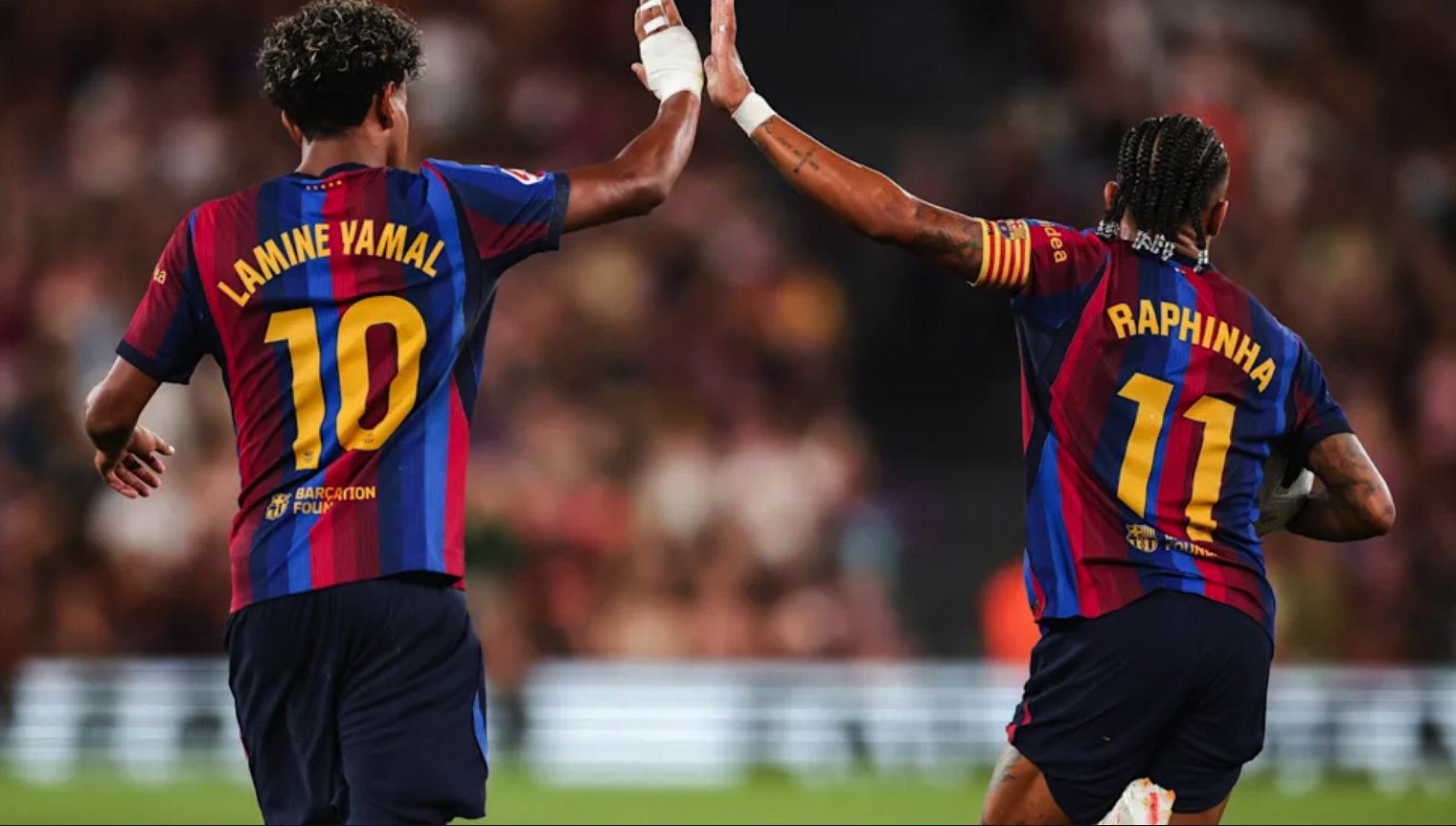
Raphinha equalised in the 19th minute. Lamine Yamal put Barcelona ahead two minutes later. By the time Yamal scored his second in the 90th minute, the scoreboard read 5-2 and Hansi Flick's side had completed a third straight league win without dropping a point.
The final score suggests a comfortable night, and for long periods it was. Barcelona dominated the ball, created far more chances and had two forwards playing at a level Rayo could not match. But the game also carried a warning. Rayo scored first, later made it 3-2 and found two different ways to hurt Barcelona. The attacking performance was excellent. The defending ( ike it is often with Flck's Barca) was not always as convincing.
That was the short version. Now lets delve into the long one.
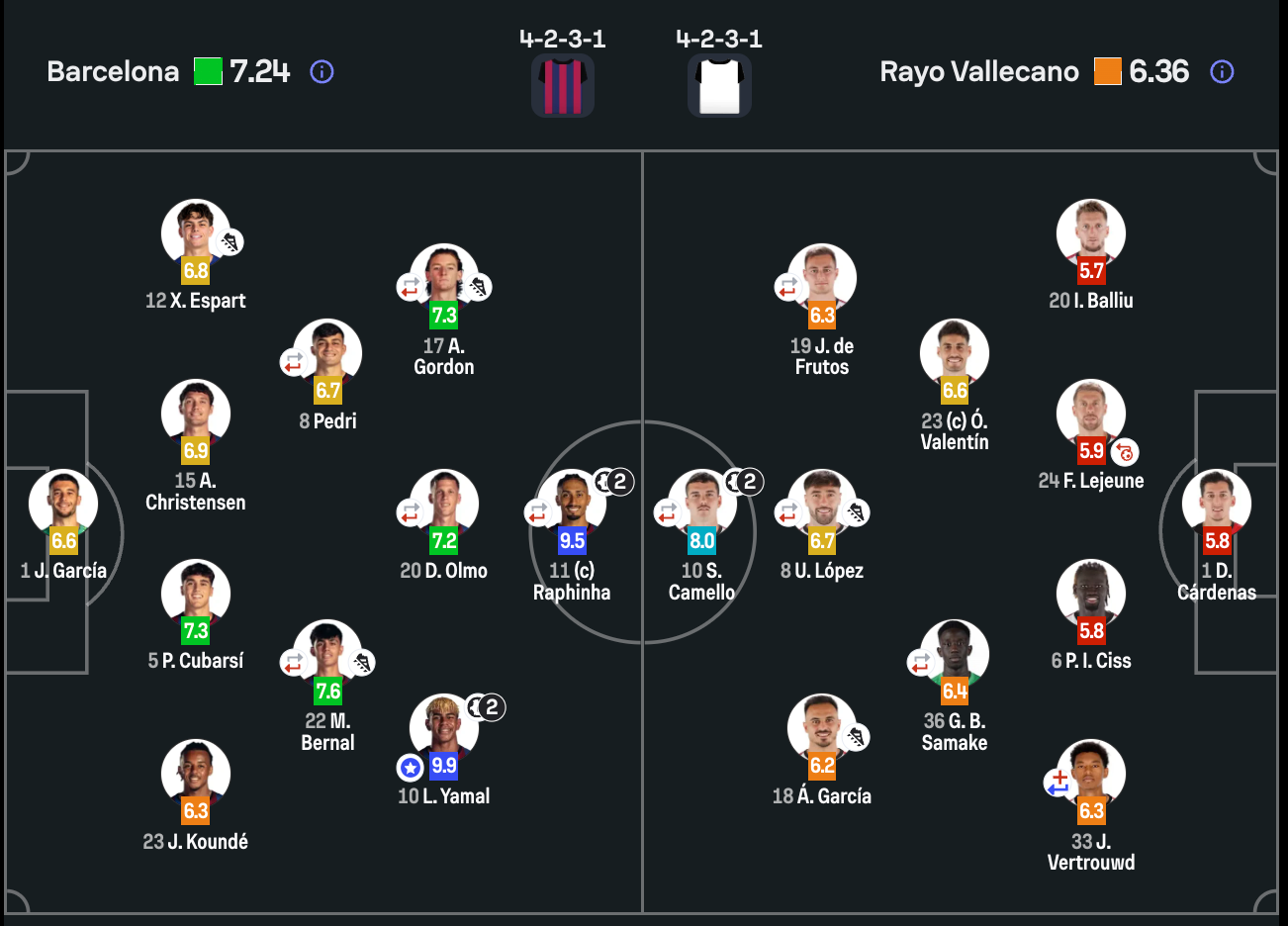
Match overview
The overall numbers are heavily in Barcelona's favour. Barça finished with 69 percent possession to Rayo's 31, took 26 shots to 11 and produced 3.04 expected goals against 1.21. They created seven big chances to Rayo's four, won nine corners to five and put nine attempts on target.
Barcelona also completed 648 passes to Rayo's 286. This was not a match decided by two moments of individual brilliance while the rest of the team struggled. Barça controlled the ball, occupied Rayo's half and created enough chances to justify a convincing win.
Still, Rayo's numbers deserve a closer look. Joan García had to make three saves and Rayo generated 1.21 xG from only 11 attempts. They did not shoot often, but several of their chances were dangerous. Camello alone accounted for 0.77 xG and scored twice. Rayo's threat was limited in volume, not in quality.
The foul count also says something about the game. Barcelona committed only four fouls, while Rayo committed eleven. Beñat San José's side wanted to disrupt Barça's rhythm, challenge quickly when the ball became loose and prevent clean attacks from developing. That plan never gave them control, but it did make parts of the match uncomfortable.
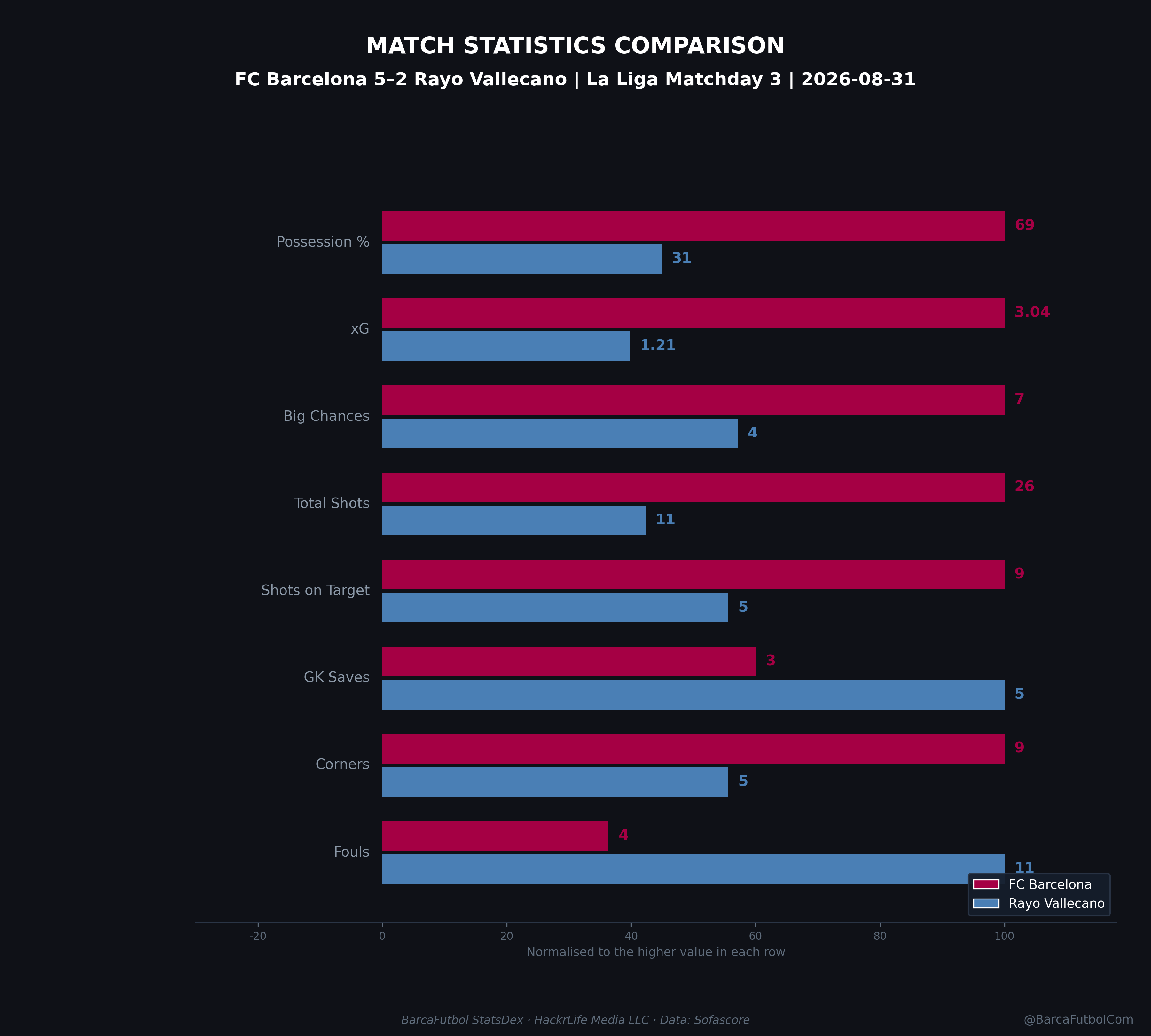
Two 4-2-3-1s, two very different nights
Both teams started in a 4-2-3-1, but both had very different outcomes.
Barcelona started with Joan García in goal and a back four of Koundé, Pau Cubarsí, Andreas Christensen and Xavi Espart. Marc Bernal partnered Pedri in the double pivot. Dani Olmo played behind Raphinha, with Yamal on the right and Anthony Gordon on the left.
Raphinha was the nominal centre-forward, but Barcelona did not play with a fixed No. 9. He moved towards the wings, dropped between the lines and then attacked the box when the ball moved forward. Yamal stayed mainly on the right but repeatedly came inside. Gordon began on the left and crossed the pitch when the move demanded it. Olmo occupied the spaces those rotations opened. The result was closer to a fluid front four than a standard line of three behind a striker.
Rayo's 4-2-3-1 was more compact. Camello led the line, while Álvaro García offered the clearest route into the space behind Barcelona's right side. Without the ball, Rayo tried to reduce the room around Pedri and Bernal. When they regained possession, the first thought was forward.
That is exactly how the opener arrived. Rayo did not need a long passing move. García received on the left, beat Koundé and found Camello inside the area. One direct attack was enough to punish a Barcelona defence caught napping.
Comparing the two teams
For those who love comparisons, the stats clearly show that Barcelona led most of the match categories. They produced more xG, put more shots on target, entered the final third more often, recovered the ball more often and won a greater share of the duels.
Rayo's main advantage was tackles. They made 23 to Barcelona's 15. That does not mean they defended better. It reflects the amount of time they spent without the ball and how aggressively they tried to win it back.
Rayo were not willing to sit on the edge of their box and wait. They challenged as soon as Barcelona's passes became loose. If they won the ball cleanly, they attacked. If they arrived late, they often stopped the move with a foul. Their 23 tackles and eleven fouls came from the same basic idea: do not allow Barcelona to circulate the ball comfortably for ninety minutes.
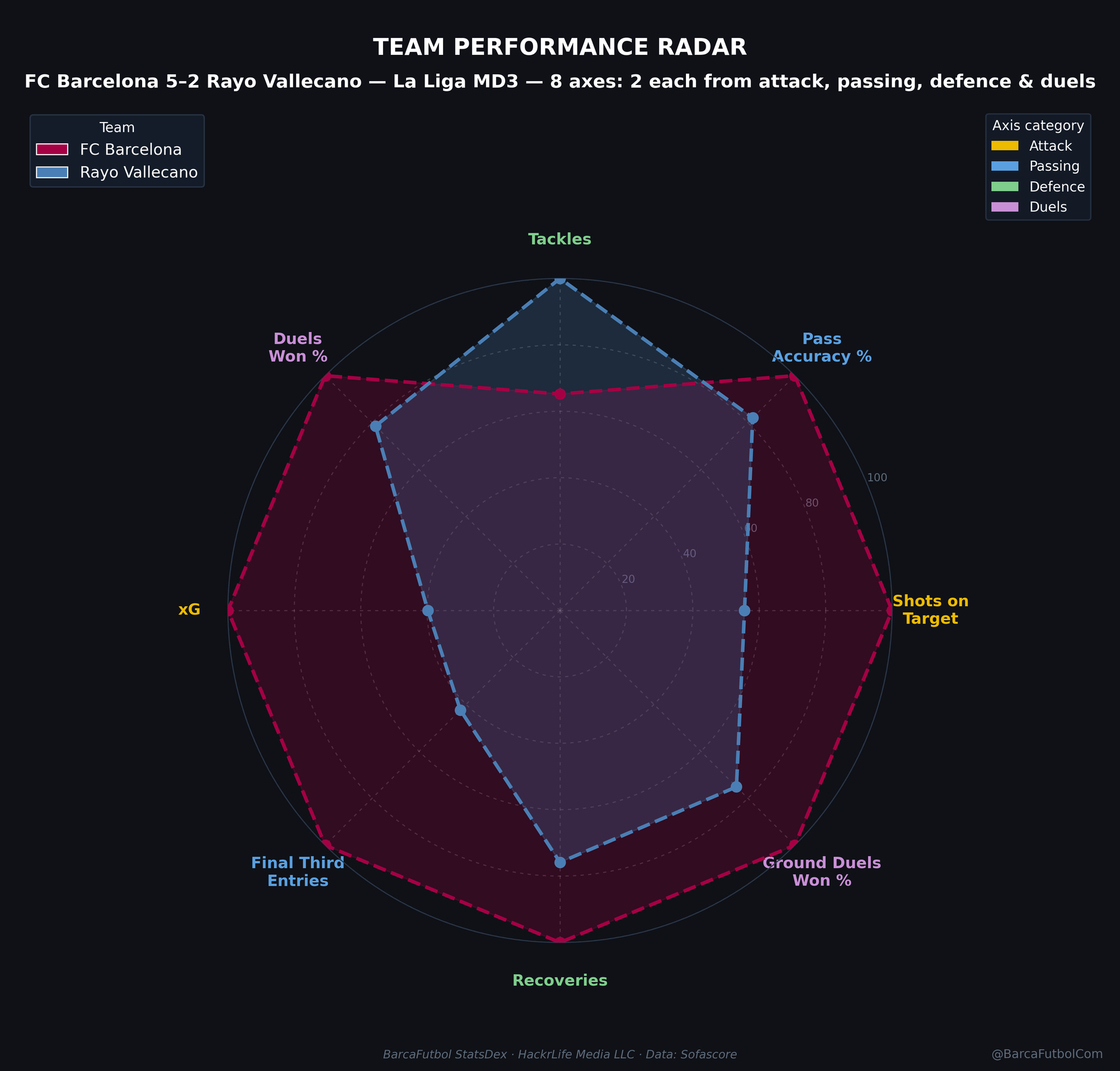
That approach created a difficult opening spell and helped Rayo remain competitive after falling behind. But it also demanded enormous energy. Once Barcelona played through the first challenge, there was space behind it. Barça finished with 66 final-third entries to Rayo's 28 and 58 recoveries to 44. The longer the match went on, the harder it became for Rayo to keep closing every lane.
A game that kept threatening to get away from Barcelona
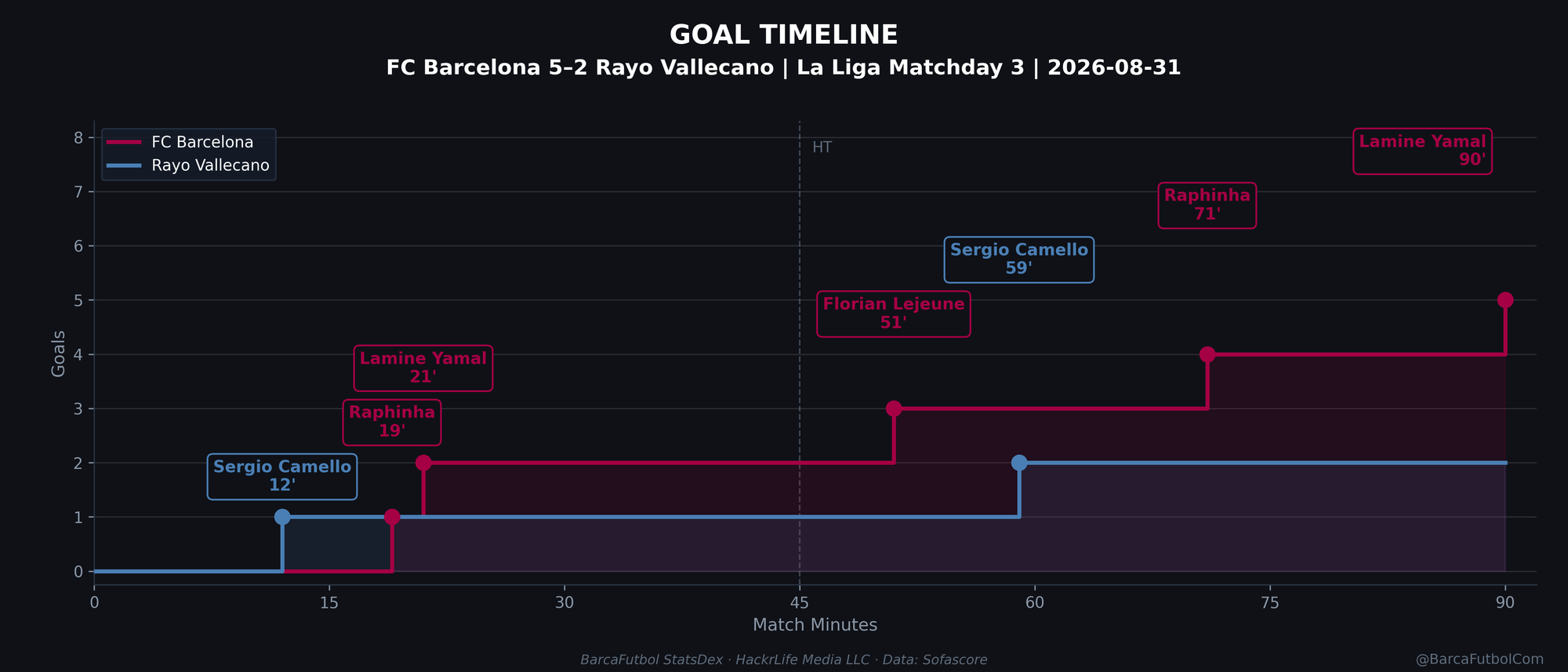
The goal timeline explains why a dominant statistical performance did not always feel comfortable.
Camello put Rayo ahead in the 12th minute. Álvaro García beat Koundé and pulled the ball back, and Camello whipped past Joan García. It was Barcelona's first league goal conceded this season and a clean example of how quickly their high territorial position can become a defensive problem.
Barcelona's response was immediate. Espart found Raphinha in the 19th minute, the Brazilian moved into the area, shifted the ball away from Pathé Ciss and finished calmly. Two minutes later, Bernal found Yamal on the right side of the box. Yamal opened his body and curled a left-footed shot into the top corner for his 50th Barcelona goal.
In seven minutes, Barça had gone from 0-1 down to 2-1 ahead.
Koundé thought he had made it 3-1 before half-time when Cárdenas spilled Gordon's shot, but VAR ruled the goal out for offside. The decision was correct, but it left Rayo only one goal behind at the break.
Barcelona added the third in the 51st minute. Olmo released Gordon on the left, Gordon drove a cross into the area and Florian Lejeune turned it into his own net while trying to stop the pass reaching Raphinha.
At that point the game should have been finished. Instead, Rayo found another route back. Unai López delivered a corner in the 59th minute and Camello attacked the near post to head in his second.
The first goal exposed Barcelona's right side in open play. The second exposed their organisation at a set piece. It would be inaccurate to describe both as transition goals, but both showed how a team with little possession can remain dangerous by attacking specific weaknesses.
At 3-2, the match became tense again. Flick responded by replacing Olmo and Bernal with Fermín López and Rodri. The change helped Barcelona recover control of midfield. In the 71st minute, Koundé played long towards Gordon, who entered the box and used a clever backheel to find Raphinha. The captain finished with his left foot to restore the two-goal lead.
Yamal completed the scoring in the 90th minute. Karim Adeyemi found him outside the area and Yamal drove a low shot beyond Cárdenas.
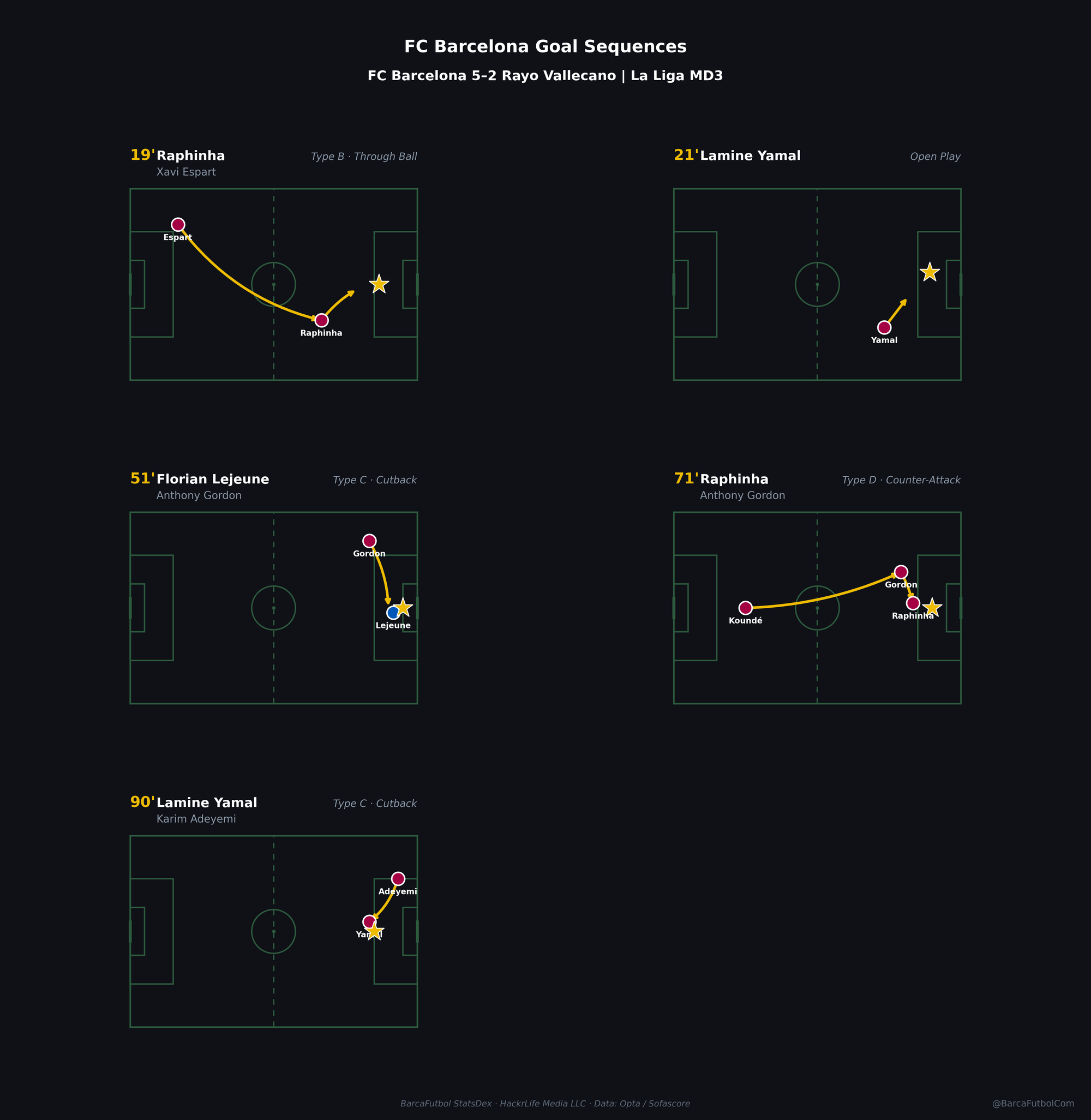
The sequence graphic captures the variety in Barcelona's goals. The equaliser came through Espart's diagonal pass and Raphinha's movement. The second was individual quality from Yamal. The third came from Gordon reaching the byline area. The fourth was a direct attack finished by Raphinha. The fifth came from some ridiculous sublime finishing from Lamine.
xG: who created the danger
Barcelona's 3.04 xG against Rayo's 1.21 confirms that the home side created the better body of chances. The player totals show how differently those chances were distributed.
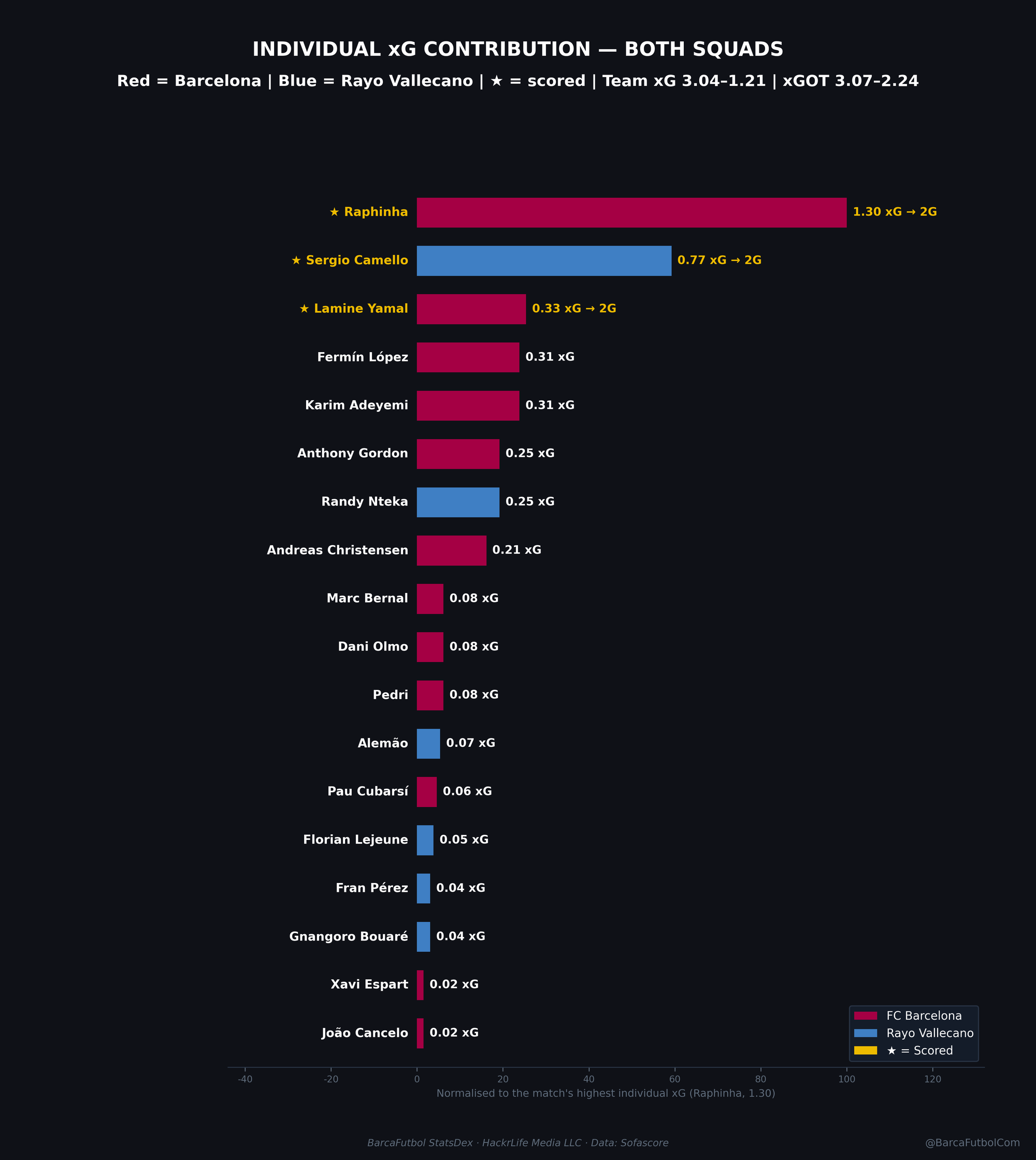
Raphinha led everyone with 1.30 xG. Camello was second with 0.77. Yamal produced 0.33, narrowly ahead of Fermín López and Karim Adeyemi on 0.31 each.
Camello's position on the chart matters. A striker playing for a team with 31 percent possession still produced the second-highest xG on the pitch. Rayo's attacks were infrequent, but their plan created valuable chances for the player selected to finish them.
Yamal's performance was the opposite. His two goals came from a combined 0.33 xG. His 90th-minute strike was valued at only 0.07 xG before the shot, but its placement lifted the effort to 0.57 xGOT. Expected goals measures the chance before the shot. Expected goals on target considers where the shot was actually placed. The difference tells us how much Yamal added through execution.
Raphinha scored twice from the best collection of chances. Camello scored twice from the second-best. Yamal scored twice from much less. The first two found good shooting positions. Yamal turned difficult positions into goals.
The team xGOT figures were 3.07 for Barcelona and 2.24 for Rayo. That gap is smaller than the difference in shots because Rayo placed several of their limited attempts well. Joan García's three saves were not decorative. Barcelona dominated, but their goalkeeper still had work to do.
This is the balanced reading of the numbers. Barcelona deserved to win and deserved to score several goals. Rayo also created enough quality to justify scoring twice. The 5-2 was decisive, but not fraudulent in either direction.
Xavi Espart, on his own
Raphinha and Yamal will receive most of the attention, but it was 19 year old Xavi Espart who produced one of Barcelona's most complete performances.
Espart completed 61 of his 66 passes for 92 percent accuracy and created two chances. His best contribution was the pass for Raphinha's equaliser. Receiving deep on the left, he spotted Raphinha's movement and played forward before Rayo could reset.
His passing was only part of the performance. Espart also made two clearances and two interceptions, and the match data credited him with five defensive actions. He won five of his eleven duels and completed three of five dribbles.
The important thing is not that he dominated one category. It is that he contributed across all of them. He defended his side, helped Barcelona play through pressure and created a goal.
Espart also gave Flick tactical flexibility during the match. He began as the left-back, move inside beside the pivot during build-up and then played as a midfielder. When João Cancelo came on late, Espart was able to move higher rather than leave the pitch.
Flick has repeatedly praised that versatility. Speaking about the teenager, he said Espart can play at full-back, as a No. 8 or as a deep midfielder, and highlighted how well he understands what to do with the ball. Espart has now played in all three league matches this season and is making a serious case for more than a temporary role.
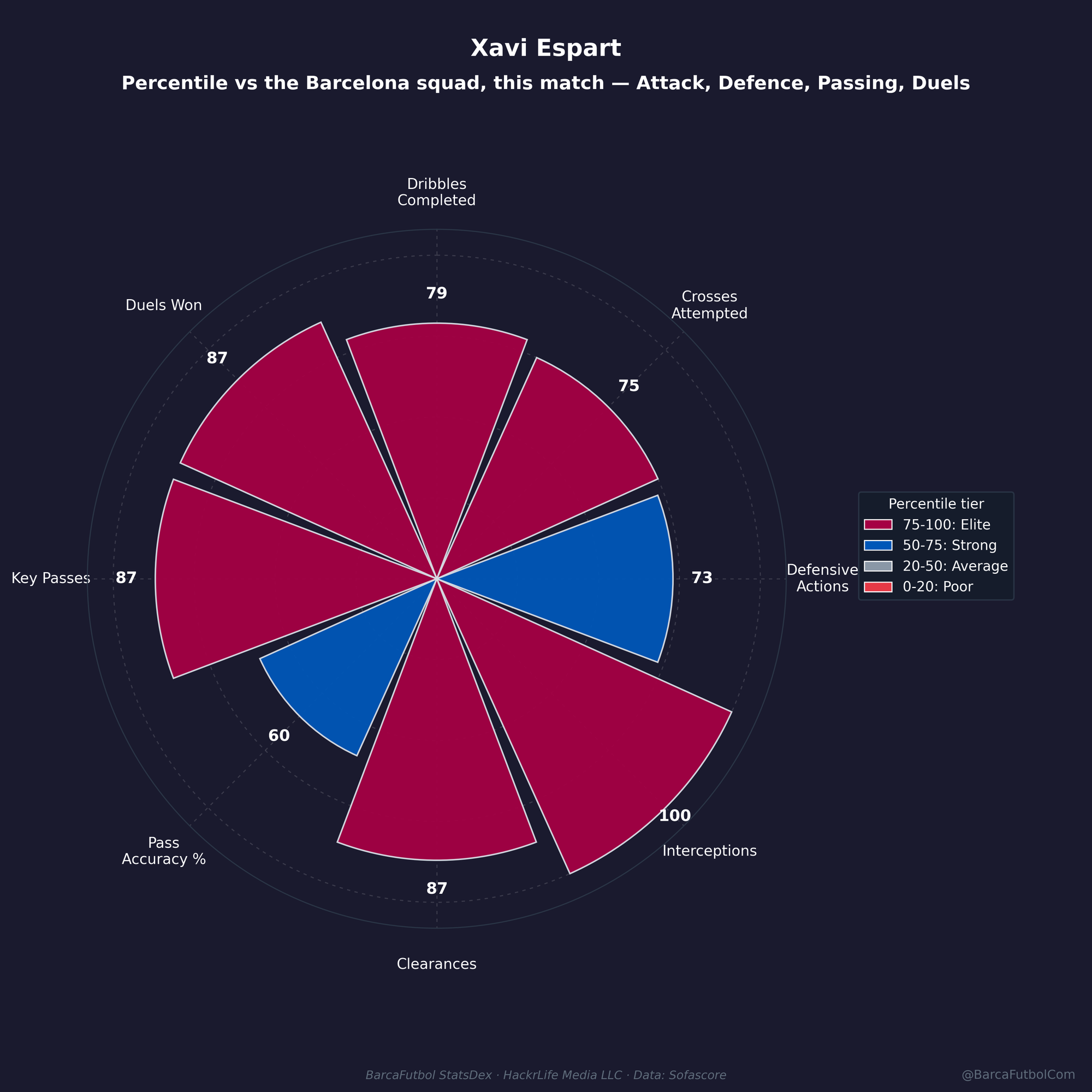
The percentile chart compares him only with Barcelona teammates in this match, including players in very different positions. It should not be treated as proof that he is already an elite La Liga full-back. What it does show is how broad his contribution was. For a teenager playing on his weaker side, that is impressive enough.
Raphinha as the nine
If Espart's passing helped provide the platform. Raphinha's movement gave Barcelona the end point.
After failing to land Julian ALvarez, Flick has been forced to build a strike force, without a fixed focal point. That's the actual system. Instead of picking a No. 9 and building around him, Flick lets his front three rotate through the central striker's zone and asks whoever gets there first to finish.
The first goal shows why the rotation works. Yamal's opener two minutes later was self-created, cutting in from the right and curling a finish into the top corner without needing a pass, but Raphinha's had already shown the other half of the mechanism moments earlier. Espart's crossfield ball found him arriving in the exact central pocket, and he cut inside and finished low. Two different players, two different sides of the pitch, the same vacated central channel.
Gordon's afternoon is the clearest sign this was coached, not accidental. He finished with only 39 touches and a modest 6.7 rating, but he had a hand in two of Barcelona's five goals, both in spaces you wouldn't expect from a right winger. For Lejeune's 51st-minute own goal, Gordon's low cross came from close to the left side, meaning the nominal right winger had drifted across to deliver the ball that Lejeune turned into his own net. For Raphinha's second in the 71st minute, the move worked its way out to Gordon, and his flicked pass sent Raphinha through to finish . That's a front three treating the width of the pitch as shared property, with Gordon doing the connecting work in both directions so somebody could finish.
Underneath all of it, Pedri was the metronome making the rotation possible. His numbers won't jump off a highlights reel: 87 touches, 72 passes attempted at 94% accuracy, no goal involvements. But that was precisely the job. When your front three are swapping positions instead of holding a shape, somebody deep had to keep finding the pass into whichever channel just opened, quickly enough that Rayo's aggressive press could not get set. Pedri did that at a near-19-to-1 pass completion rate, and when Rodri came on late to add control ( 31 for 31 passing, two tackles won, barely a mistake)it freed Pedri to push a little higher and kept the platform stable while the front three kept swapping lanes.
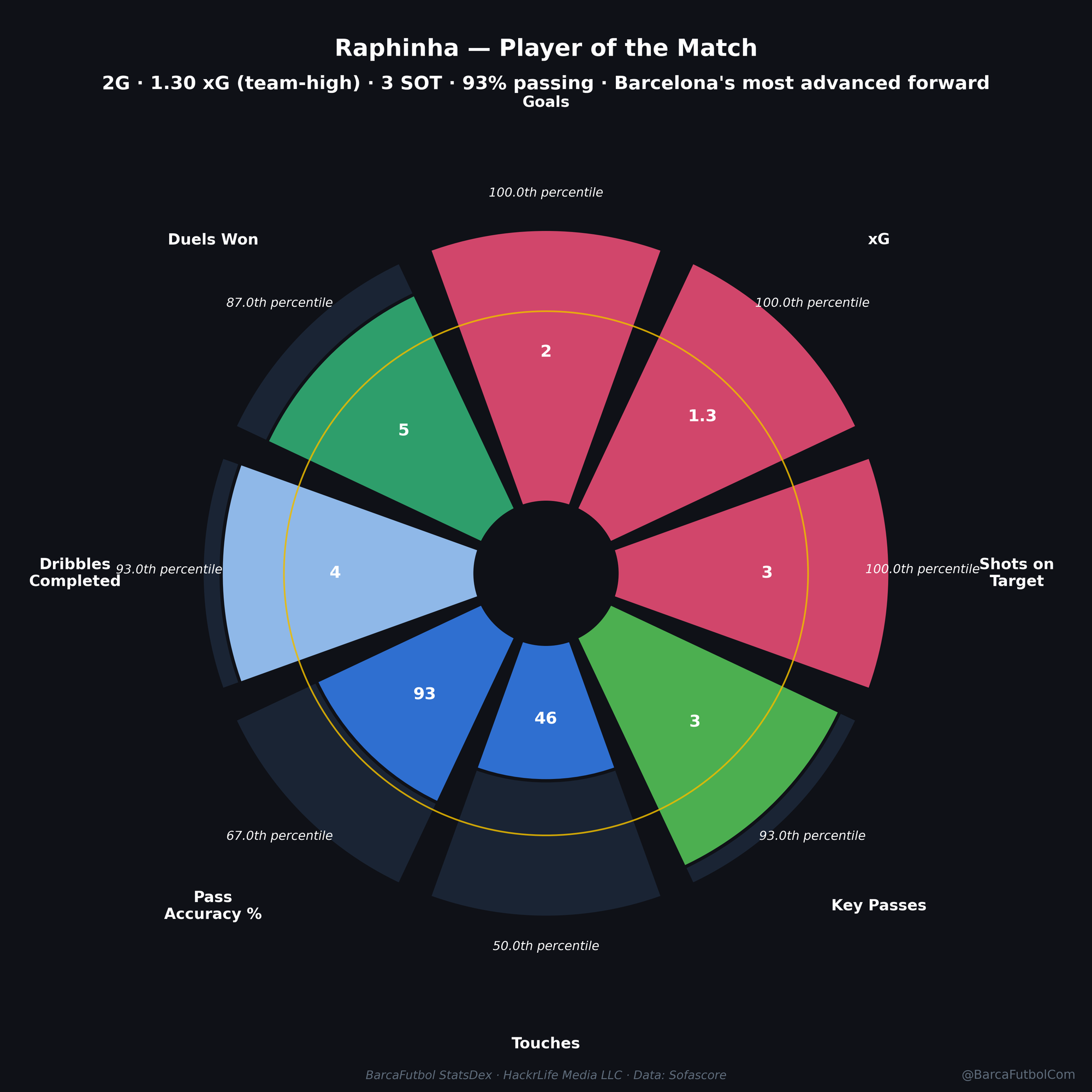
Put together, that's a team that scored five without ever really needing a specialist finisher, because it built a structure where the finisher's job rotated to whoever was best placed in the moment. Yamal running in off the right, Raphinha arriving from the left into the middle, Gordon supplying from wide, Pedri and eventually Rodri making sure the supply never dried up. Raphinha's 1.30 xG and 3 shots on target off just 4 completed dribbles and 46 touches tell you he took his moments clinically. How those moments kept arriving for him, and for Yamal, is the story of Flick fielding a Barcelona side with no recognised No. 9.
Lamine Yamal's game, by the numbers
If Raphinha was the finisher this system was built to free up, Yamal is proof the same system doesn't have to sacrifice its most talented individual to do so
Yamal completed 8 of his 13 dribbles, a 62% success rate. Nobody else in Barcelona's XI beat more players with the ball than he did. He also won more duels than anyone on the pitch, 12 of 19, a 63% return, and created more chances than anyone in a Barcelona shirt, his 7 key passes more than double Raphinha's total of 3. Three different disciplines: beating a man, winning the physical battle, picking out a teammate. Yamal finished top of the squad in all three.
That's not a poacher's stat line. That's a player who's simultaneously his team's outlet, its physical presence and its creative hub.
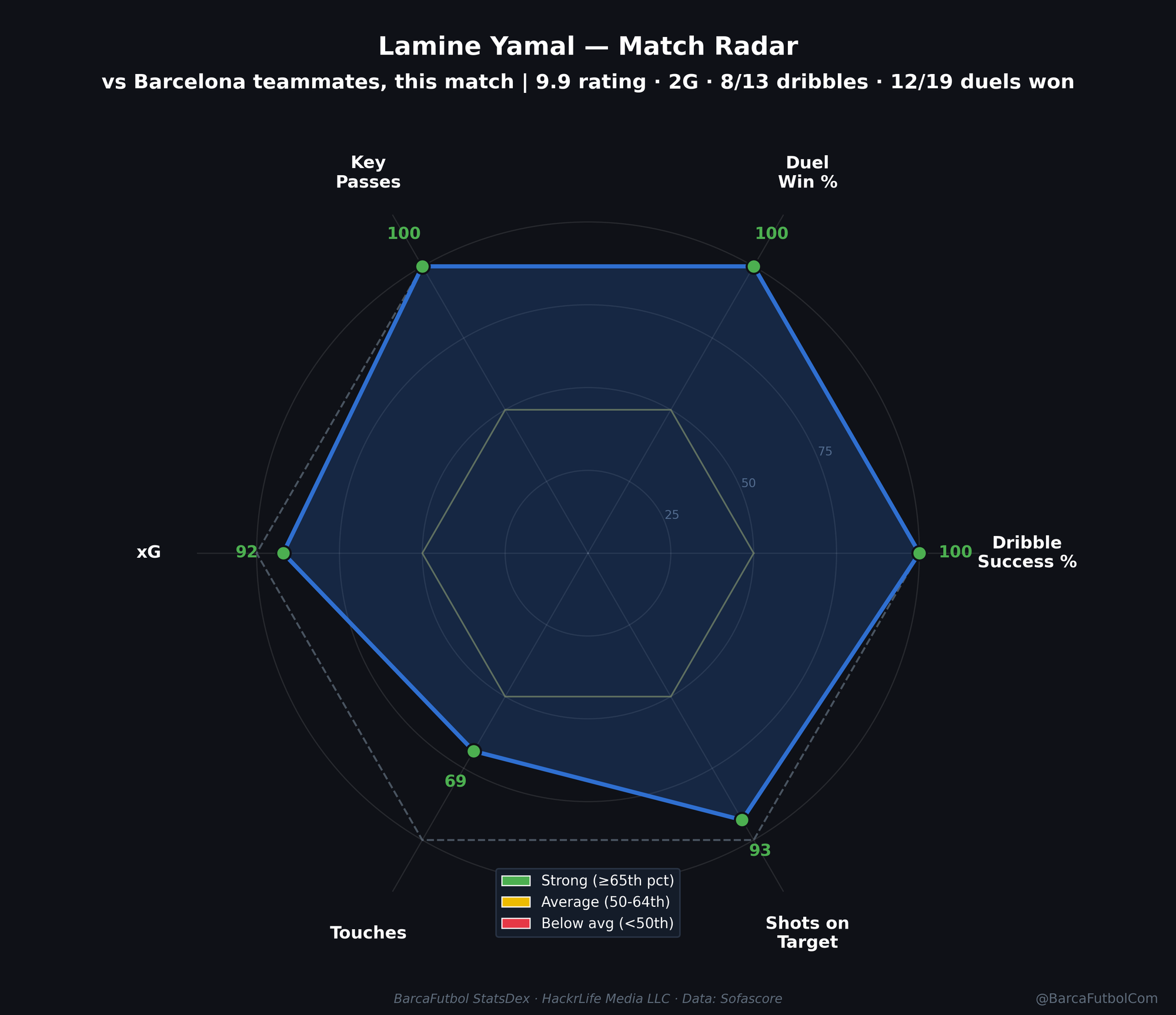
Yamal wasn't camped centrally waiting for service like a normal No. 9. He was popping in and out of the middle, taking his touches in bursts rather than as a constant outlet, and making hem count more than anyone else on the pitch. His 21st-minute solo goal and 90th-minute finish came from a combined 0.33 xG, meaning he scored twice from chances that, added together, weren't even worth one expected goal between them.
This Barcelona team has two players who can play the empty central striker's role and finish like specialists once they get there, and on this night both of them did it in the same 90 minutes. Yamal's 0.33 xG is second on the pitch behind only Raphinha's team-high 1.30, and his 2 shots on target trail only Raphinha's 3. The rest of it, the dribbles, the duels, the key passes, is what a No. 10 or a wide creator produces, not a No. 9. Put a player like that through the middle of a system with no fixed striker, and the answer to who finishes the moves stops being one name and becomes whoever gets there first. Twice, in this match, that was Yamal.
Who moved the needle
Raphinha and Yamal combined for four of Barcelona's five goals and 1.63 of their 3.04 total xG. More than half the team's underlying threat came from two players who both started the match away from the middle of the pitch.
The dribbles-versus-xG numbers make the contrast between them clear. Raphinha needed only 4 dribbles, completed every one, and still produced a team-high 1.30 xG. . Yamal had 8 successful dribbles, double anyone else on the pitch, but only 0.33 xG to show for all that carrying, sitting right on the squad median for finishing threat despite being the most dangerous ball-carrier by a distance. One forward turned a handful of clean chances into 1.30 expected goals. The other spent his match beating players and still finished as a carrier first, scorer second, and still managed two goals from moments a normal No. 9 would never have created for himself. Both of Barcelona's most advanced players ended the night on the scoresheet, and they got there doing different things.
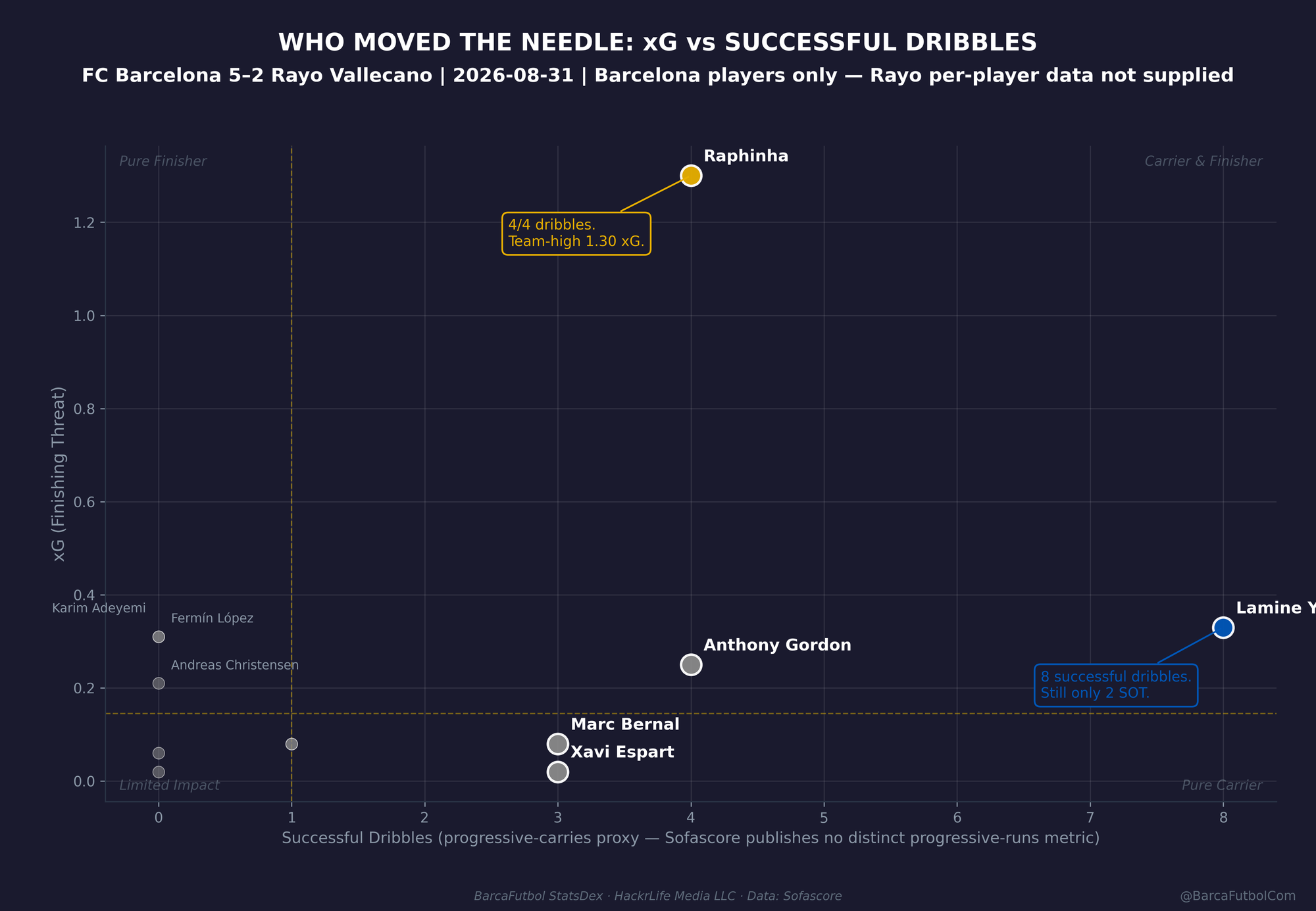
Everyone else's job was to make that possible, and the numbers back that up too. Gordon sat between them. He did not generate the same shooting threat, but he helped create three important moments: the attempt before Koundé's disallowed goal, the cross that became Lejeune's own goal and the backheel that officially assisted Raphinha.
Bernal won 10 duels and made 4 tackles protecting the back four. Espart created a big chance and completed 92% of his passes. Neither needed to show up on a finishing chart to have a good night. A system without a fixed striker doesn't need every outfield player threatening goal. It needs enough of them creating and holding the shape that the two or three players who are threatening goal keep getting found in the right pockets, which, over 26 shots, 17 of them from inside the box, and a 3.04 xG return, Barcelona managed relentlessly.
Why does Kounde bring out the best in Lamine?
There's one relationship on this pitch that explains more about Barcelona's attack than any radar chart can, and it isn't between two forwards. It's between Jules Koundé and Lamine Yamal, and it's the reason this team's best attacking form and its most obvious defensive weakness keep showing up on the same flank, in the same ninety minutes, off the same player.
Start with Rayo's first goal. Koundé was not caught high up the pitch after an overlap. He was in position and Álvaro García beat him. Once García reached the area and pulled the ball back, Christensen and the rest of the defensive line could not prevent Camello from finishing. Several defenders were involved, but the move began with Koundé losing his duel.
That distinction matters. This cannot be explained simply by saying Koundé is a centre-back being asked to learn right-back. He has played the position for several seasons and, at his best, has been one of the strongest one-on-one defenders in Europe. The concern is that this part of his game has declined. The pace, timing and certainty that once defined his defending have become less consistent.
Against Rayo he was directly beaten for the opener and looked less secure when Rayo attacked his side. One match does not prove a long-term regression, but this was not an isolated concern either. It added to a pattern Barcelona supporters have been noticing for months.
But that said, going forward, Koundé still offered plenty. He had 100 touches, completed 72 passes at 92 percent, made a key pass, completed two dribbles and had a goal disallowed. His long pass to Gordon also began the move for Raphinha's second. More attacking involvement than almost anyone in Barcelona's back four.
The fact is Kounde's movement remains valuable to Yamal. When Yamal receives wide and threatens to come inside, Koundé can overlap outside him. If the opposing full-back follows Koundé, Yamal gains room on his left foot. If the defender stays with Yamal, Koundé becomes available on the outside. Koundé can also underlap into the half-space and create a different passing angle.
Those runs do not always need to receive the ball. Their purpose is to force the defender into a decision. That helps explain why Yamal can face so many one-on-one situations and get the better of most.
But attacking value does not make the defensive decline free. Can Barca accept a basic duel being lost because the same player gets the best out of their most prodigious creator on the other end ? Against Rayo, the front line was good enough to erase the damage. Against stronger teams, particularly in Europe, one lost duel on the right may carry a much higher price.
But what is equally true is that a Lamine with a Kounde on pitch is a far more difficult proposition for opponents. Can a better right back compensate for a less effective Yamal? That is the question Barcelona have not answered. Flick has built an attack that doesn't need a recognised centre-forward, because his best players keep finding space in the right areas without one. He also has a right-back who can still create that space better than almost anyone in Spain, and who, at the same time, isn't the defender he used to be.