Barca vs Alaves: Six Goals and the Cold Math Behind Flick’s 100th Win
How a makeshift backline held the halfway line, why 1.66 xG turned into six goals, and the hidden vulnerability waiting at the Metropolitano

For a few hours on Saturday afternoon, the narrative around Barcelona was ready to curdle. Atlético Madrid had just dispatched Levante 2-0 to climb to the top of La Liga, leaving Hansi Flick’s side staring at a one-point deficit on the back of their worst week of the season: a bruising 4-2 Champions League defeat to Paris Saint-Germain followed immediately by a 2-1 Clásico loss to Real Madrid.
Worse, the back four Flick had to send out at Spotify Camp Nou barely existed on a team sheet. With Jules Koundé, Eric García, Andreas Christensen, and Xavi Espart all sidelined, Flick didn’t retreat into a conservative shell. Instead, he doubled down on his principles with an improvised line that looked like a tactical dare: Frenkie de Jong drafted in at left centre-back, and twenty-year-old La Masia midfielder Brian Fariñas handed his senior debut at right-back.
"I asked Frenkie if he could play centre-back and he said yes, that he wanted to help the team," Flick explained afterwards.
On paper, asking a press-resistant midfielder and an academy debutant to anchor a defensive line that routinely camps on the halfway stripe sounds like self-sabotage. By full-time, Barcelona had put six past Alavés, reclaimed the top of the table on 30 points (two clear of Atleti), and handed Flick his 100th victory in just his 131st match in charge.
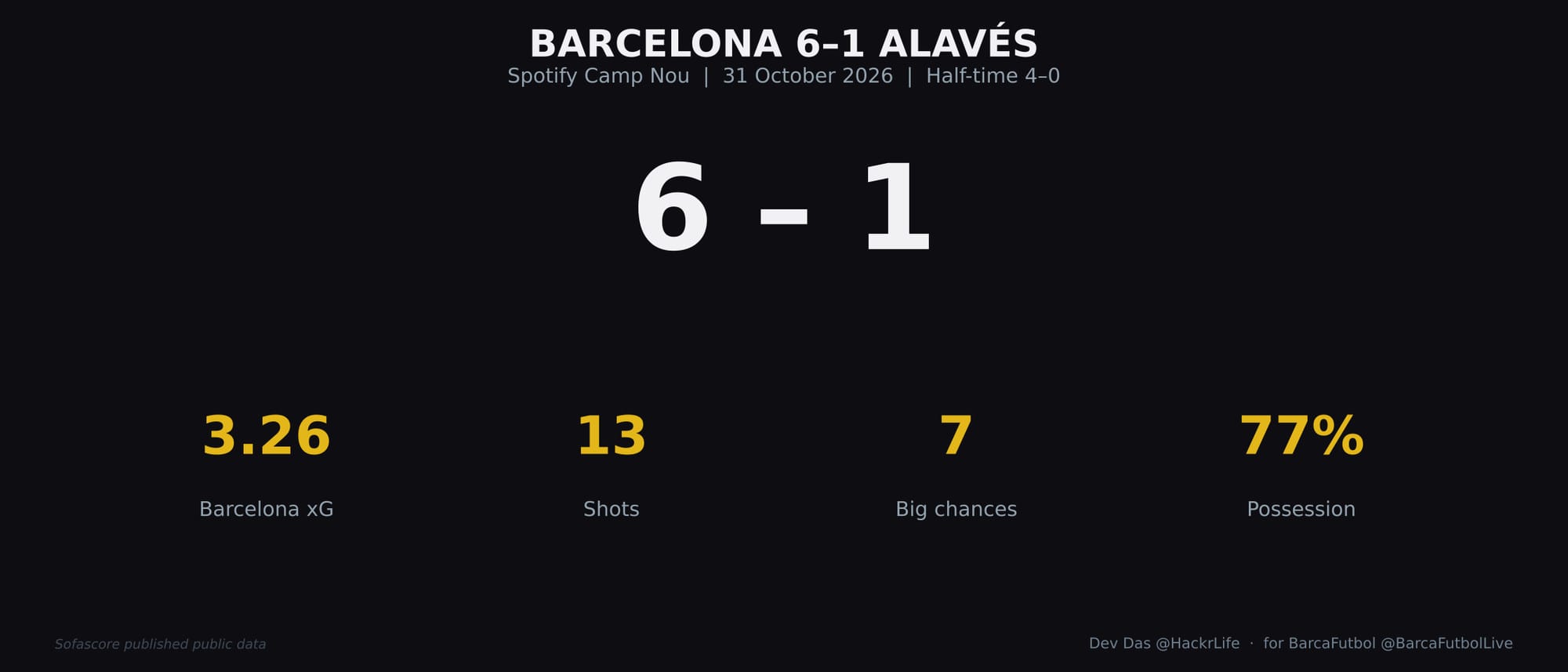
Yet if you only look at the 6-1 scoreboard, you miss the real story of the night. Barcelona generated 3.26 xG from 13 shots, carving out 7 big chances on 77% possession. On an ordinary night in La Liga, 3.26 xG buys you three, maybe four goals. Turning that volume into six required a ruthless, almost absurd clinic in ball-striking—combined with two Alavés errors leading directly to goals—where Barcelona repeatedly turned half-glimpses worth 0.05 xG or less into unstoppable finishes.
The Structural Dare: A Two-Midfielder Rest-Defense
To understand how Barcelona suffocated Alavés before the visitors could even test that makeshift backline, you have to strip away the pre-match broadcast graphics. Depending on where you looked before kickoff, Barça were listed as a 4-3-3 or a 4-2-3-1 with Fermín López as the ten. The average touch coordinates tell a much more radical story.
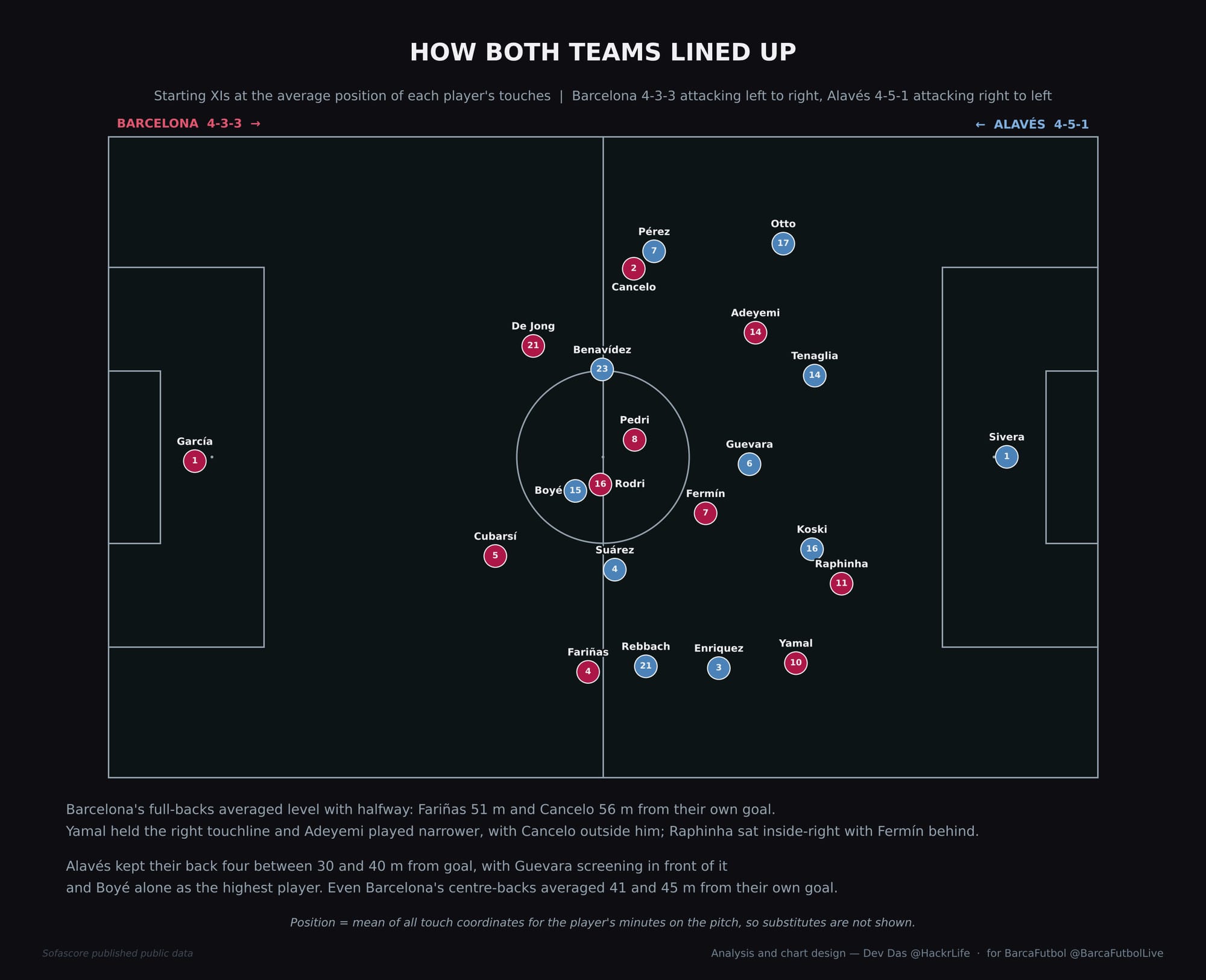
In possession, Barcelona’s back four ceased to exist. Fariñas (51 metres from his own goal) and João Cancelo (56 metres) spent the evening parked directly on the halfway line. Even the centre-backs, Pau Cubarsí and De Jong, averaged 41 and 45 metres up the pitch. That left Barcelona defending transitions with a 2-1 rest-defense structure: Cubarsí and De Jong at the base, with Rodri screening just ahead of them in the centre circle. Three players holding the entire width and depth of the pitch behind the ball—two of them midfielders by trade.
Ahead of that platform, Flick tilted the pitch heavily toward the right. Lamine Yamal pinned the right touchline to stretch Alavés horizontally, allowing Raphinha to operate not as a winger, but as the highest inside-right outlet on the pitch, with Fermín buzzing directly underneath him in the right half-space. On the left, Karim Adeyemi tucked inside to vacate the wide corridor for Cancelo’s overlapping runs.
Quique Sánchez Flores set Alavés up in a compact 4-5-1, parking his back four between 30 and 40 metres from Antonio Sivera’s goal with Ander Guevara screening the space in front. The game plan was transparent: absorb the pressure, wait for a turnover, and launch Lucas Boyé or the wide midfielders into the acres of green grass behind Fariñas and Cancelo.
In the 11th minute, we saw the exact danger of Flick’s high-wire act. Alavés sprung Abderrahman Rebbach into the box on a lightning fast break, resulting in a 0.27 xG effort that he blazed over the bar. It was the cleanest look Alavés would get all night. For the rest of the match, Barcelona’s offside trap snapped shut five times, and the sheer territorial gravity of Flick’s setup strangled the visitors' outlet passes at the source.
Surgical Penetration Over Mindless Crossing
When you pin a 4-5-1 deep in its own third with your full-backs past the halfway line, monopolizing the ball is inevitable. Barcelona racked up 77% possession and completed 774 of 836 passes, leaving goalkeeper Joan García to make just two saves all evening.
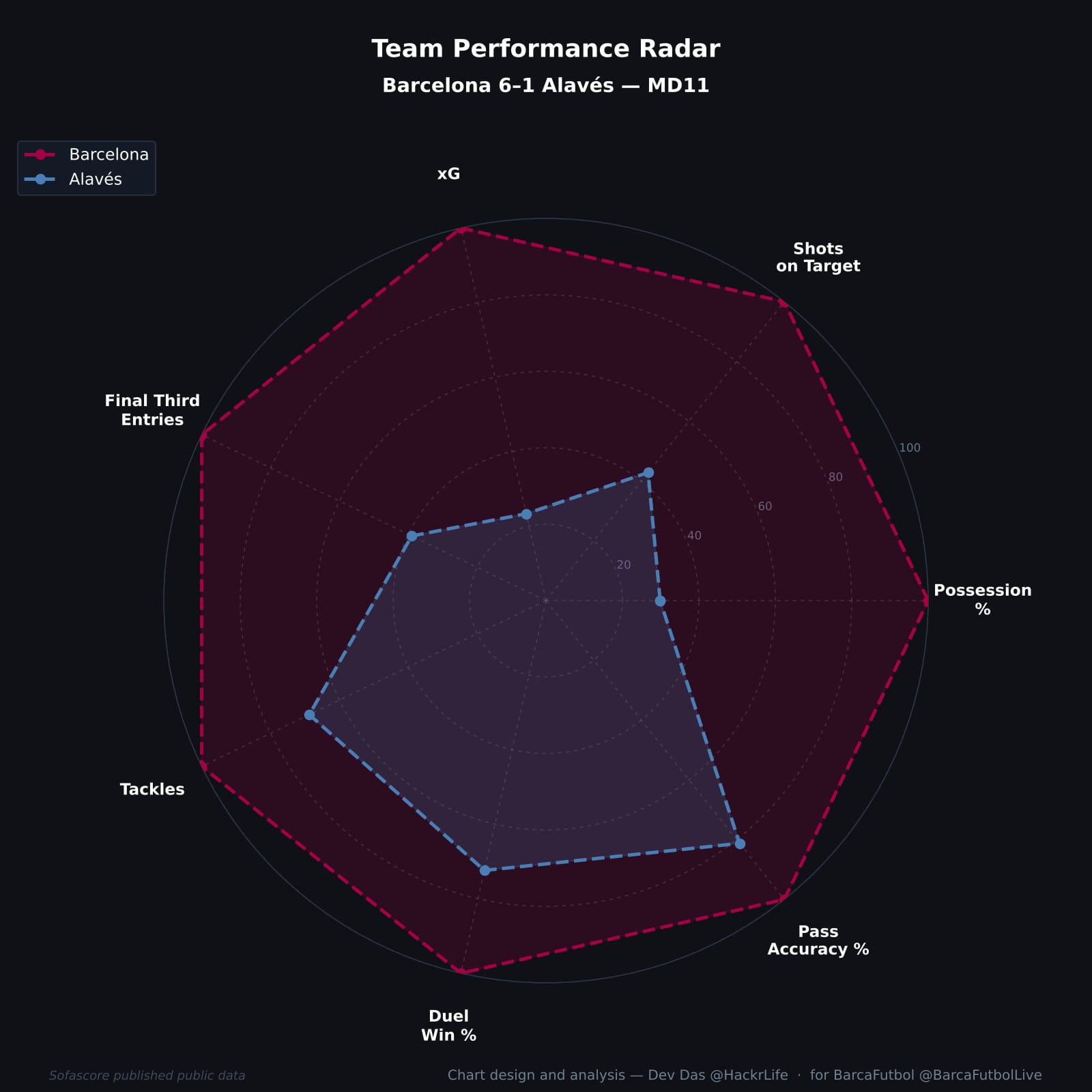
What separates this performance from sterile possession, however, is how Barcelona chose to break the block. Look at the lower half of the Team Performance Radar and you can see that Alavés actually competed well when the game became physical in tight spaces—winning 42% of their duels and logging 11 tackles to Barcelona’s 16. Where Alavés drowned was in transition and territory: with Boyé completely isolated, they completed just 14 of 37 long passes, managed only 23 final-third entries to Barcelona’s 59, and produced a fraction (0.76) of Barcelona’s xG.
Faced with a congested nine-man wall in front of Sivera, a lazy team swings crosses into the box. Barcelona attempted just seven crosses all night and completed zero. Instead, they went through and behind the block, registering six through-balls to Alavés’ zero. Every time an Alavés midfielder stepped up a yard to press Rodri or De Jong, the ball was slipped behind their ankles.
The xG Paradox: Two Goals, Two Misses, and a First-Half Avalanche
Trace the xG Timeline from kickoff to the final whistle and a fascinating quirk emerges. Barcelona’s goals arrived in three neat bursts of two, yet the moments when Barcelona actually broke the game open on the scoreboard barely align with their biggest statistical chances.
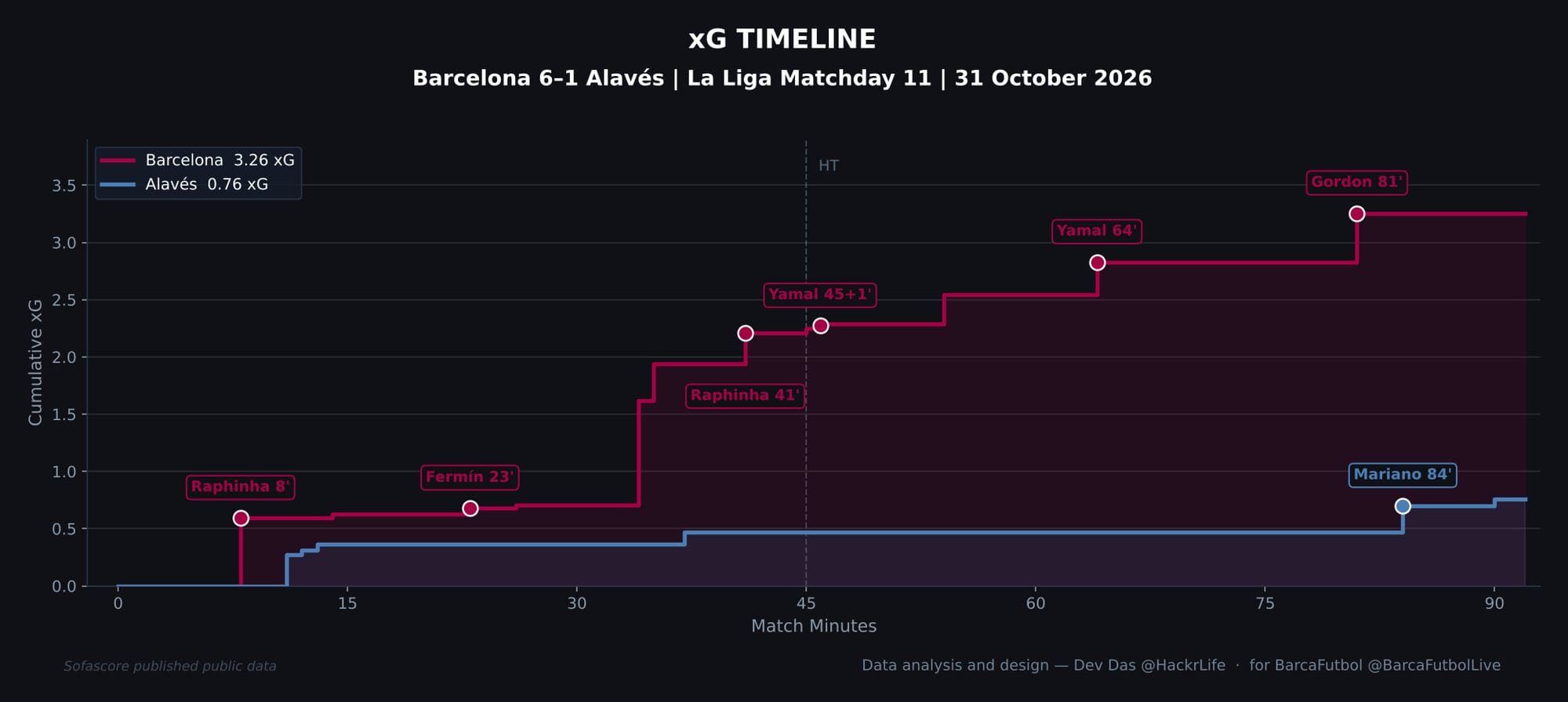
By the 33rd minute, Barça led 2-0 through Raphinha (8') and Fermín (23') while having generated a modest 0.71 cumulative xG. Immediately after that, the crimson xG line shoots almost vertically upward—jumping from 0.71 to 1.94 xG in the span of sixty seconds—and Barcelona didn’t score from any of it. In the 34th minute, Raphinha missed a 0.91 xG look (the single biggest chance of the match), and a minute later Sivera pulled off a sharp close-range save to deny Yamal a 0.32 xG effort.
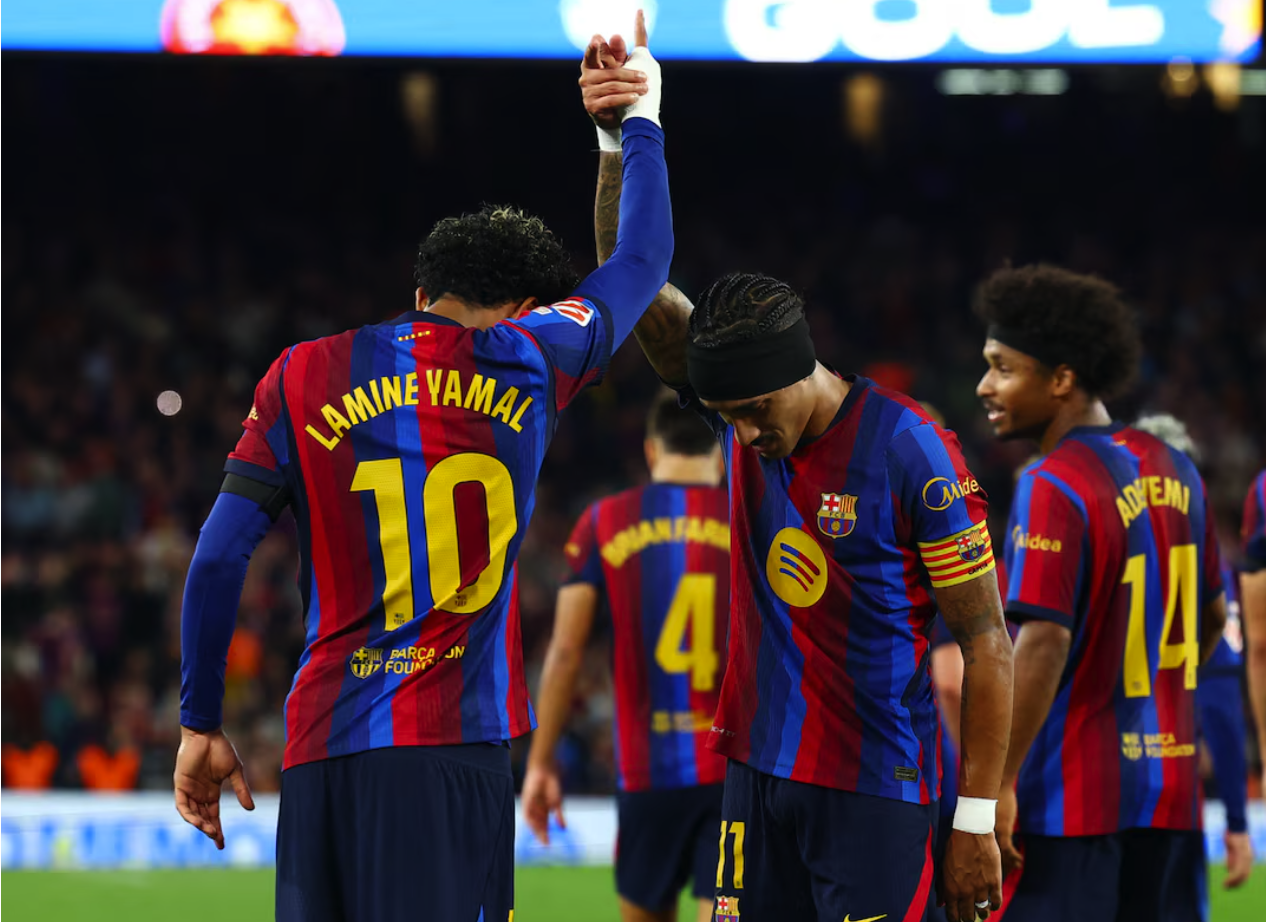
For a brief window at 2-0, Alavés sensed a lifeline, firing off two quick shots through Carlos Benavídez and Boyé in the 37th minute. "We had some chances when the score was 2-0, and we almost scored, but the other two goals settled the match," Sánchez Flores admitted afterward. He was right. Within five minutes of Alavés' flurry, Raphinha (41') and Yamal (45+1') struck back-to-back blows before the interval to send Barça into the dressing room at 4-0, backed by 2.29 xG from ten first-half shots against Alavés' 0.47 from five.
The second half was pure game-state stranglehold. Even after Sánchez Flores threw on Toni Martínez to form a front two with Boyé, Barcelona held 78% of the ball after the break and took only three shots in the entire 45 minutes. Every single one of those three shots was a big chance: Adeyemi’s miss in the 54th minute, Yamal’s chip in the 64th, and substitute Anthony Gordon’s finish in the 81st. Aside from Mariano Díaz's 84th-minute goal off a loose Rodri back-pass and a blocked Martínez shot in the 90th, Alavés barely crossed halfway.
Six Goals, Six Routes
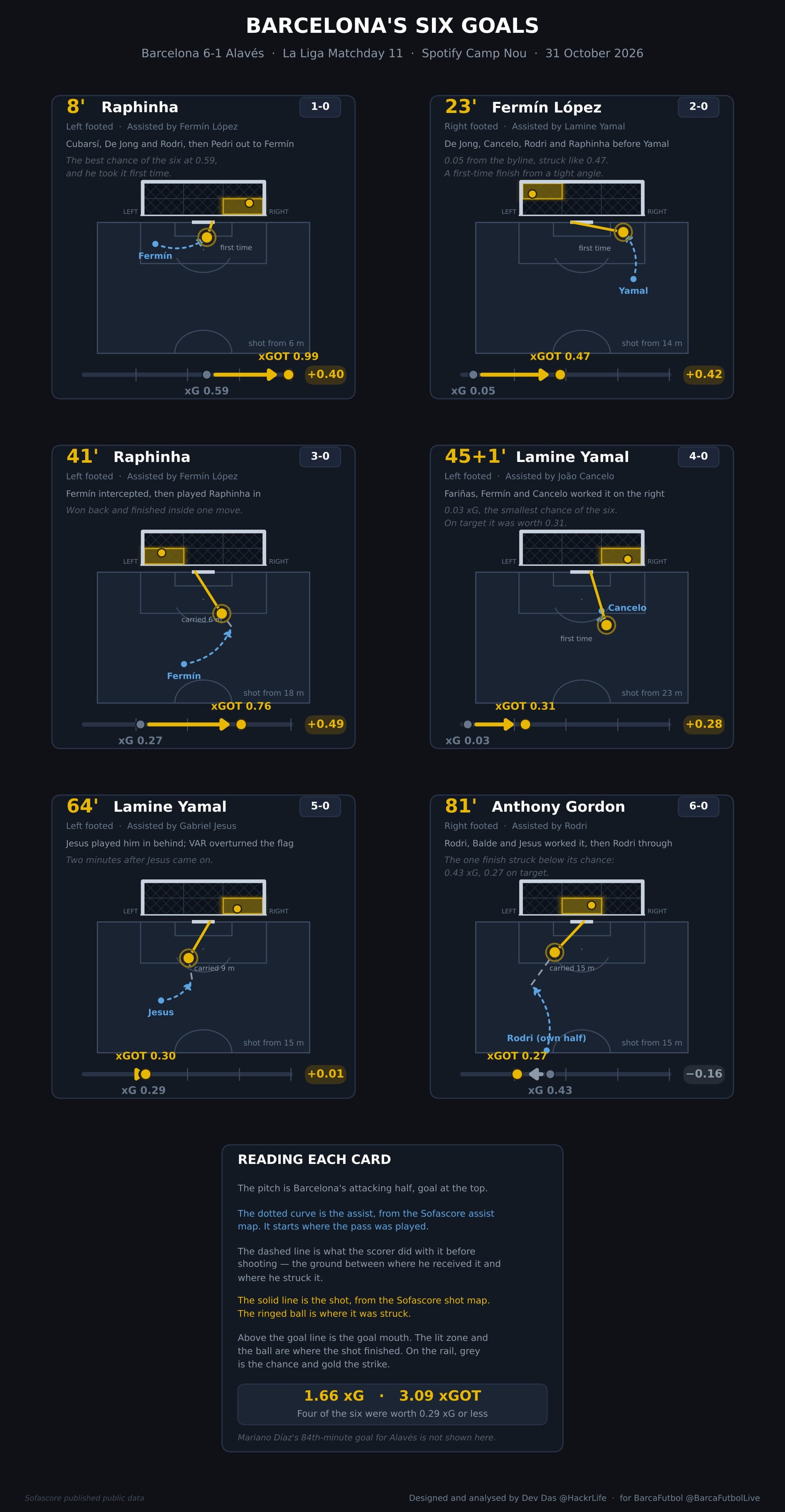
Dig into the shot cards for those six goals and you find the golden statistical insight of the night: the six scoring shots carried a combined pre-shot value of just 1.66 xG, but Barcelona’s ball-striking elevated them to 3.09 Post-Shot xG (xGOT). Four of the six goals came from chances worth 0.29 xG or less, and no two goals were built the same way:
- 1-0 Raphinha (8' — 0.59 xG to 0.99 xGOT): The 15-pass panoramic move involving nine players. Cubarsí, De Jong, and Rodri worked the ball to Pedri, who clipped a long pass over the block to Fermín deep on the left of the area. Fermín cut it back, and Raphinha buried it first time from six metres into the bottom right corner (+0.40 xGOT value added).
- 2-0 Fermín López (23' — 0.05 xG to 0.47 xGOT): A right-sided overload. De Jong, Cancelo, Rodri, and Raphinha shuttled it wide to Yamal, who slipped Fermín toward the byline. From a tight 14-metre angle on the right where almost every midfielder squares the ball, Fermín lashed a first-time right-footed strike high into the roof of the net (+0.42 xGOT added).
- 3-0 Raphinha (41' — 0.27 xG to 0.76 xGOT): Pure vertical transition. Fermín stepped in to intercept a pass in the centre circle, drove forward, and fed Raphinha in the inside-right channel. Raphinha carried it six metres and drilled a low left-footed finish from 18 metres inside the far post (+0.49 xGOT added).
- 4-0 Lamine Yamal (45+1' — 0.03 xG to 0.31 xGOT): The lowest-probability goal of the night. Fariñas, Fermín, and Cancelo triangulated on the right before Cancelo laid it back to Yamal 23 metres out. First time with his left foot, Yamal whipped a low strike into the corner (+0.28 xGOT added).
- 5-0 Lamine Yamal (64' — 0.29 xG to 0.30 xGOT): Two minutes after coming off the bench, Gabriel Jesus threaded a pass in behind the line. Yamal carried it nine metres, waited for Sivera to commit, and chipped him cleanly—a goal initially flagged offside before VAR overturned it.
- 6-0 Anthony Gordon (81' — 0.43 xG to 0.27 xGOT): The only strike of the six that graded lower on xGOT than its initial xG (-0.16). Rodri launched a through-ball from his own half, and Gordon carried it 15 metres into the box before lifting it over Sivera.
The Engine Room: How Five Players Built the Platform
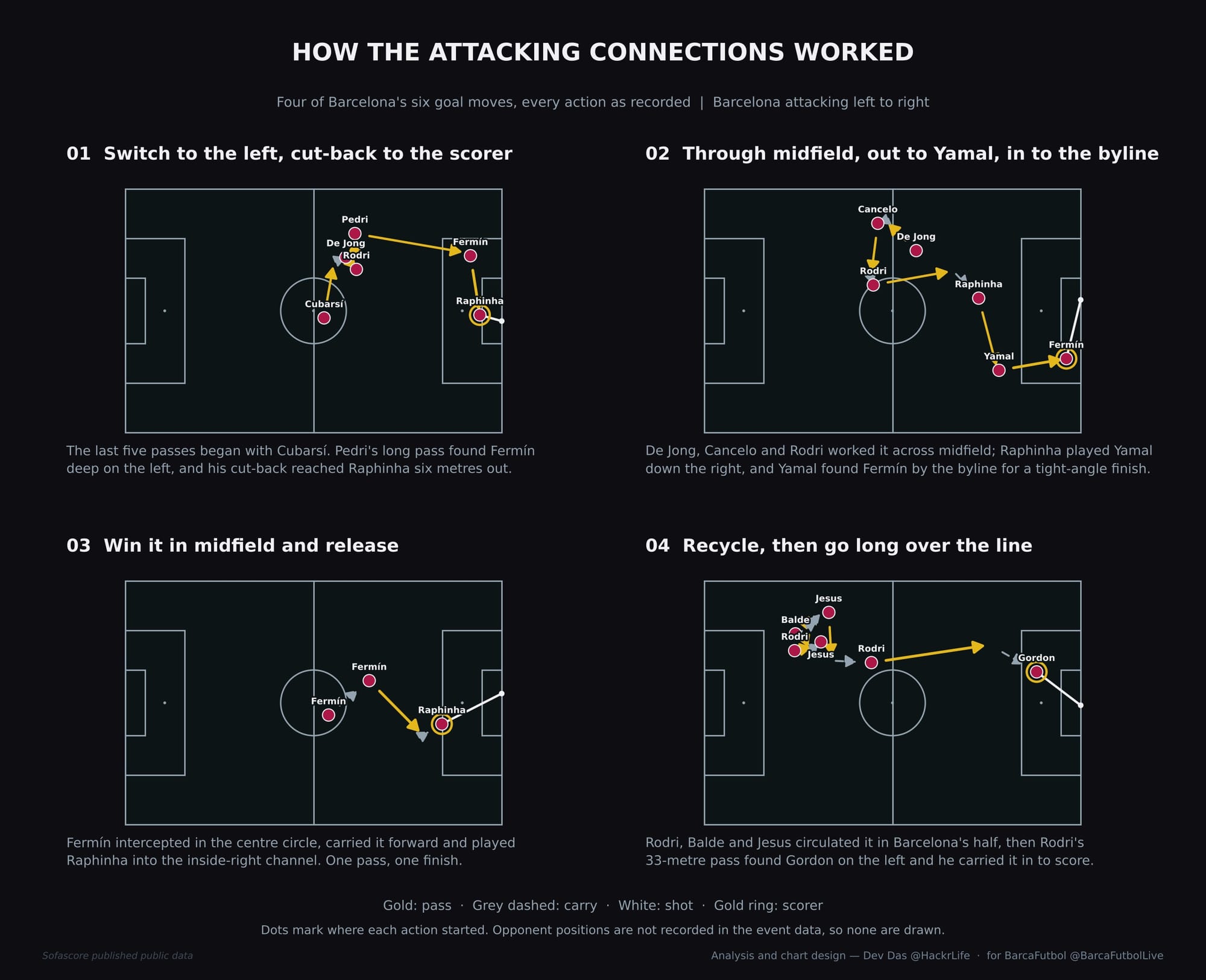
Follow the four full-pitch sequence maps from the first touch to the finish and the same names appear at the root of every move. Three of the four sequences began with Cubarsí, De Jong, or Rodri circulating the ball around the centre circle before suddenly breaking a line to find Fermín or the space in behind.
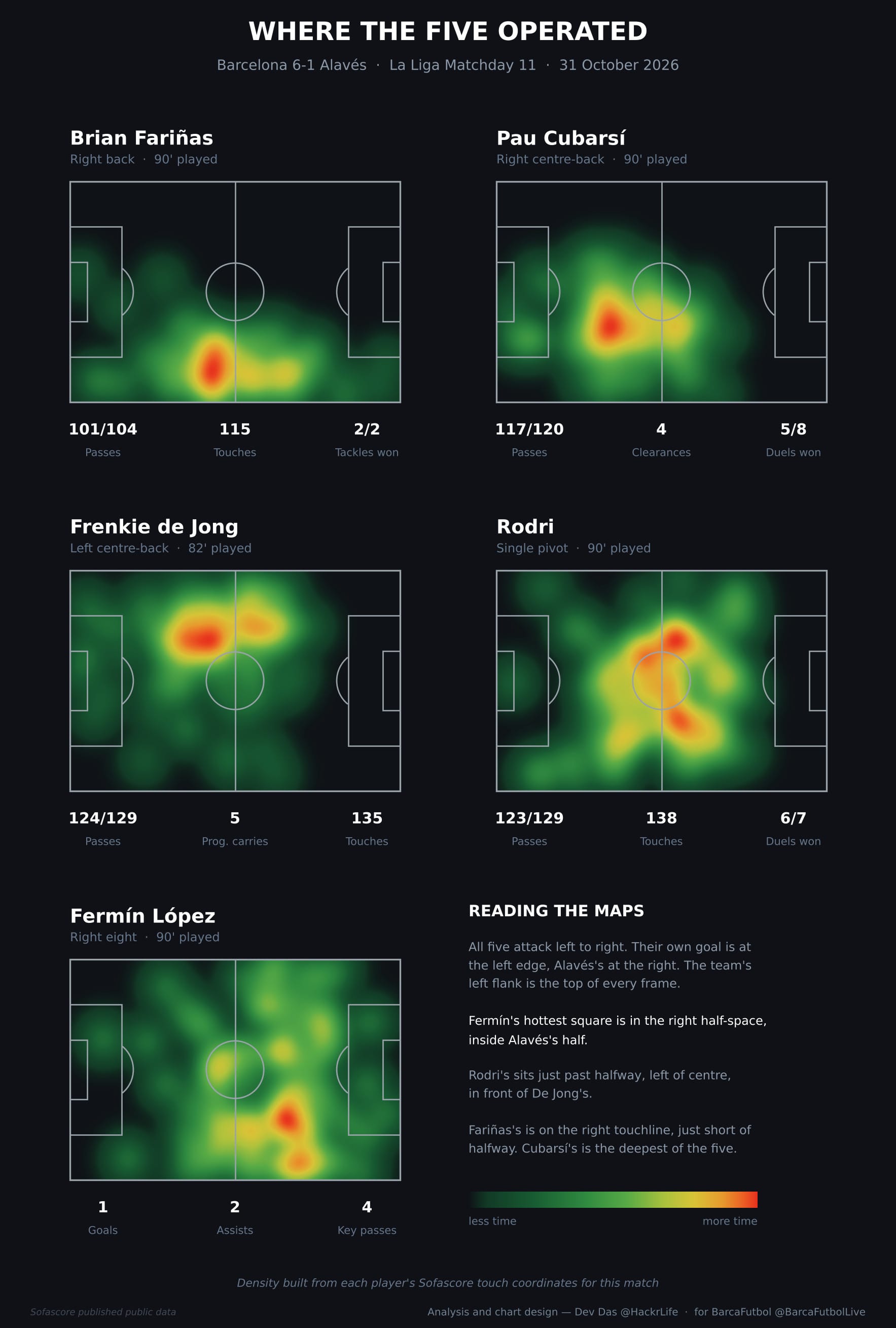
Pair those passing sequences with the touch-density heatmaps for Fariñas, Cubarsí, De Jong, Rodri, and Fermín, and you see the spatial discipline that held Flick's structure together.
Start with the debutant on the right touchline. Fariñas’ hotspot sits just short of halfway—exactly where Flick's system demands a full-back live. In his first 90 minutes of senior football, the 20-year-old logged 115 touches, completed 101 of 104 passes, and won 2 of 2 tackles. He never looked exposed because the right-sided ecosystem insulated him. "Whether it was Cubarsí, Rodri, Fermín and Lamine, they were all there on my flank," Fariñas told club media afterwards. Behind him, Cubarsí’s heatmap is the deepest of the five, sitting right of centre to sweep up the space Fariñas vacated—completing 117 of 120 passes, making 4 clearances, and winning 5 of 8 duels.
To their left, Frenkie de Jong played centre-back by turning the backline into a launchpad. In 82 minutes, he recorded 135 touches, completed 124 of 129 passes, registered 5 progressive carries, and led the entire squad in total ball progression distance. Because Alavés refused to step out of their 4-5-1 mid-block to press a centre-back, De Jong simply drove the ball straight into the heart of their midfield. Flick singled both out on Monday: "[A]gainst Alaves, what I saw was that everyone pitched in; everyone stepped up to help, like Farinas and De Jong".
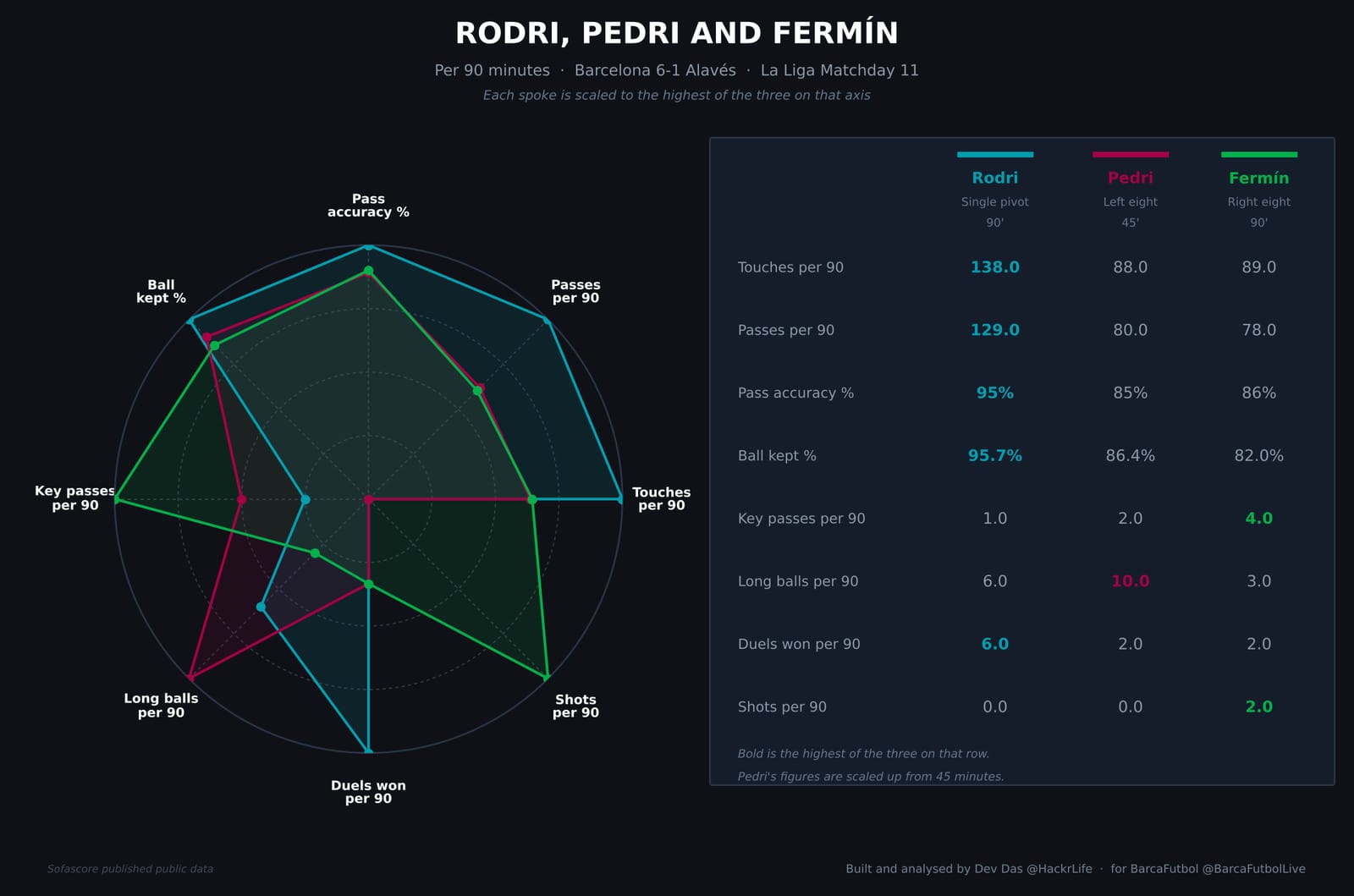
Ahead of the back two, the midfield three split their responsibilities with surgical clarity:
- The Metronome (Rodri): Operating just past halfway in front of De Jong, Rodri led the match with 138 touches and 129 passes (95% accuracy), retaining possession on 95.7% of his involvements while winning 6.0 duels per 90. Even with his 84th-minute misplaced back-pass that gifted Mariano Díaz Alavés' lone goal, his control of the centre circle was total.
- The Quarterback (Pedri): Needed for just 45 minutes before being rested at half-time, Pedri scaled up to a massive 10.0 long balls per 90—one of which split Alavés open for the first goal.
- The Disruptor (Fermín López): Fermín’s heatmap glows bright red inside the Alavés right half-space. He retained the ball least of the three (82.0%) because his job was final-third risk: generating 4.0 key passes and 2.0 shots per 90 to lead the midfield on both counts.
Reading the Contribution Matrix
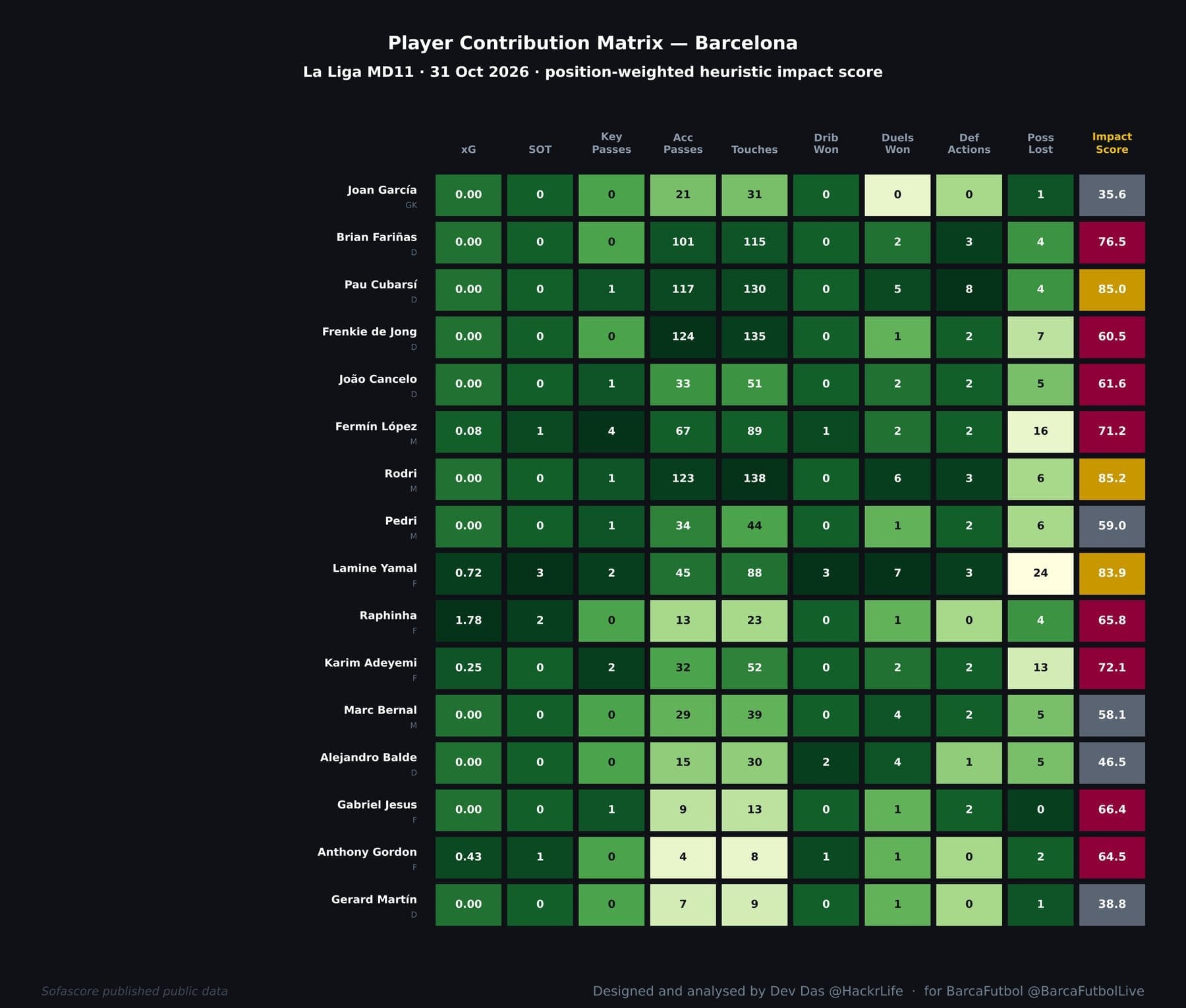
When we run Saturday’s numbers through our position-weighted heuristic Player Contribution Matrix, we get a masterclass in what algorithmic models see clearly—and what they completely miss.
At the top, the model crowns Rodri (85.2), Cubarsí (85.0), Yamal (83.9), and debutant Fariñas (76.5). As a measure of who controlled the game state, volume, and territory, that top four is unimpeachable.
Look further down, however, and the spreadsheet betrays its bias toward raw event volume. Frenkie de Jong ranks 11th on 60.5 despite completing a match-high 124 passes and progressing the ball further upfield than any player on the pitch. Because Alavés never forced him into last-ditch defending (just 2 defensive actions and 1 duel won), a defender-weighted algorithm punishes him—ignoring that his progressive carries were the very reason Alavés never got near Barcelona's box. Even more glaring is Raphinha sitting 8th (65.8) and Man of the Match Fermín López sitting 6th (71.2). A nine-column volume table simply does not know how to price a forward who touches the ball 23 times and changes the scoreboard twice.
The Architect, The Executioner, and the 10.0 Hybrid
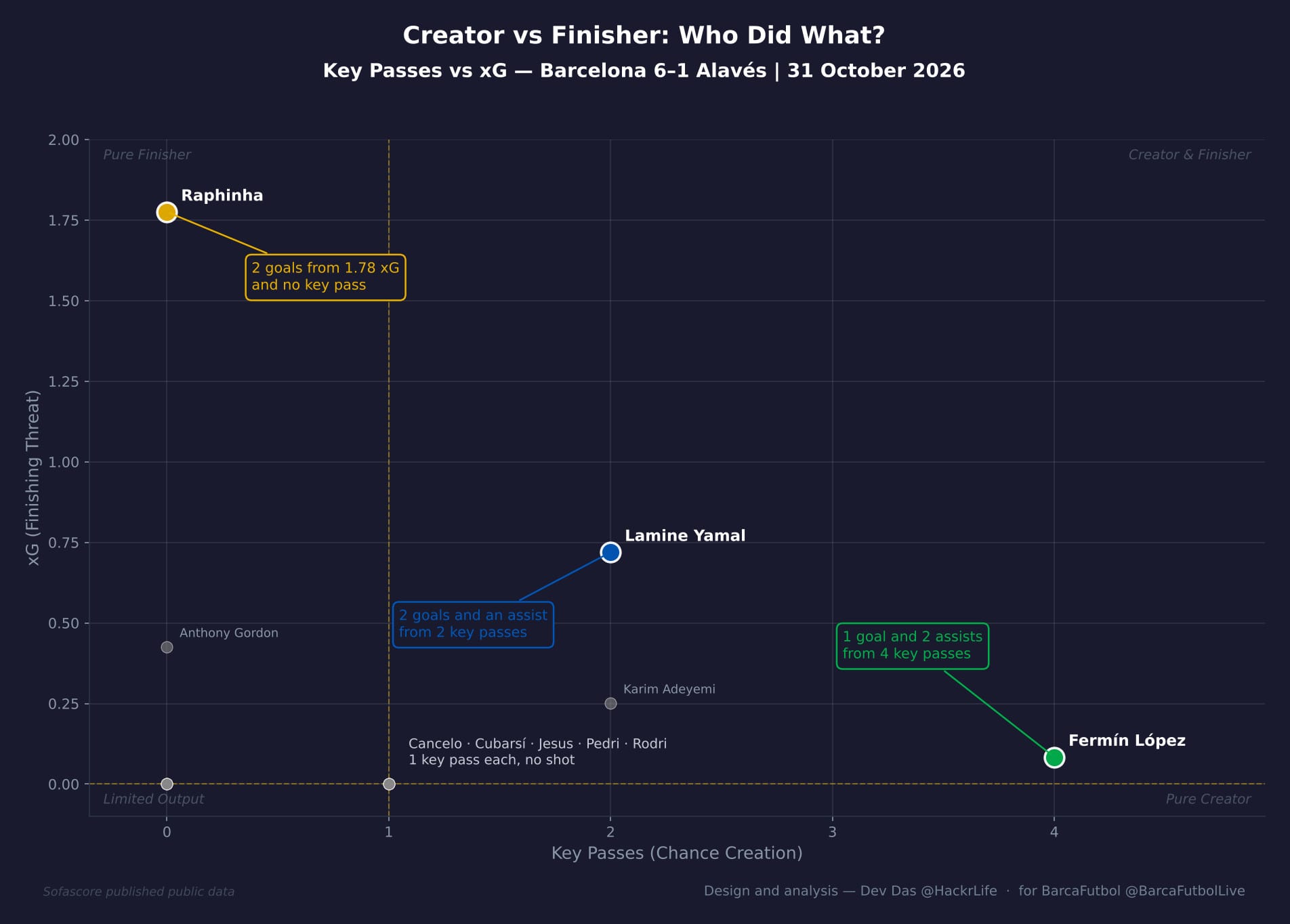
Plot the squad on a Creator vs. Finisher quadrant (Key Passes vs. xG) and the true anatomy of Barcelona's front line snaps into focus. While Cancelo, Gabriel Jesus, and Rodri sit in the bottom cluster with a single key pass each—every one of them a direct assist—the match was broken open at the extremes by Fermín, Raphinha, and Lamine Yamal.
Floating right between the pure creator and the pure finisher is Yamal (2 key passes, 0.72 xG), which explains how Sofascore handed him a perfect 10.0 rating even while Man of the Match honours went to Fermín. Before walking off to a standing ovation in the 74th minute with two goals and an assist, Yamal accounted for a mere 8.8% of Barcelona’s touches (88/995) and 5.8% of their completed passes (45/774), yet he generated 42.9% of the team's shots on target (3/7), 42.9% of their successful dribbles (3/7), 22.1% of their xG (0.72), and won a match-high 7 duels (17.5% of the team's total).
"When you score two goals, it's easier to go out," Flick smiled afterwards, noting that after a half-time chat, what mattered most for the team was seeing that Yamal "has the confidence back with the one vs. one situations".
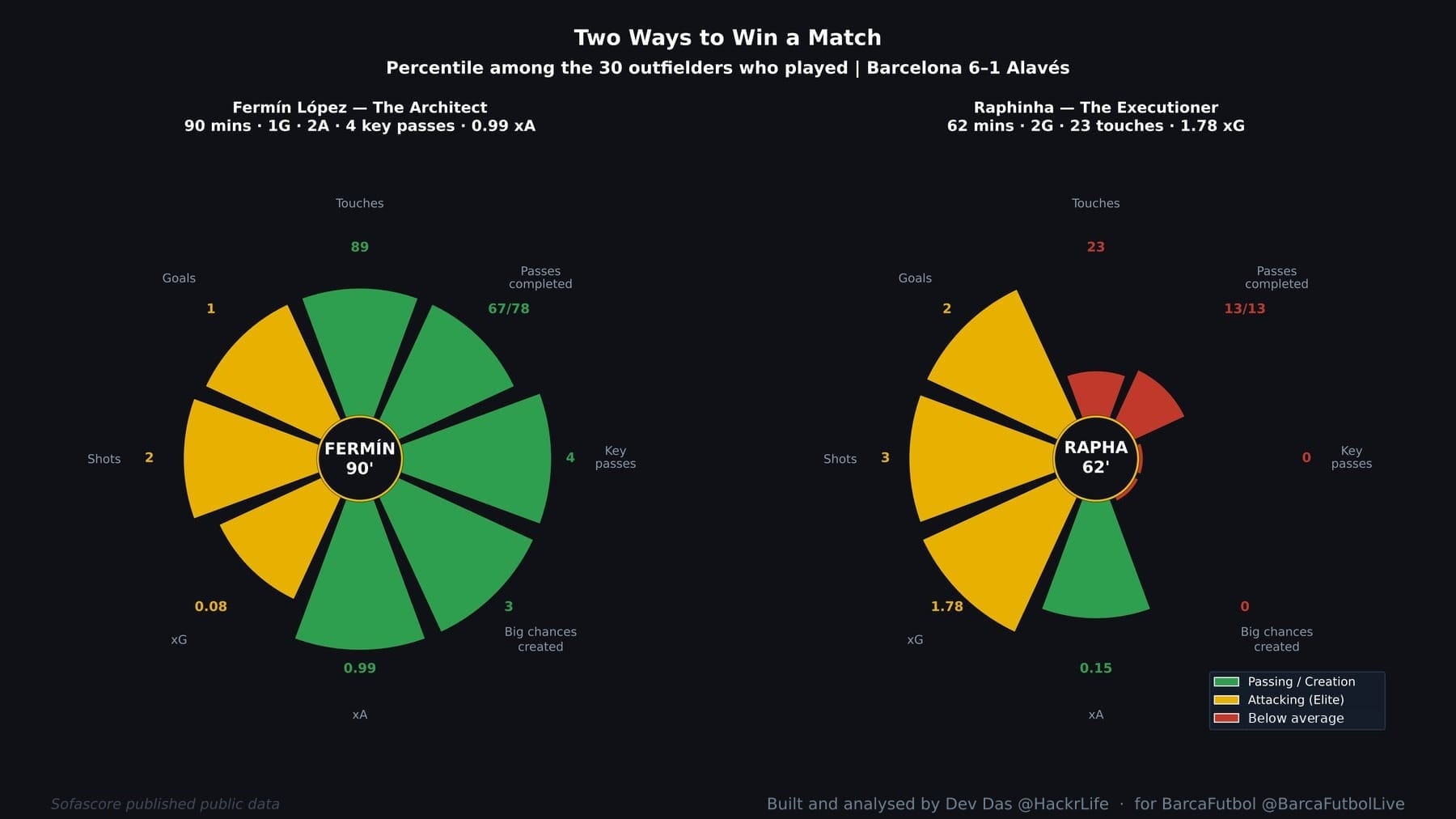
Benchmarking Fermín López and Raphinha against all 30 outfield players who stepped onto the pitch crowns our Player of the Match while illustrating the exact duality that makes Flick’s attack so difficult to game-plan against:
- Fermín López — The Architect (90 mins): Operating in the tightest spaces of Alavés' block, Fermín ranked 1st on the pitch for key passes (4), big chances created (3), and expected assists (0.99 xA), while placing in the top 20% for touches (89) and completed passes (67/78). With a goal, two assists, and a direct hand in all four first-half strikes, he was the skeleton key that unlocked the 4-5-1.
- Raphinha — The Executioner (62 mins): Where Fermín's pizza chart blooms green with passing and creation volume, Raphinha’s is a ruthless slash of gold: 23 touches (bottom percentile), 13/13 passes, zero key passes, and zero big chances created—paired with a match-high 1.78 xG (more than half of Barcelona's team total) and two clinical goals that take him to 15 goals in 11 La Liga games. Fermín built the runway; Raphinha burned the net down.
The Warning Sign Waiting for Villa and Atlético
With Aston Villa arriving at Spotify Camp Nou in the Champions League on November 3 and a top-of-the-table showdown against Atlético Madrid at the Metropolitano looming on November 8, Flick’s defensive injury crisis isn't over yet. On Monday, Flick admitted he hopes Koundé, Eric García, and Christensen will be fully back "after the break"—noting Christensen is "fine, but we'll have to wait until the weekend" and Espart is "not yet" ready.
If you are Unai Emery or Diego Simeone studying the tape of this 6-1 rout, you aren't admiring the six goals. You are looking back up at the Player Contribution Matrix and circling two pale cells in the second-to-last column: 24 and 16.
Those are the possessions lost by Yamal (24) and Fermín (16)—the highest turnover counts on the pitch. Against an Alavés side parked 70 metres from goal with 23% possession, losing the ball 40 times between your right winger and right interior is the harmless tax of creative risk-taking. Try coughing up the ball 40 times in that right channel against Villa's vertical transitions or Atlético at the Metropolitano—while your full-backs are camped past the halfway line and a midfielder is filling in at centre-back—and Rebbach's 11th-minute breakaway (0.27 xG) won't remain a forgotten footnote. On Saturday night, Atlético held the top of La Liga for a few hours before Barcelona emphatically snatched it back; on Sunday, they meet on Atlético's turf to see who keeps it.