The Geometry of Chaos: How Hansi Flick’s Front Line Dismantled Feyenoord 5-1
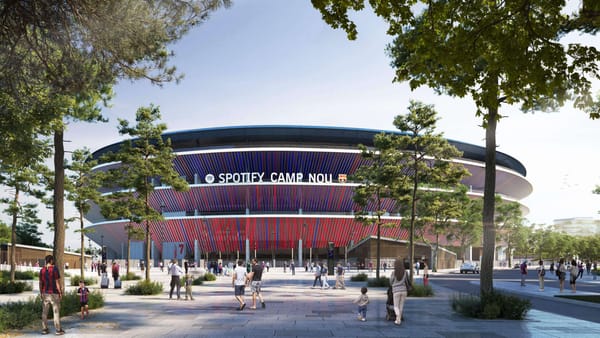
Beyond the 5–1 scoreline, Barcelona’s positional rotations and elite finishing proved devastating at the Camp Nou as the catalans started their Champion’s League journey this year.


Barcelona opened their Champions League campaign with another five-goal statement, right after their manita agaisnt Valencia earlier in the week
The scoreline was identical. The swagger was familiar. Even the sight of Raphinha leading the line without behaving like a conventional centre-forward felt like a direct continuation of Hansi Flick’s domestic blueprint.
Raphinha struck after three minutes. Karim Adeyemi detonated a 24-metre diagonal strike on 22 minutes. Pedri released Raphinha for a surgically executed third early in the second half, before Lamine Yamal bent a dead ball through some questionable defending and a huge a gap in a free-kick wall into the low right corner on 77 minutes. Sem Steijn pulled one back for the Rotterdam side, only for Gabriel Jesus to come off the bench and nod in Barcelona’s fifth roughly three minutes later.
Barcelona’s five goals were constructed from shots carrying an aggregate total of just 0.94 expected goals (xG). Flick’s side did not rack up a barrage of tap-ins; they produced an underlying 2.10 xG across the 90 minutes. They were dominant, yes, but they were made to look devastating by world-class, outlier execution.
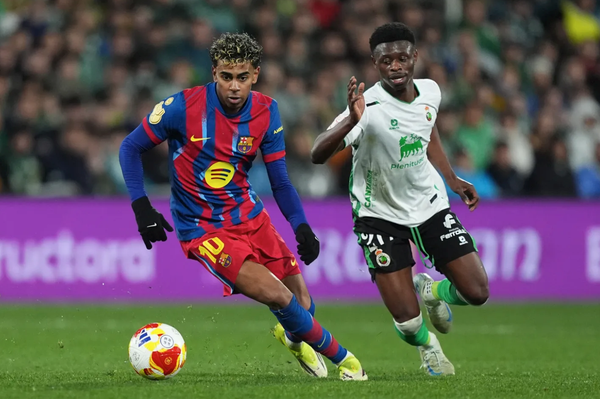
More significantly, this performance exposed how Flick's tactical jigsaw functions when every gear engages. Starting Rodri as a solitary, metronomic pivot gave Dani Olmo and Pedri positional freedom. Raphinha operated as a roaming false nine who gravitated relentlessly toward the right half-space, vacating central territory only for Lamine Yamal to cut into from the touchline. Meanwhile, Karim Adeyemi stayed pinned to the left chalk to ensure the pitch never compressed.
It was fluid structural rotation, offering several iterations of the same team within a single phase of play.
The Numbers Show Control, Not Just Possession

Possession can often be a hollow metric—sterile circulation between centre-backs designed to run down the clock. Barcelona’s 72 per cent was the antithesis of sterile.
Barcelona completed 746 passes from 794 attempts, generating 82 entries into the final third compared to Feyenoord’s 17, and logging 46 touches inside the opposition penalty area against just 11. Yet the defining metric of Flick’s structural dominance was that Barcelona out-ran (117.5 kilometres to 115.1) and out-sprinted (135 to 128) their Dutch visitors. Not the metric you expect Barca to win.
Those running numbers show that Barcelona’s possession was supported by serious off-ball work. Their rest defence came from the positioning of Rodri, Koundé and the centre-backs behind the attack. When Barcelona turned the ball over, they did not drop into a passive mid-block. They clamped down immediately. Feyenoord won 24 tackles to Barcelona’s 17 and logged six interceptions to five, figures that suggest the rearguard action Feyenoord had to perform in their own defensive third.
Barcelona won 82 per cent of their tackles; Feyenoord won just 54 per cent. The Dutch side were required to challenge far more frequently and were substantially less successful when they did.
The visitors were constantly squeezed by Barcelona's counter-press and Rodri's anticipation at the base. Winning the ball back inside their defensive third merely exposed Feyenoord to Barcelona's second wave of pressure. They were forced into rushed, low-percentage escape routes: attempting 31 long balls and completing just 11.
The Goal Timeline

Feyenoord’s game plan lasted exactly three minutes.
Giovanni van Bronckhorst set his team up in a compact 4-2-3-1, anchoring Gjivai Zechiël and Charles Vanhoutte in front of the back four. The tactical logic was clear: deny central passing lanes, guide Barcelona’s buildup toward wide areas, and hit long into the channels behind Flick's aggressive high line.
Raphinha’s opener obliterated that premise before Feyenoord had settled into their defensive shape. Dropping off the front line, the Brazilian picked up a pass from Lamine Yamal, drove through the heart of the pitch, and finished low. The early goal completely warped the game's risk profile: Feyenoord could no longer sit deep and protect a stalemate.
Feyenoord were forced to step out, leaving open spaces behind their defensive block—the exact operational terrain where Adeyemi thrives and his strike on 22 minutes compounded the crisis.
The match then entered a 35-minute holding pattern between the 22nd and 57th minutes. This was Feyenoord's most disciplined spell of damage limitation. They defended their box with greater compactness, yet they offered virtually nothing in transition. Barcelona recirculated the ball via Rodri and camped deep inside Feyenoord’s half until the third breakthrough arrived.
Pedri’s surgical assist to Raphinha on 57 minutes effectively put the match out of reach, granting Flick the opportunity to rotate:
- 63rd Minute: Pedri and Karim Adeyemi departed for Marc Bernal and Anthony Gordon enter.
- 71st Minute: Raphinha got rested, replaced by Fermín López.
- 83rd Minute: Rodri and Dani Olmo withdrew, replaced by Gavi and Gabriel Jesus.
Rather than letting the match drift into passive preservation, Barcelona's structure held firm. Even when Feyenoord capitalised on a momentary opening—substitutes Gonçalo Borges and Sem Steijn combining for an 82nd-minute consolation—Barcelona extinguished any flicker of momentum within three minutes. Gabriel Jesus, who had entered the pitch immediately following Steijn’s goal, attacked an in-swinging cross from Lamine Yamal to restore the four-goal cushion.
Deconstructing the Five Goals

There is an interesting story for data nerds in these charts, which calculates chance quality versus pure finishing ability.
The pre-shot Expected Goals on Barcelona's five goals totaled a modest 0.94 xG. In four of the five sequences, the probability of the initial chance resulting in a goal was under 20 per cent. Yet they all converted.
When you finish your half chances then domination becomes your second skin.
1. Raphinha (03' | 0.49 xG ──> 0.63 xGOT): Lamine worked the ball inward to Raphinha, who received outside the penalty area. Rather than acting as an isolated reference point, he feinted past two defenders, (which gave birth to countless memes) and carried the ball in a forward surge before stabbing a finish from around nine metres out.
2. Karim Adeyemi (22' | 0.04 xG ──> 0.25 xGOT): João Cancelo recycled a short central pass out to the left flank. Adeyemi took possession wide, carried diagonally inward for roughly 13 metres, and right about when no one was sure what he would be doing with it, he uncoiled an unstoppable strike from around 24 metres into the top corner. A golazo by every definition.
3. Raphinha (57' | 0.18 xG ──> 0.77 xGOT): Barcelona’s cleanest transitional sequence. Andreas Christensen stepped forward to intercept an outlet pass. Pedri received the turnover, swiveled on the half-turn, and threaded an inch-perfect 20-metre line-breaking ball. Raphinha timed his diagonal run behind the backline, and slotted home.
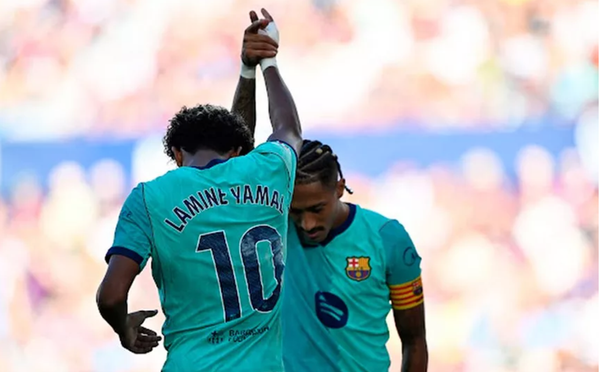
4. Lamine Yamal (77' | 0.19 xG ──> 0.82 xGOT): Olmo drew a foul from Jeremiah St. Juste on the edge of the area. From around 19 metres out, Lamine whipped a direct free kick through a gap in the defensive wall and into the bottom right corner. Extremely poor wall defense from Feyenoord. This was truly a goal that should never have happened.
5. Gabriel Jesus (85' | 0.04 xG ──> 0.53 xGOT): A demonstration of traditional number-nine box movement. Working in late possession, Lamine Yamal shaped to deliver from wide right. Jesus made a sharp blindside run across the front of his marker, meeting the delivery from around 11 metres and glanced a header across the keeper with his first meaningful touch inside the box.
Another day, another game 3 out of these 5 goals don't convert. The headlines write itself. The gap between the math of xG and the certainty of G is what makes football such a wonderful game.
And thank goodness that can't be sterilised and automated.
Cancelo's Chaos vs Koundé's Rest-Defense

Barcelona won 51 per cent of total duels; Feyenoord 49 per cent. In ground duels, the teams split exactly down the middle: 46 won out of 92 each. Barcelona did not dominate this match through raw physical superiority. They dominated because their successful actions flowed into structured possession, whereas Feyenoord’s regains got lost in turnovers.
A crucial component of that territorial stability lay in the deliberate asymmetry of Flick’s full-backs.
João Cancelo on the left operated with complete offensive license. Pushing high into the half-space, Cancelo registered two shots (accumulating 0.19 xG, including one effort off the woodwork), assisted Adeyemi's goal, and completed 65 of 75 passes. However, his aggressive positioning carried inevitable trade-offs: he surrendered possession 15 times and completed none of his four attempted crosses.
On the right flank, Jules Koundé functioned as the structural balance:
- Pass Completion: 90 completed from 92 attempted (98 per cent accuracy).
- Ball Security: Only four possessions lost across the entire 90 minutes.
- Defensive Output: Five clearances and one interception.
- On-Ball Efficiency: One successful dribble from one attempt; zero chances created.
Koundé appeared to hold a more conservative position, frequently giving Barcelona a back-three structure behind the attack alongside Pau Cubarsí and Christensen, with Rodri sweeping the intermediate corridor ahead of them.
This asymmetry provided the defensive platform for Lamine Yamal's creative freedom. With Koundé holding the base behind him, Lamine had the license to isolate defenders, drift inside, or attempt ambitious combinations without exposing Barcelona to immediate transitional vulnerability.
The Roaming Nine and the Touchline Pin

The official team sheet listed Raphinha as the central striker and Lamine Yamal on the right wing, but the positional heat maps reveal how fluid that dynamic actually was.
Raphinha's primary zone of activity was not inside the 18-yard box. His visual density is heavily concentrated in the right half-space, just beyond the halfway line. By dropping off the front line, Raphinha presented Feyenoord's centre-backs with an uncomfortable dilemma: step out into midfield to track him and leave gaps behind, or hold the line and let him turn cleanly into open pitch.
His movement established a natural progression axis with Pedri and Lamine Yamal:
                  [Feyenoord Penalty Area]
                             ▲
              Lamine Yamal   │   (Attacks Vacated Box)
              [Touchline ───> Inside Box]
                             │
                             │
        Raphinha ◄───────────┴───────────► Pedri
(Drops Deep into Half-Space)       (Progressive Needle from #8)
                             ▲
                             │
                           Rodri
                 (Single-Pivot Rest-Defense)
Lamine’s map shows that his densest operational territory sat right at the edge and inside the right side of Feyenoord's penalty box. When Raphinha dropped deep, Lamine sliced inside from the wing to become Barcelona's most advanced threat. When Lamine held the width, Raphinha exploited the vacated half-space channel. They shared the right flank in tandem without congesting each other's operating lanes.
Karim Adeyemi provided the tactical balance on the opposite flank. Adeyemi’s map reflects his role as a touchline outlet across his 63 minutes. By staying wide on the left, he pinned Feyenoord’s right-back and prevented their defensive line from sliding over to choke Barcelona's overloaded right flank. His goal was the direct payoff.
Behind them, the midfield heat maps highlight strong positional awareness. Neither Rodri nor Pedri show sustained activity inside the Feyenoord penalty area. They had no need to overload the box; Olmo, Adeyemi, and Lamine were already occupying advanced territory. Rodri governed the central corridor, while Pedri orchestrated between the boxes
The Controller, Needle, and Chaos Agent

The midfield radar highlights a clear division of labour. This was not three central midfielders competing for identical touches; it was a controller, a progressive distributor, and an attacking disruptor functioning in complete harmony.
Rodri: The Metronomic Anchor
- 100.8 touches per 90; 92.2 passes per 90.
- 96 per cent pass accuracy; 93.5 per cent ball retention.
- Only six total possessions lost across 83 minutes.
- Zero shots, zero dribbles attempted.
Operating as a solitary pivot, Rodri governed the operational tempo. He provided an ever-present reset option, ensuring turnovers were quickly corralled before Feyenoord could break out centrally.
Pedri: The Progressive Needle
- 95.7 touches per 90; 80.0 passes per 90.
- 91 per cent pass accuracy; 85.1 per cent ball retention.
- 4.3 key passes per 90; 7.1 long balls per 90 (100 per cent completion).
Pedri served as the transitional bridge, turning sustained possession into vertical penetrations. His assist for Raphinha’s second goal was textbook playmaking: collecting the ball on the half-turn, assessing the run, and eliminating three defenders with a single delivery.
Dani Olmo: The Disruptive Inside Threat
- 74.8 touches per 90; 52.0 passes per 90.
- 83 per cent pass accuracy; 79.7 per cent ball retention.
- 5.4 shots per 90; 8.7 duels won per 90.
- Four fouls drawn in advanced areas.
Olmo’s numbers provide a deliberate contrast to his midfield partners. A lower retention rate was the natural consequence of his aggressive positioning. He attacked the box, contested loose balls, and forced Feyenoord's defensive midfielders into hasty challenges—drawing the foul from St. Juste that led to Lamine's free-kick goal.
THE MIDFIELD MATRIX (PER 90 METRICS)
Metric              Rodri (Pivot)       Pedri (#8)          Olmo (#10)
----------------------------------------------------------------------
Touches / 90        100.8               95.7                74.8
Pass Accuracy %     96%                 91%                 83%
Ball Kept %         93.5%               85.1%               79.7%
Key Passes / 90     2.2                 4.3                 0.0
Long Balls / 90     2.2                 7.1                 1.1
Duels Won / 90      3.3                 1.4                 8.7
Shots / 90          0.0                 0.0                 5.4
Tactical Role       Control & Shield    Line-Breaking Axis  Box Disruptor
Raphinha's Masterclass in Efficiency

Raphinha’s performance was an exceptional demonstration of attacking economy. Across his 71 minutes on the pitch, he logged 47 touches—representing just under 5 per cent of Barcelona’s 979 team touches.
Yet within that compact on-ball footprint, Raphinha produced match-winning output:
- Direct Goals: 2 of Barcelona’s 5 (40 per cent share).
- Expected Goals: 0.74 of 2.10 total xG (35 per cent share).
- Shot Creation: 4 key passes (22 per cent share of team total).
- Crosses: 2 of 4 accurate crosses completed by the team (50 per cent share).
- Shots on Target: 2 of 9 for the team (both converted into goals).
- Duels & Take-Ons: 6 of 9 duels won (67 per cent); 3 of 3 successful dribbles.
RAPHINHA: USAGE VS MATCH-DEFINING OUTPUT
Total Team Touches:  [ 47 / 979 ]  ( 5%) ░░░░░░░░░░
Total Team xG:       [0.74/ 2.10]  (35%) █████████████░░░░░░░
Total Goals Scored:  [  2 / 5   ]  (40%) ████████████████░░░░
Accurate Crosses:    [  2 / 4   ]  (50%) ████████████████████
The data demonstrates how effectively Raphinha operated outside of traditional forward conventions. Despite starting through the middle, he delivered half of Barcelona's successful crosses. Dropping into the right half-space allowed him to face Feyenoord’s defensive block head-on rather than competing exclusively with his back to goal.
His two goals illustrated the flexibility of that movement. For the first, he came short to receive and drove through the defensive block on a solo carry. For the second, he made a direct channel run behind the defensive line onto Pedri’s pass.
Both Raphinha and Lamine Yamal registered four key passes on the night. The fact that Lamine finished with two assists while Raphinha recorded zero reflects the finishing conversion of the teammates on the end of those balls. In terms of primary creative volume, both players operated on an identical plane.
The Creator vs Finisher Landscape

The creator-finisher scatter plot illustrates how cleanly Barcelona’s attacking output was distributed across multiple profiles, avoiding an over-reliance on a single creative outlet.
At the top right of the chart Raphinha and Lamine Yamal combined scoring threat with high-volume chance creation. Raphinha paired 0.74 xG with four key passes; Lamine paired 0.34 xG with four key passes and two assists. Between them, they were directly involved in four of Barcelona's five goals.
Underneath the primary duo, the supporting cast filled complementary roles:
- The Midfield Creators: Pedri operated as the pure distributor, generating three key passes without taking a single shot (0.00 xG). Rodri added two key passes from deep, dictating buildup angles from the pivot.
- The Box Disruptor: Dani Olmo produced five shots and 0.25 xG with zero key passes, crashing the box and shooting on sight to keep Feyenoord's defensive block pinned.
- The Impact Substitute: Gabriel Jesus accumulated 0.26 total xG across his brief appearance—converting a 0.04 xG header before later striking the woodwork on a 0.22 xG chance—while also registering one key pass.
Feyenoord’s defensive block struggled to address these simultaneous threats. Stepping out to close Pedri left Raphinha room to run into the channel. Doubling Lamine Yamal out wide invited Raphinha to surge through the half-space. Narrowing the back four to defend the box allowed Adeyemi to attack in space on the opposite flank.
The Road Ahead
This 5-1 win was an emphatic opening-night performance, but it also requires separating structural success from an opponent's specific deficiencies.
Feyenoord struggled in three key areas:
- Passive Pressure on the Pivot: Feyenoord applied too little sustained pressure on Rodri, allowing him to receive and distribute uncontested. Higher-tier European sides will look to place an active shadow on him, disrupting Barcelona's central progression.
- Exploiting the Left Flank: Cancelo surrendered possession 15 times while pushing high up the pitch. While Koundé balanced the shape on the opposite side, an elite opponent with rapid counter-attacking wingers would exploit the space left behind.
- Finishing Variance: Scoring five goals from chances worth 0.94 xG represents an exceptional, clinical outlier. Against more disciplined Champions League defenses, Barcelona will not always be so lucky
Yet these caveats do not diminish Hansi Flick’s tactical framework. Barcelona once again proved they can generate overwhelming attacking momentum without relying on a fixed centre-forward. The striker zone was never left empty; it was filled through dynamic rotations—Raphinha’s runs from deep, Lamine Yamal’s diagonal cuts, Dani Olmo’s box entries, and Gabriel Jesus’ penalty-box instincts off the bench.
Barcelona did not merely outscore Feyenoord with individual brilliance. They deployed an adaptable, fluid tactical shape that moved faster than their opponents could react. The result was a symphony.
The best thing about this team is that you may not support them, but you will still get entertained by the way they play football. And very few teams can bring that to a football pitch.